Digital Collection Highlight: Temple University Yearbooks

Collage of Temple University Yearbooks Names: The Record, The Dental Log, Templar, Skull, Odontolog, Arrex, Apothecan.


How did students at Temple cope with going to college during World War II?  Were Temple students involved in the Civil Rights movement?  What influenced Temple students in the 1970’s?  Answers and insights into all of these questions and much more are now available at your fingertips through Temple University Libraries’ digitization of the University’s yearbooks.

In addition to the Templar, one can search and browse yearbooks from allied health, law, medical, nursing, podiatry, and pharmacy schools as well.  Here’s a list of titles:

Templar 1923-2009 (Temple’s general yearbook)

Allied Health: Plexus

Dentistry:

  • The Dental Log
  • The Dent-Owl
  • The Dental Ray
  • The Diamond
  • The Gateway
  • The Handpiece
  • Odontolog
  • Impressions
  • The Record

Law:  The Advocate 1967.

Medical School:  The Skull

Nursing:

  • Cross-Bones
  • Promethean
  • Promethian
  • Reveille

Podiatry:

  • Tempodian
  • Templodian
  • Achilles

Pharmacy:

  • The Alembic
  • Apethocan
  • Arrex
  • Asclepian
  • The Pharmacopian
  • Pharmacy
  • Secundum Artem
  • The Show Globe.

Enjoy a blast from the past at Temple University Libraries digital collections!


March 20 Luncheon and Information Session Will Help Prep a Winning Prize Application

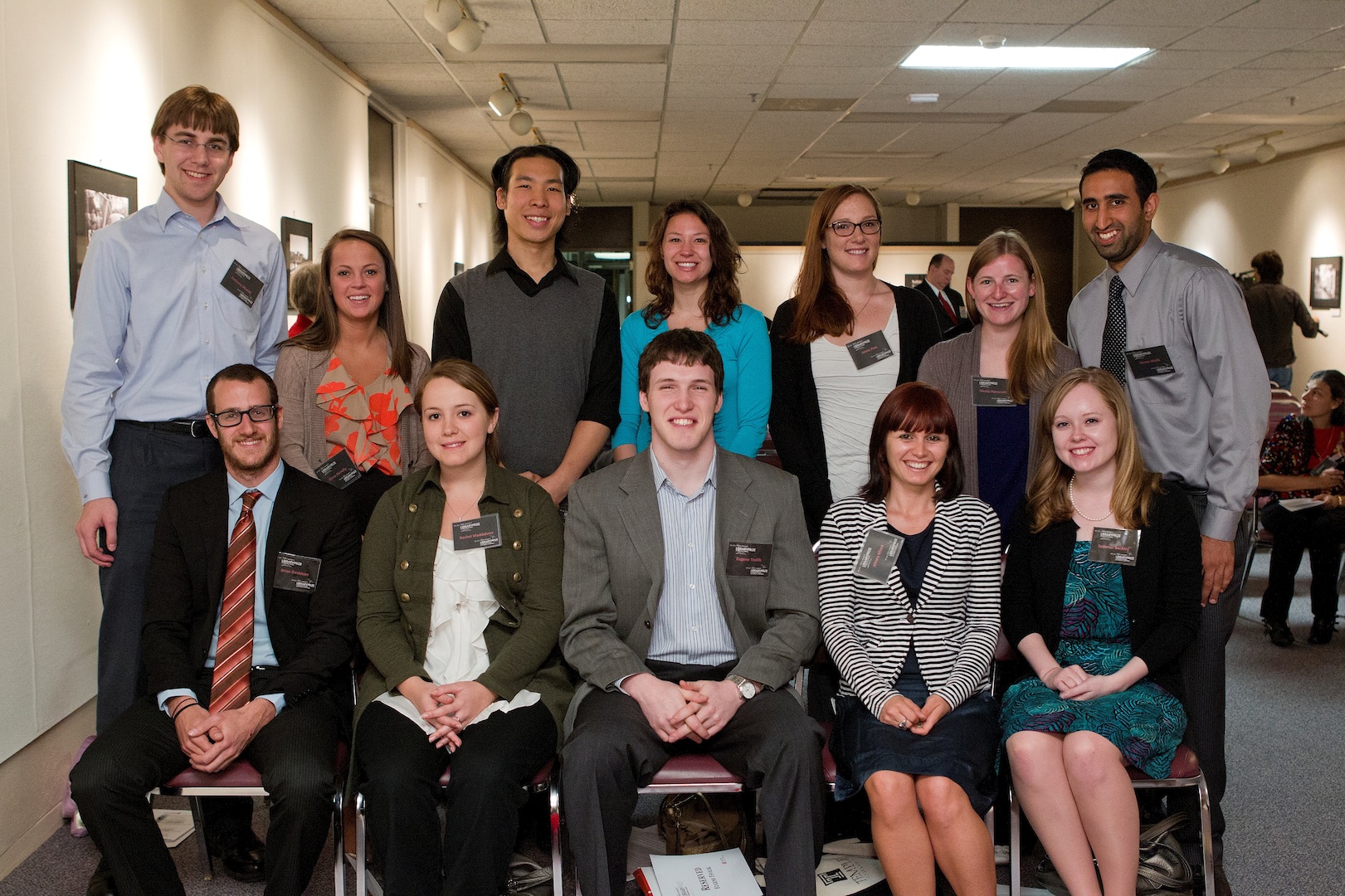
Thumbnail of 2012 winners as a group, (linked to larger version).


What do these students have in common? They are all recipients of the Library’s prizes for undergraduate research. Each year we honor the best undergraduate research and the best undergraduate research specifically on sustainability and the environment with cash prizes and an awards ceremony that honors winners’ excellence and provides an opportunity to present research. Students are also honored with a reception, certificates and acknowledgement from the university’s senior academic administrators.

On Wednesday, March 20 from noon to 2pm drop by Paley Library Lecture Hall, grab some lunch, and find out how you can submit a winning prize application. Lunch and information provided!


Kathleen Fitzpatrick discusses social possibilities in online scholarship

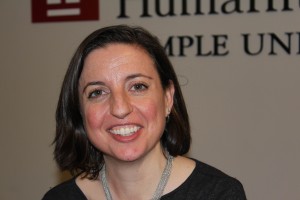
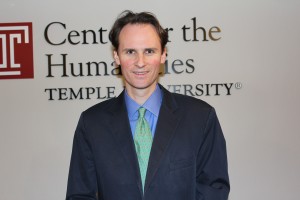
Portrait of Kathleen Fitzpatrick.

On March 7, 2013, the Center for the Humanities At Temple (CHAT) hosted Kathleen Fitzpatrick, Director of Scholarly Communication at the Modern Language Association. Dr. Fitzpatrick’s talk, The Humanities In & For the Digital Age, focused on how scholars can leverage digital technologies to solve deep contradictions that currently plague academic publishing.

Fitzpatrick argued for the peer-to-peer structure of online communication as a corrective to problems with traditional peer review processes. Online publishing platforms allow scholars to publish their work earlier, calling on a supportive network of known peers to provide feedback during an idea’s development. This approach also lets academic authors remain engaged with their work longer, as their focus shifts from completing scholarly productions to the process involved in knowledge creation.

Fitzpatrick expects that an additional benefit of this new mode of authorship will be greater scholarly engagement with the broader culture, bringing with it greater awareness of the humanities’ potential for enriching public life.  For such changes to bear fruit, the conservative culture of academia will need to recognize online publication and review as valuable activities meriting tenure consideration.

Rather than claiming that technology itself is a panacea to the scholarly communication crisis, Fitzpatrick’s work highlights the quintessentially social nature of the best technological solutions. She has incorporated these ideas into her own scholarly practices, releasing an online draft of her most recent book Planned Obsolescence: Publishing, Technology, and the Future of the Academy for open review. At the Modern Language Association, she has helped in the development of MLA Commons, an online space where association members can form fluid groups to share and review work-in-progress.

Tech issues in the Library? Get help from one of our student Tech Assistants

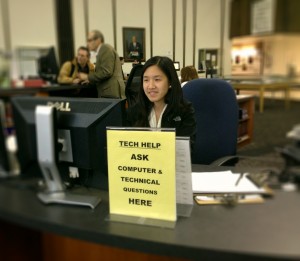
Student tech assistants staff the reference desk daily to help assist with technology issues related to both computing and library equipment. I recently sat down with Sokieu Mach, student Tech Assistant at Temple University Libraries, to learn about a little more about the great services the student Tech Assistants can provide.

Girl sitting at reference desk behind sign reading: Tech Help, Ask Computer and Technical Questions Here.

Sokieu is a Biology major who enjoys running and hanging out with her friends.

Student Tech Assistants can walk you through using those tricky photocopiers, scanners, printers, our book scanner and more. Having an issue with Microsoft Office? Can’t get online? Tech assistants can help with issues as simple as copying and pasting text in a document or walking you through the process of getting your laptop connected to TU’s wireless. Whether you’re working on your personal laptop or a library computer, the tech assistants are there to troubleshoot a range of needs. Just stop the desk and ask!

Please Welcome Latanya Jenkins, Our New Reference Librarian for Government Documents and African American Studies

Latanya Jenkins is our new Reference Librarian for Government Documents and African American Studies.

She started her career at Temple’s Health Sciences Library as a clerk, and soon discovered that academic libraries were interesting enough for her to want to pursue a career as a librarian.

Ms. Jenkins graduated from Drexel University in 2006 with an MSLIS. Her first position out of library school was at Purdue, where she was actively recruited to take part in their Diversity Fellowship Program.

She comes to us by way of Bowie State University where she was a bulldog and Morgan State University, where she was a bear. As an owl, a main goal is to be the kind of engaging and dynamic librarian who inspires others to follow their passions. Towards that end, Ms. Jenkins recently participated in the American Library Association’s Midwinter Conference in Seattle where she presented on a panel about diversity standards in academic libraries.

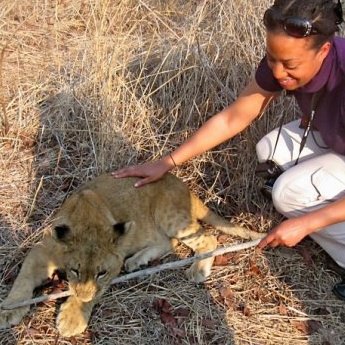
Outside of work, Ms. Jenkins has dual interests which fit nicely together. She enjoys travel, having spent several weeks in South Africa, Zambia, and Zimbabwe, where she met orphaned lion cubs who were being prepared to be returned to the wild. Thanks to that experience, Ms. Jenkins can advise us not to wear dangling jewelry, striped, or red colored clothing when petting lions!

Throughout her trip Ms. Jenkins was happy to indulge another interest—getting to know diverse cultures through interrogating their cuisine. Whether she is traveling or at home, Ms. Jenkins is happy to explore the width and breadth of human culinary expression.

Please stop by room 219 in Paley and welcome Latanya Jenkins!

Woman petting a lion cub that is playing with a stick in dry grass.

Librarian Latanya Jenkins helps lion student in Zimbabwe research newest stick technology.

Envisioning Emancipation: What Did Freedom Look Like?


Hand written warrant with photograph of a runaway slave, (linked to larger version).

Photographer unknown, circa 1863, carte-de-visite and manuscript page (University of North Carolina Library, Chapel Hill, Manigault Papers, no. 484, vol. 4)

As part of its commemoration of the 150th anniversary of the Emancipation Proclamation, the Charles L. Blockson Afro-American Collection presented an Author’s Talk and Book Signing with renowned photographic historian Dr. Deborah Willis and historian of slavery Dr. Barbara Krauthamer on February 8, 2013 in Mitten Hall, Great Court.  Their book features 150 rare photographs (some of which are housed in the Blockson Collection) pertaining to the experiences of enslaved and freed black men, women and children from the antebellum, Civil War and post-Civil War eras.  Speaking to the group, Willis and Krauthamer were able to engage a packed audience of over 200 in a discourse that was a kinetic one, moving through the history, hopes and possibilities of a people seeking to achieve their fullest humanity during one of the most transformative years in our nation’s history.

Krauthamer and Willis became interested in this book project when they discovered a photograph of a woman named “Dolly.” Her picture was pasted onto a $50 Reward notice created after she ran away from an Augusta, Georgia plantation in 1863.  “We both thought that was a story that needed to be explored,” Willis said. “These images allow us to connect to people whose lives would be lost [to us otherwise]” said Krauthamer.  Their book asks: “What did [Dolly] envision when she planned her escape? What did she see around her when she stepped outside her master’s yard and closed the gate behind her? When we look at her picture we see her life in slavery, but we also recognize that the picture is a testament to her liberation.”

The brilliance of their work simply asks the viewer to look at these African Americans as agents in their emancipation.  In the end, Willis hopes their readers will find “a much more nuanced story about slavery. Not just the top down, but the fact that Black people were actively involved in obtaining their freedom,” she said. “That’s what I want people to walk away with, because I didn’t know it when I was in high school.”  “What we wanted to show through the book was African American’s dignity and sense of their own strengths and potential to shape the future and that they were intellectually and philosophically engaged in the major political and social issues of the day.”  “When we look at these photographs, we see full human-beings,” Willis said.  “They were creating their own biographies through these images.”

“Envisioning Emancipation: Black Americans and the End of Slavery” is published by Temple University Press; I encourage you to read it.

www.temple.edu/tempress.

A Digital Public Library of America Free-For-All

Portrait of John Palfrey.

On February 6, 2013, the Center for the Humanities At Temple (CHAT) hosted John Palfrey from the Digital Public Library of America (DPLA).

DPLA has been in the planning stages since 2010 and will have its kickoff in April 2013. Palfrey explained that digital libraries have typically not undergone the level of deliberate planning used during the architectural design of the past’s glorious library buildings. Thus, DPLA considers it important to build an information architecture that will support the project well into the future.

Rather than being a massive repository of digital works, DPLA is designed as a repository of metadata about works held by the country’s other digital libraries. Users can search this metadata to find pathways to digital objects held in previously hard-to-locate information silos.

An important aspect of this open, distributed infrastructure is its modularity. DPLA believes in making their code, metadata, and content free to all. This model will allow any programmer or developer to create applications that access the DPLA metadata in new, creative, and useful ways.

One interesting concern expressed by Palfrey is the idea that we are a critical juncture in the divide between public and privatized information. Today’s cloud-based systems and their ownership by private, profit-driven firms set dangerous precedents that work against the public interest. Consider, for example, the large sums Temple pays for subscription databases and scholarly journals. Palfrey hopes that projects such as DPLA, Open Access publishing, and Wikipedia-style development will shift the balance of information power back to the wider community.

Justin Hill is Librarian for Access Services and Resource Sharing

Justin Hill is the new Librarian for Access Services and Resource Sharing at Temple University Libraries. Justin begins this new position after eight years as our Supervisor of Interlibrary Loan. Prior to that, he was a Bibliographic Assistant, also at Paley Library. Justin received his Masters of Library and Information Sciences from the University of Pittsburgh and his BA from Temple. As Access Services Librarian, Justin will operate, develop, and provide leadership for Temple University Libraries’ resource sharing activities that support teaching, research, and learning. We are delighted to welcome this long-time Owl to his new post.

Inside the Struggle: Photos Give Insight into the Desegregation of Girard College

In commemoration of the legacy of Dr. Martin Luther King, Jr., the Charles L. Blockson Afro-American Collection, Temple University Libraries exhibited images from its signature collection, John W. Mosley Photograph Collection, at Girard College for the Martin Luther King Day of Service on January 21, 2013. The civil rights photos by the internationally and nationally known Philadelphia photographer document the interconnections between Dr. King, Cecil B. Moore, the Freedom Fighters and other Philadelphians who were active participants in the movement to expose and eliminate the wrongs of segregation and inequality in Philadelphia and throughout the nation during the 1960s.

Many of Mosley’s Girard College protest images along with a treasure trove of archival materials from Temple University Libraries’ Urban Archives are featured on the Temple University Libraries’ website Civil Rights in a Northern City: Philadelphia. This primary source collection of photographs, newspaper clippings, oral histories, videos of Dr. King and more powerfully reveals the campaigns fought by African Americans and their supporters at the 10-foot Girard College wall because of an 1831 segregation clause in the will of its founder, Stephan Girard, that the school was created to offer free education to white, male orphans only. Girard believed that a quality education would be marred severely if the sons of enslaved Africans were allowed to study next to the sons of whites. As a result, civil rights organizations prepared to challenge the school’s philosophy. In his speech on August 2, 1965, Dr. King stated that “on the one hand I am delighted to see so many of you here … on the other hand, it is a sad experience to stand at this wall in the 20th century in Philadelphia, the cradle of liberty, and know that it is a barrier to God’s Negro children.”

To learn more about Black activism and civil rights protests launched in North Philadelphia, including the Columbia Avenue riots, visit northerncity.library.temple.edu.