Digital Commons Network Offers Open Access to Scholarly Research

This week Bepress, a company that creates institutional repository software, announced it had created a new multi-disciplinary repository of open access research content. According the announcement:

Bepress Digital Commons invites you to explore a new database of open access scholarship (600,000+ articles) that is curated by university librarians and their supporting institutions, and represents thousands of disciplines and subject areas — from Architecture to Zoology. Researchers will never run into paywalls or empty records, because only full-text, open access research and scholarship are included. This new resource for researchers includes scholarship from hundreds of universities and colleges, including peer-reviewed journal articles, book chapters, dissertations, working papers, conference proceedings, and other original scholarly work. It continues to grow rapidly thanks to the contributions of researchers, librarians, faculty, and students who believe that scholarship is a community enterprise.

It will be interesting to see how quickly the Digital Commons Network grows and whether it will catch on as a valued research resource among scholars, but we welcome this new entry into the world of open access scholarship.

Erin Finnerty is new Electronic Resources Librarian

Erin Finnerty joined Temple University Libraries on January 4 as the Electronic Resources Librarian. In this role she will oversee the acquisitions of the Libraries’ many e-resources. She will also oversee the many technical and logistical aspects of implementing such resources.

Erin joins Temple from Richard Stockton State College in New Jersey, where she was the Electronic Resources Coordinator. Prior to that she served as the e-Resources and Serials Librarian at the New Jersey Institute of Technology. Erin is an active member of the VALE Electronic Resources Committee since 2007, and presented at their scholarly communications workshop in 2011.

Erin earned her M.S. in Library and Information Science from Pratt Institute and her B.A. in English and Art History from Rutgers University.

Latanya Jenkins is TUL’s Government Information and African American Studies Librarian

Latanya Jenkins joined Temple University Libraries on January 4, and we are thrilled to have her on board as the new Government Information and African American Studies Librarian. In this role, Latanya will provide collection development and reference for African American Studies and will lead in the selection and de-selection of government documents and information. She will also identify opportunities for and oversee training of staff in the use of government information.

Latanya joins Temple from Morgan State University where she was a Reference and Government Documents Librarian, as well as the liaison to the School of Architecture and Planning. She has also served as a Diversity Fellow and Visiting Assistant Professor at Purdue University. Latanya’s many awards, presentations, and service to the field include ALA Emerging Leader (2008), “Project to Recruit the Next Generation of Librarians Wrap-up Talk” at the University of Notre Dame (2007) and work at the Diversity and Outreach Fair at the American Library Association Annual Conference (2012).

Latanya received her Masters of Science in Library Science & Information Science from Drexel University and her BA in Anthropology and English from Franklin & Marshall College.

Katy Rawdon Joins Special Collections Research Center as Coordinator of Technical Services

Katy Rawdon recently joined the Special Collections Research Center at Temple University Libraries as Coordinator of Technical Services. She will oversee accessioning, cataloging and finding aids for new and existing SCRC collections.

Katy joins Temple from the Barnes Foundation, where she worked as the Director of Archives, Libraries and Special Collections for more than ten years. Katy’s presentations and publications include “‘Art is no trivial matter:’ The Barnes Foundation Archives and Library,” (Art Libraries Journal, 33 no. 1, 2008) and  “Dr. W. C. Williams and Dr. Albert Barnes: A Correspondence and an Archive”  (panel presentation, the Modern Language Association Annual Conference, 2009).

She received her Masters in Library Science with an Archives Management Concentration from Simmons College and a BA in Art History and Women’s Studies from Smith College.

Jacqueline Sipes is TUL’s new Emerging Technologies Librarian

Jacqueline Sipes joined Temple University Libraries as the Emerging Technologies Librarian in October of 2012. She is also the liaison to the School of Education. In her position at Temple, Jackie will identify, evaluate and implement new and existing technologies that aid in the delivery of library services, particularly as they relate to reference and instruction.

She joins Temple after four years as an Instructional Design Librarian at George Mason University. Presentations include “Improving Student Research” at the Innovations in Teaching and Learning Conference (2011) and “Library Jargon Translator” at the ACRL annual conference (2011).

Jackie received her Master of Science in Library Science as well as her BA in English from the University of North Carolina at Chapel Hill.

Paley Library Break Hours

Paley Library will be open from 8:00 a.m.-5:00 p.m. Monday, December 17 through Friday, December 21 and again with those hours from Wednesday, December 26 through Friday, December 28. Paley will be closed December 22-25 and December 29-January 1.

From January 2 through the start of spring semester on January 22, Paley is open from 8:00 a.m.-7:00 p.m. on weekdays, 9:00 a.m.-7:00 p.m. on Saturday, and noon-8:00 p.m. on Sundays.

Starting on January 22 we’re open from 8:00 a.m.-2:00 a.m. during the week, like always during the semester.

Check our schedule for other library locations, more details, and all the most up-to-date information.


Paley Library Open 24 Hours Now Through Finals

Hunkered down and studying hard? You don’t have to worry about leaving your library carrell for the next week. We’ll suit your study schedule, no matter what it is. Paley Library is open 24 hours, all day, every day, from today, Tuesday, December 4th, through next Friday, December 14. We close at 5PM on Saturday, December 15.

Read ‘The Teaching Professor” for Inspiration To Teach Better

The Chronicle of Higher Education has a worthwhile essay about a unique publication called The Teaching Professor.  Titled “Inspiration From ‘The Teaching Professor” it sings the praises of this publication. This is how the author describes it:

What struck me as most distinctive about the newsletter was the feature that remains most valuable to me today: brief summaries of recently published articles on teaching and learning from a wide range of journals. The summaries not only evaluated the quality of the latest research but also teased out its practical implications.

The Teaching Professor is a monthly newsletter that averages about eight short articles per issue. They provide either first-hand accounts from faculty of their own teaching experiences with advice on some technique they’ve tried to improve student learning or it might be a summarization of a research article about a pedagogical technique.

The good news is that the Temple Libraries subscribes to a site license version of The Teaching Professor. That means every Temple University community member has free access to the newsletter. Click on this link to get to our group page. Keep in mind that this link will work on campus. You can then subscribe to the RSS feed to be notified when the latest issue is published. When you are off campus you will be prompted to authenticate to our network. The other great thing is that you can search the complete archive of all past issues. This is invaluable when seeking advice on a particular teaching issue, such as how to generate better class discussions, how to improve grading or how to deal with class disturbances.

You will find this essay a good source of inspiration, and it just may motivate you to become a regular reader of The Teaching Professor.


Notes from the Littell Project: Sci Fi Writings

Franklin Littell grew up to be a prolific writer of religious history, but he may have gotten his start writing science fiction.  When he was just 11 years old (circa 1928), he wrote “A Trip to Mars.”  In this story, a young student of astronomy named Jim journeys to Mars with his professor.  They travel in a ship invented and built by the professor that went “one hundred thousand miles an hour, forward, and one hundred thousand five hundred miles an hour, perpendicularly…” In the story, Littell describes a ship that was “run by five engines, of eight thousand horsepower each….  It had one pair of wings…,” was equipped with “fifty large oxygen tanks…,” and ran on “a new kind of gasoline that will make the plane go one thousand miles per gallon.”

Littell describes their arrival on Mars as experienced by his character Jim: “…under the plane some of the boldest men of mars, were preparing to fight…”.  Jim and the professor landed the ship and disembarked when “suddenly the chief [Martian] yelled and started for the man [the professor].  They [Jim and the professor] put up a desperate fight, but were outnumbered.  It was their [the Martians’] custom to poke their spears into their victims before they burned them…” .  Page 6 of the manuscript tells us what happens next.

Typed page on yellowed paper, from a Littell manuscript, (linked to larger version).

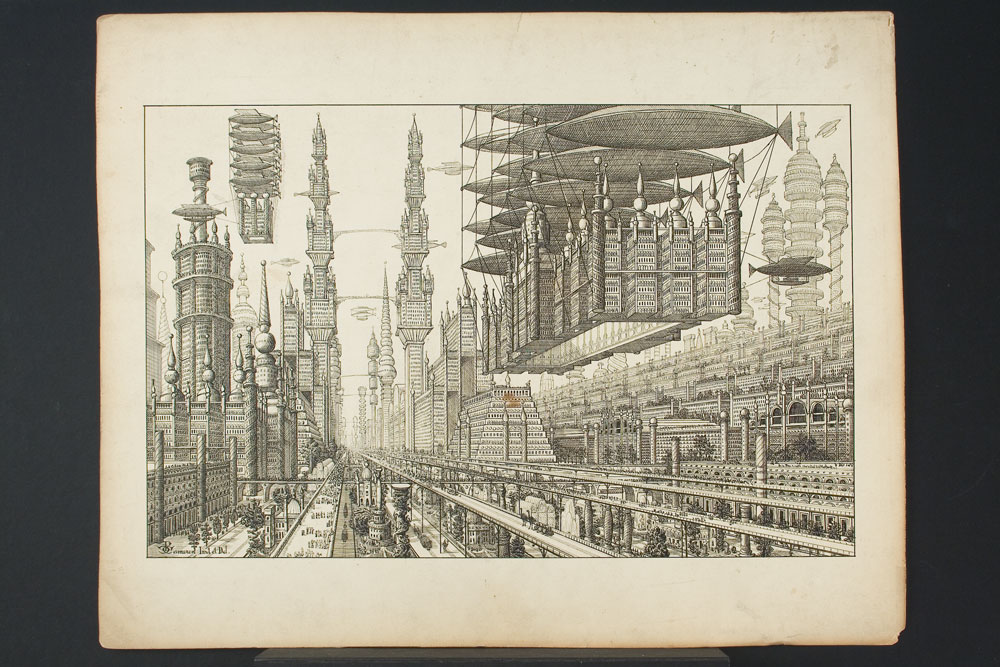
Littell’s short story is creative and fun and a definite foreshadow to his future life as a writer, but it also unexpectedly links the Littell papers to another collection acquired by the Special Collections Research Center in 2010, the manuscript and illustrations for Peter Caledon Cameron’s Nodnol (circa 1900).  Part of Temple’s Science Fiction and Fantasy collection, this manuscript takes the reader on an expedition to the Antarctic, where among other things, a new race of people are discovered.  The people found inhabiting the South Pole prove to be far less aggressive than those encountered on Mars by Littell’s Jim and the professor, but both stories speak to the early 20th century’s fascination with discovery and encountering new worlds.  By the time Littell wrote, the race to the South Pole was over and space was beginning to take shape as the newest, unexplored frontier.

“Nodnol. The narrative of a Voyage for scientific investigation into the Antarctic Regions, the discovery of Astrogee, a Second Satellite or New World, resting on the South Pole of Our Earth, its exploration, its strange fauna and flora, its marvellous [sic] natural phenomena, its wonderful nations of civilized Quadrumana and its glorious population of perfect Humanity.” 279 pages, annotated and edited by the author, with a separate portfolio of seventeen signed illustrations in pen and ink.

Purchased in May 2010 for the  SCRC’s Science Fiction and Fantasy Collection, the Nodnol manuscript was written and illustrated by the English-American water-colorist Peter Caledon Cameron (active in the U.S., coming from England, 1880s-1930s?; Philadelphia/New Jersey area) and is typical of 19th and early 20th century fantasy and science fiction writing and illustrating.

Black and white print of a futuristic city scene, (linked to larger version).


New Upgrade to Digital Collections Interface

The Temple University Libraries are pleased to announce a new upgrade to our Digital Collections interface. On November 1, 2012,  Temple Libraries will upgrade to the latest version of our digital presentation platform, CONTENTdm®.

Some of the new features of Version 6 are:

  • Streamlined interface: Users will be able to browse by collection or by thematic subject area.
  • Improved Search capabilities:  The default search options have changed, so that users that create a search can “drill down” by refining their search set with additional keywords.
  • Enhanced Faceting: Improved faceted browse and search results that are customized for each collection will help patrons to narrow down result sets by author, date, subject, and other relevant categories.
  • Tracking recent additions: Digital Library Initiatives, the Special Collections Research Center, and the Charles L. Blockson Afro-American Collection are adding to Temple’s digital collections on a regular basis.  To keep informed of new additions, users can now subscribe to an RSS feed by clicking on the option to “receive updates” for the digital collection.

This new upgrade represents a large amount of behind-the-scenes effort from the Digital Library Initiatives Department and the Digitization Practices Group in coordination with other Library departments to design the layout and settings of this new interface. Many hours were spent troubleshooting software bugs and issues with our database provider, OCLC, and this work has led to improvements made to the software’s functionality. We believe that the wait for CONTENTdm® Version 6 has been worth it, as our patrons will benefit from various enhancements.

For questions about the new interface, or to suggest items to be digitized for inclusion in Temple’s digital collections, please contact Digital Library Initiatives at diglib@temple.edu .