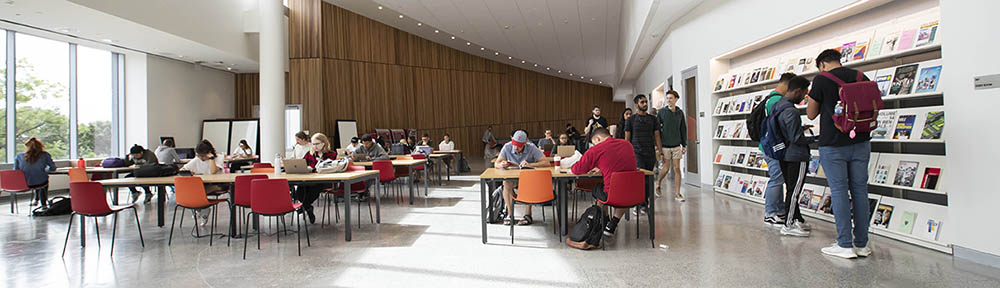
After many years of loaning laptop computers to Temple University students, the Paley Library will no longer loan laptops from its Circulation/Reserve Desk in the Tuttleman Building as of August 17th 2012. The decision to end the program was brought about by a confluence of factors. While this has been a valued service for many years, as more students bring their own laptops to campus there is a declining need to make laptops available for loan. To responsibly manage the Libraries’ budget we must make careful and informed decisions about the library services in which we will invest.Tablet computers, such as iPads, have grown in popularity, so we will be increasing the number of tablet computers available for loan. For those who still want to borrow a laptop, the TECH Center continues to have laptops available for short-term (three hour) loan periods.
Library Special Collections Boost a University’s Reputation
Obtaining a great collection of papers from a scholar or organization or other types of unique materials can be a significant accomplishment for the special collections department of an academic research library. Increasingly, what makes an academic library unique or distinctive is the content of its special collections and archives. According to the New York Times article “In University Holdings, Entry to History and Culture“, these collections can also serve to enhance the reputation of the institution as a resource for global scholars. The article states:
U.T.-Arlington officials, meanwhile, hope their future William Blair Collection will bolster their library’s reputation as a repository for artifacts of black history. For universities striving to improve their reputation — particularly the handful, including U.T.-Arlington, vying to be the state’s next Tier 1 research institution — special collections can provide a boost. And for a general public largely unaware of the items stored in public universities, they can be a veritable treasure-trove.“Tier 1 is all about scholarship and recognition by your peers from around the world for the great and wonderful research that you do,” said Ronald L. Elsenbaumer, the provost at U.T.-Arlington. “And special collections bring that uniqueness to your university. Having those unique, scholarly activities going on that distinguish you, that’s important.”
The Special Collections Research Center (SCRC) at Temple University Libraries is just such a collection of unique materials with a focus on 20th century Philadelphia history. With the recent addition of content from the Philadelphia Inquirer and Daily News Archives and the papers of Lew Klein, the SCRC helps to build the reputation of Temple University as a unique research source for scholars. Visit the SCRC soon to learn more about the fantastic collections of unique primary research material waiting for you at Temple University Libraries.
“Philadelphia: Where to Turn?” Information Guide


The “Philadelphia: Where to Turn?” information guide provides information on services to help our city’s residents. The guide lists where to find food assistance programs, shelters, and health services, as well as information on job-skills development, educational programs, and community centers, addressing the needs of many Philadelphians. The resources in the guide range from municipal and state programs to programs sponsored by non-profit organizations. These resources were selected for the free or low-cost quality services they provide. “Philadelphia: Where to turn?” also provides information on volunteering opportunities in the city. The guide will continue to grow as new services become available.
“Philadelphia: Where to turn?” provides access to information on services available to Philadelphia residents who are in need of assistance. You can use this guide to find:
- Food assistance
- Shelter/housing
- Health services
- Educational opportunities (G.E.D., adult education, etc.)
- Job training and employment opportunities
- Legal help
- Resources for New Americans (E.S.L.,citizenship test preparation, etc.)
- Volunteer opportunities
- Community centers
New Look and URL for E-ZBorrow
As of today E-ZBorrow has a new URL.
It is https://e-zborrow.relaisd2d.com/gateway/TEMPLE.html
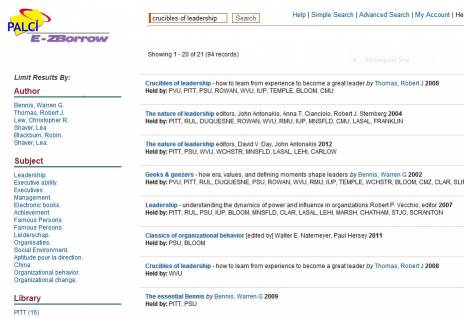
At the same time E-ZBorrow is introducing a new user interface that we hope will make searching and requesting easier and more efficient. While the search box is unchanged, the display of the results is more clear and on the left margin you can limit the search with a variety of screening tools.
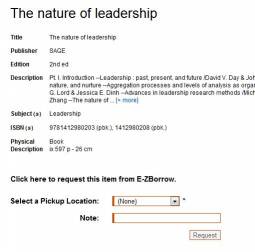
Once you select a book to obtain from the result list, you’ll see it is much easier to request that book.
We value any feedback you may have. If you would like additional assistance with E-ZBorrow contact pmyers@temple,edu or 215-204 -0749.
If you have trouble logging in or making requests please call 215 204 -0744.
Could Open Access Disrupt Traditional Scholarly Publishing
It’s not often that the mainstream media takes up relatively unpopular higher education issues, so it comes with some surprise that U.S. News & World Report published a rather extensive article on the debate about the future of scholarly publishing. The article, titled “Is the Academic Publishing Industry on the Verge of Disruption?” provides a balanced look at both sides of the push for open access journal publishing.
Using interviews with both open access advocates such as Heather Josephs of SPARC and representatives from scholarly publishers such as the American Institute of Physics, the article provides an excellent overview of the current challenges of traditional scholarly journal publishing. It covers new business models for open access publishing and current and proposed government policies aimed at promoting the sharing of scholarly research funded by taxpayer dollars.
If you’d like to learn more about the current issues confronting traditional scholarly publishing, the challenges that both libraries and scholarly publishers face, and new models and ideas for a better scholarly publishing system, then give this article a read. If you do, let us know what you think (use the comments) by sharing your thoughts about scholarly communications, open access, and its impact on higher education. Do you believe that the traditional system is ripe for disruption, and if so, will open access be the disruptive factor?
Loan period for E-ZBorrow books extended
Starting on Monday July 16th your E-ZBorrow books can be borrowed for six weeks, with one six week renewal. Formerly the loan period was four weeks.
This change has been made in response to many requests from our borrowers for a longer loan period.
If you have questions please call 215 204-0744.
Penelope Myers
Please Share Your Feedback On Our New Website
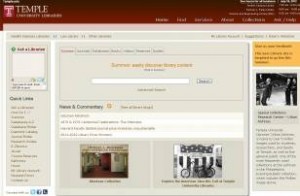
After many years of maintaining its current website, the Temple University Libraries is poised to move to an entirely new design for its website.On Thursday, July 12, 2012 the new website made its debut. We hope you find the new design refreshing – and that it makes your experience using our library resources much better. Please use the feedback link in the upper right corner of the homepage to tell us what you think of the site – what can we continue to improve?
For the past several months a preview of the website has been available to the campus community, and we have received encouraging positive feedback about the new look of the website, which is more streamlined, less cluttered with links and makes use of more visual content.

Temple Libraries New Website Design
The Libraries’ Summon search, which is a great starting point for research in almost any subject area, is the focal point of the new homepage design. A tabbed approach allows for easy navigation to other types of search modes and other sections of the website. We’ve added the daily hours right on the homepage, and an instant messaging tool allows for quick communication with library staff when help is needed.
Please know that some areas of the site are still being refined, and it is possible you will encounter a broken link or some other minor problem. If that happens, please contact us – using the feedback link on the homepage – to let us know of any problem. We hope to keep improving our website so that all of our community members will have the best possible experience using the Temple Libraries.
Library Prize Interviews, April 2012
On the day of the Library Prize Awards Ceremony, May 1, 2012, I spoke with the three library prize winners and their faculty sponsors. We discussed their research, the sources they used, the relationship between student and sponsor, and the winding roads that first brought them to their topics.
Please listen to these engaging conversations below.
Summer Beckley:
[ensemblevideo contentid=qrxqfUgc6kqzLdgvrygg6Q captions=true height=150]
“A Crisis of Identity: Advertising & the British Ministry of Information’s Propaganda Posters of World War II”
Afrora Muca:
[ensemblevideo contentid=LVjrzBVEh0aEqdIg4-Mf6A captions=true height=150]
“From Classroom to Battlefield: The Role of Students in the Closing of Carlisle Indian Industrial School, 1918”
Eugene Tsvilik:
[ensemblevideo contentid=i5nXhfn5b0Sx6z21ntlL5g captions=true height=150]
“No Enemies to the Left: The Communist Party of the United States and Crises of International Communism, 1956-1968”
1876 & 1976 Centennial Celebrations: The Interview
[ensemblevideo contentid=F0xKKU0OlkqSUMopjJ_aGQ captions=true height=90]
On March 28, 2012, Paley Library welcomed Professor Susanna Gold, Assistant Professor of 19th and 20th century Art History at the Tyler School of Art, Temple University, and Malgorzata Rymsza-Pawlowska, graduate student at Brown University, to discuss the 1876 Centennial and the 1976 Bicentennial celebrations. The program was moderated by Paley Library Director of Communications Nicole Restaino.
Susanna Gold is currently at work on a book on the 1876 Centennial Exhibition for Penn State University Press. Since our interview, Malgorzata Rymsza-Pawlowska completed her dissertation — “Bicentennial Memory: Postmodernity, Media, and Historical Subjectivity in the United States, 1966-1980” — and was awarded her PhD from Brown University. (Congratulations, Malgorzata!)
After the completion of the program, Susanna Gold, Malgorzata Rymsza-Pawlowska, and Nicole Restaino sat down with me to discuss Philadelphia’s Centennial and Bicentennial celebrations.
Harvard Faculty declare journal price increases unsustainable
A few days ago, the Faculty Advisory Council at Harvard University sent a memorandum to all Harvard faculty concerning the ever-increasing prices Harvard’s libraries must pay for subscriptions to scholarly journals and databases. The Harvard Council declares that the price increases cannot be sustained.
An excerpt from the memo is below, together with a link to the full report.
But first, why does the Harvard memorandum matter to students and faculty at Temple University?
You should know that we face the identical problem here at Temple. Our contracts with the same providers are virtually identical in amount and term, calling for near-automatic increases of 4 or 5% per year.
As Temple’s own budget situation becomes clearer in the next months, we in the Temple libraries will begin to discuss with faculty and administrators our options as an institution. Hard choices will be faced.
Meanwhile, Temple’s faculty and graduate students have options as individuals. I would commend to you the Harvard Faculty Council report for its recommendations as to what individual scholars might do to help break the big providers’ stranglehold on scholarly communication.
Note that the sums referenced in the Harvard report are are actually low and only a fraction of what Harvard as a whole actually pays for all its online journals and databases, so the report is treating only of two or three major packages of online journals to which they subscribe. Temple has these same packages, as do most research universities in the US.
Harvard’s annual cost for journals from these providers now approaches $3.75M. In 2010, the comparable amount accounted for more than 20% of all periodical subscription costs and just under 10% of all collection costs for everything the Library acquires. Some journals cost as much as $40,000 per year, others in the tens of thousands. Prices for online content from two providers have increased by about 145% over the past six years, which far exceeds not only the consumer price index, but also the higher education and the library price indices. These journals therefore claim an ever-increasing share of our overall collection budget. Even though scholarly output continues to grow and publishing can be expensive, profit margins of 35% and more suggest that the prices we must pay do not solely result from an increasing supply of new articles.
It is untenable for contracts with at least two major providers to continue on the basis identical with past agreements. Costs are now prohibitive. Moreover, some providers bundle many journals as one subscription, with major, high-use journals bundled in with journals consulted far less frequently.
Read the whole memorandum at “Harvard Library Transition.”
Jonathan LeBreton
Senior Associate University Librarian