“Groove dreams whipped stiff”: Poetry, Performance, and the (In)finitude of the Archive

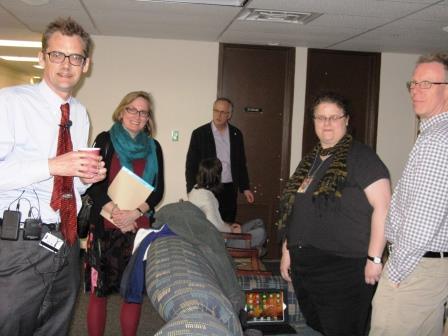
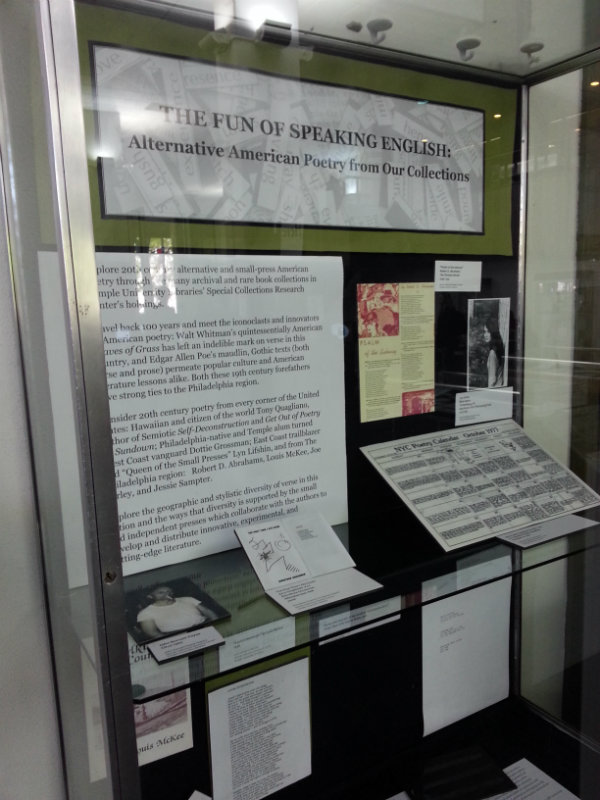
As a kick-off for Archives Month Philly, Paley Library hosted “Live from the Collections: In and Out of Poetry” Tuesday, October 1st. Stemming from an exhibition of small press and alternative poetry entitled “The Fun in Speaking English” done by TU Libraries in spring, the afternoon saw the assembly of three poets who, through their own work’s thematic concerns and by their very participation in the event of the reading, interrogate and explore the notion of The Archive. Challenging the audience to consider the reading as more than a recitation of poetic product, Moderator Matthew Kalasky (director of Philadelphia cultural organization Nicola Midnight St. Claire) prefaced the reading by posing the question, “How does the current reading color the writing process of the past?”

The reading began with Penn Ph.D. student/writer/media archivist Daniel Snelson sharing work exploring the infinitude of the poetic page. Snelson read from Ronald Johnson’s Radi O’s, a poem which, through the careful, meticulous removal of text from Milton’s Paradise Lost, recontextualizes and reinvents the work. Snelson then shared one of his own projects of reimagining, audio of himself reading over archived audio of a reading by poet Rosmarie Waldrop of her work Differences for Four Hands reading over audio of a previous reading of her poem. Yes, you did in fact read that correctly: note the layers! Waldrop’s last stanza in particular, speaks toward the process & performance theme of the reading:

“Clara, play for us. The performance over, your name drops back out of the air. Records now, of course. Groove dreams whipped stiff. You never stepped twice…”

Next, the program featured prolific contemporary poet Lyn Lifshin, a writer whose work is partially housed in TU Libraries’ Special Collections Research Center (check out the extensive list of the Library’s holdings here). Plumbing her own archive of material, Lifshin read a number of poems, sometimes pausing between each to give the audience a history of the poem, in terms of both its initial writing and its life as a performed piece. The following piece, the beautiful and devastating “I Remember Being Lovely But,” was one of these historicized poems, allowing the audience a glimpse into the moments of its creation. The work itself functions as the poeticized written trace of lived experience, each performance of the work a further instance of documentation:

“There were snakes in the
tent. My mother was
strong but she never
slept, was afraid of
dreaming. In Auschwitz
there was a numbness,
lull of just staying
alive. Her two babies
gassed before her, Dr.
Mengele. Do you know
who he is? She kept
her young sister alive
only to have her die
in her arms the night
of liberation. My mother
is big-boned but she
weighed under 80 lbs.
It was hot. I thought
the snakes lovely. No
drugs in Israel, no
food. I got pneumonia,
my mother knocked the
doctor to the floor
when they refused,
said I lost two in
the camp and if this
one dies I’ll kill
myself in front of you.
I thought that once
you became a mother
blue numbers appeared
mysteriously, tattooed
on your wrist.”

The SCRC also contains a substantial amount of Lifshin’s papers, including poem drafts and correspondences.

Poet Elaine Terranova ended the afternoon’s readings, reading from several of her seven collections of poetry. (Some of Terranova’s work is housed in the SCRC–see the list here). Her poem “Stairway”, from her most recent collection Dollhouse, nicely summates many of the tensions of the archive:

“Think of the dollhouse
as a collection, a museum,
even a prison, but a little doll,
a tiny chair, mean nothing
if not in the context of a house.

There is in a house, despite
its safety, I don’t know,
such capacity for movement and change.

At night, for instance, a house
talks back, crackles and knocks.
Turn on the alarm and it is like
setting the alarm of your fear,
little birdcall of eternity.

Downstairs you have only just
shut the door on the world
and you float up, giddy with sleep.
You fly–don’t they call the sets
of steps flights? At the top,
massive dark, a wind that rushes through the hall.

Everything moves around.
Nothing is stable. Then you open
a door, look through a window,
and find there, pocketed by the sky,
the nearly perfect moon.”

Terranova reminds us, “Nothing is stable”, and such is the archive, not merely a static collection of printed texts “whipped stiff”, to borrow from Waldrop, but an animate entity that circulates beyond its physical repository, full of a “capacity for movement and change,” each performance a circuit on a current that loops both backward and forward. The works shared by these three wonderful poets that afternoon were indeed dreams grooved and regrooved, each performance an instance of truly moving beyond the page, renegotiating the boundaries of the printed word.
IMG_1264 (2)

Poet Daniel Snelson explicates his poetic process to the audience while Moderator Matthew Kalasky and poets Lyn Lifshin and Elaine Terranova look on.

Interested in future library programming? Take a look at this calendar for the Beyond the Page schedule of events.
Browzine Takes Your Journal Reading to a New Level

Temple University Libraries provides access to thousands of journals in electronic format. The challenge is identifying all the ones relevant to your needs, and then setting up a system that makes it convenient to keep up with the latest issues and articles.

That’s where Browzine comes in handy. It’s an app for both Mac and Android tablet devices that makes tracking, reading and managing journals a simple task. The Temple University Libraries has acquired a site license for Browzine that will allow Temple community members to easily gain access to a vast majority of the journals to which we subscribe – as well as many more open access journals. While viewing articles, Browzine facilitates saving and sharing them.

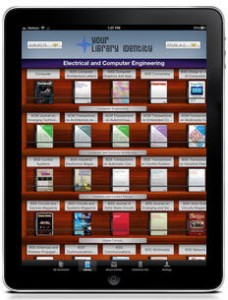
When you become a Browzine user you begin by selecting the journals you wish to regularly follow, by title or by browsing different subject areas. The selection covers journals that the Temple University Libraries subscribes to, as well as open access journals. Browzine creates a virtual bookshelf on your device. Just click on individual journal issues to proceed to the table of contents for each issue.

Ipad screen showing thumbnails arranged as if on a wooden bookshelf.

Screenshot of the Browzine Bookshelf Where Journals Are Organized


To get started just download the Browzine app from the App Store or Google Play. If you are interested in learning more about Browzine take a few moments to watch this introductory video. Your Libraries subject specialist can also provide you with more information about or guidance with Browzine.

Do You Have My Textbook?

One of the first things students do as the new semester begins is figuring our their textbook strategy. Which ones can they borrow from friends that took the course before. Can it be rented in e-format from B&N, Amazon, Google or Chegg? Does the bookstore have a used copy? For which courses could a textbook purchase be delayed or even ignored? With the high cost of textbooks, figuring out how to get them at the cheapest possible price is high on the students’ beginning of the semester to-do-list.

That’s why one of the most frequently asked questions at the Temple Libraries during the first week or two of the semester is about textbooks. Students want to find out if the Libraries hold a copy of their textbook. Some assume we buy them, but they find out that’s not the case. Sometimes their book is placed on course reserve by the instructor. Sometimes a fairly out-of-date edition, a past reserve item, can be found in the book stacks. Some students will choose to take that outdated edition over the current edition.

Student interest is growing  in having faculty point them to open education resources instead of assigning traditional textbooks. In a research paper titled “Online and Campus College Students Like Using an Open Educational Resource Instead of a Traditional Book“, Brian Lindshield and Koushik Adhikari of Kansas State University, report that data gathered over several semesters using an alternate textbook they called the “flexbook”, that utilized an open-source textbook platform to allow faculty to collaboratively offer freely available learning materials, was preferred by students over the traditional textbook. They conclude  “that students are willing to move beyond traditional print textbooks.” An article in Inside Higher Ed titled “Expense Experiments” identifies how different institutions are experimenting with both e-textbooks and technology for reading them.

Additionally in the Chronicle of Higher Education’s Almanac of Higher Education 2013, there is a chart that summarizes student responses to a question asking them what technologies they would like to most see their professors using – and what they’d like to see used less often. Nearly half of the students surveyed indicated that they would like to see more use of freely available course content beyond the student’s own campus. A slightly lesser number of students wanted more use of e-books and e-textbooks.

The Temple University Libraries offers a resource page for faculty seeking more sources for open educational resources – such as the University of Minnesota open textbook catalog that can subject search the holdings of numerous open textbook repositories. The Libraries also owns thousands of e-books that may be used as an alternate to a textbook. Using the SUMMON search (on the Libraries homepage) it is possible to modify a search to locate book chapters in electronic sources:

With the growing number of open educational resources available to faculty, and the increasing student acceptance of e-resources, the possibility of replacing traditional textbooks with open learning materials is greater than ever.

Library Virtual Learning Lunches to be held September 3-6, 2013

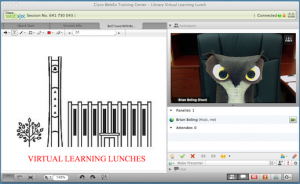
Screenshot of WebEx software

When the Temple University community returns from summer break, students will be attending classes from off-campus, and from locations well outside the Philadelphia metropolitan area. Luckily, even at this distance, all Temple students still have access to the incredible wealth of databases, eBooks, and streaming media available through the library. Now, more than ever, students can engage directly with the library staff who are positioned to guide them towards academic success.

Temple librarians already provide specialized assistance to remote students with through our “Ask a Librarian” service. We also offer in-class information literacy instruction to students enrolled in some online-only courses.

In order to extend library instruction to remote learners and faculty teaching online courses, Temple University Libraries is pleased to offer our first ever Virtual Learning Lunch Week on September 3rd-6th. Each session will consist of 20 minute long presentations, designed to jumpstart your use of various library services and resources, with additional time to ask the librarian your questions on the topic.

Sessions are open to the whole Temple community, no matter whether you are many miles away or right next-door. To attend, login to https://webex.temple.edu with your AccessNetID and password. Click on “Live Sessions” under “Attend a Session” and look for the day’s “Library Virtual Learning Lunch”. (Please note: first-time WebEx users should arrive a few minutes early to install the WebEx Add-On on their computer or the Cisco WebEx Meeting app on their mobile device.)

The event starts off with a Tuesday session designed to help faculty use the new Ares course reserve system, followed by one explaining the legal ins-and-outs of using video in both face-to-face and online classes. On Wednesday and Thursday, we continue with sessions fostering basic research skills and highlighting some of the useful databases and unique resources available at the library. Then, Friday sessions introduce both students and faculty to the streaming media available through the library, resources equally useful for research and leisure.

September 3rd
12:00pm – Ares course reserves system (Justin Hill)
12:30pm – Video copyright basics for faculty (Brian Boling)
September 4th
12:00pm – Refworks for citation management (Fred Rowland)
12:30pm – Basic research in education (Jackie Sipes)
September 5th
12:00pm – Learn about primary sources (David Murray)
12:30pm – Special Collections Research Center orientation (Josue Hurtado)
September 6th
12:00pm – Streaming Music Databases (Anne Harlow)
12:30pm – Streaming Video Databases (Brian Boling)

Come celebrate Welcome Week with TU Libraries!

Planning on hitting the TUFest tables on Liacouras Walk? We’ll be there, too, handing out bags, bubbles, buttons, and information about the libraries. Feel free to drop by and ask us any questions you may have about our services, and don’t forget to grab some candy before you leave!

Thumbnail link to larger version of librarians at an open air table at the TU Fest.

We’re here to answer your questions!

Paley Library will also be hosting CeLIBration, a party for students that will include fair-themed food (think: cotton candy, popcorn, and hotdogs), arcade games, & a DJ spinning jams. Stop by and bring your friends!

While it’s still Spring: A recap of TUL @ Spring Fling

Gallery

This gallery contains 9 photos.

On Wednesday, April 17th, Temple Libraries joined 200-plus Temple organizations and vendors at Spring Fling 2013.  It was delightful to participate in our second year at Spring Fling. Here’s a little recap, with big thanks to everyone who volunteered.  . . … Continue reading →

Free and Easy: The Appearance of Truly Useful Cultural Heritage Data

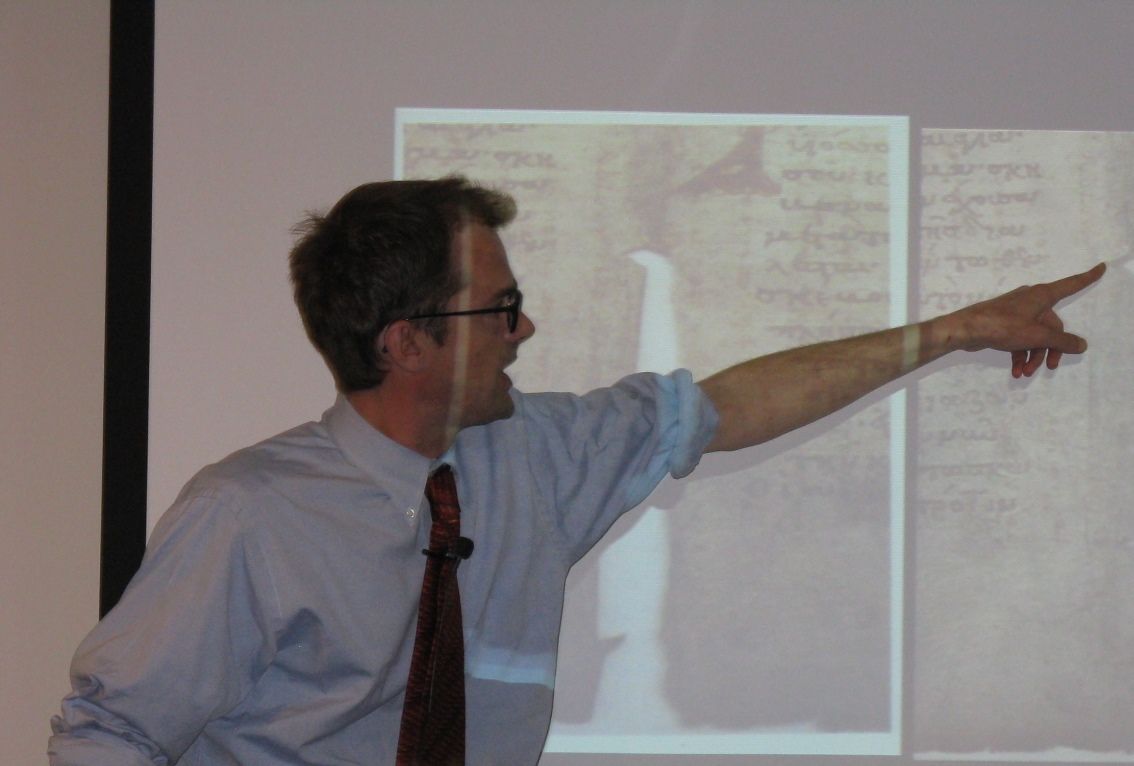
William Noel pointing to a presentation projection on a whiteboard.

William Noel at the Center for Humanities at Temple

“My mission is to bring art and people together, for learning, discovery, and enjoyment.” –William Noel

On Thursday, April 25th, the Center for Humanities at Temple hosted William Noel,  internationally renowned expert in the application of digital technologies to manuscript studies.   Dr. Noel is currently director of the Special Collections Center, and Founding Director of the Schoenberg Institute for Manuscript Studies at the University of Pennsylvania.  His presentation,  “Free and Easy: The Appearance of Truly Useful Cultural Heritage Data”, covered the restoration and digitization of the Archimedes Palimpsest, a project that he led while at the Walters Art Museum in Baltimore.  Dr. Noel concluded with a discussion of the reasons why a “free and easy” approach is best for digitization of cultural materials.  (Eureka!)

What is the Archimedes Palimpsest?

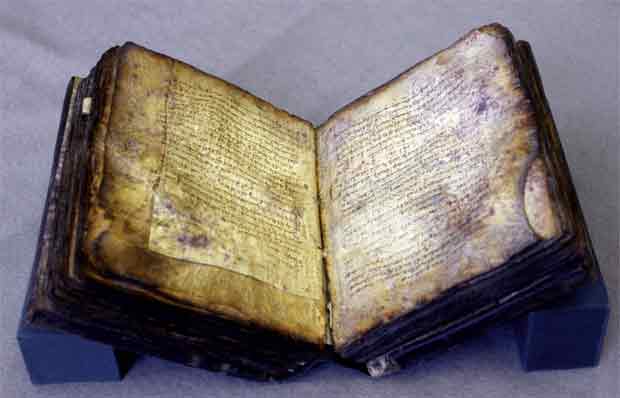
The codex Archimedes Palimpsest: book opened to middle with darkened, spotty pages and worn blackened edges

Upon initial examination, what is now known as the Archimedes Palimpsest, appears to be a medieval prayer book, dating from 1229, written by the scribe Johannes Myronas in Jerusalem. Back then, parchment was expensive, and therefore was sometimes “recycled.”  To make this prayer book, the scribe scraped off old mathematical text from some parchment  and wrote new text on top, making the book a palimpsest.  From then until 1906, this prayer book was used in liturgical services, and suffered numerous abuses, most notably dripping candle wax, mold, missing pages, and images painted over text as late as the 1930s.  In 1906 the Danish philologist Johan Heiberg discovered the manuscript in the Church of the Holy Sepulchre in Istanbul, and identified the hidden text as Archimedes.  He photographed every page, and with the help of only a magnifying glass, transcribed and published the underlying text that he could perceive.

The twentieth century was no kinder to manuscripts than the middle ages, and from about 1930 to 1991, the Archimedes Palimpsest was either lost or gone from public view until 1998, when an anonymous collector bought the manuscript at an auction at Christie’s in New York.  This collector brought it to William Noel at the Walters Museum in Baltimore for preservation and digitization, for the world to study and enjoy.

Why is the Archimedes Palimpsest important?

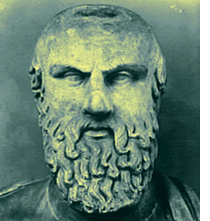
Bust of Archimedes of Syracuse

Archimedes (c.287BC-212BC), brilliant scientist, inventor, mathematician, and engineer of ancient Greece, worked extensively in geometry, calculating the value of pi, the circle, the sphere, and cylinder.  He developed a theory of buoyancy called the Archimedes Principle.   Of the nine known treatises by Archimedes in Greek, hidden within the Archimedes Palimpsest are seven.  Of these seven, The Stomachion and The Method are the only known copies in the world.  Archimedes’ treatise On Floating Bodies contained here is the unique source in the original Greek.  These Archimedes texts predate any other surviving Archimedes manuscripts by 400 years.

“Best of all is to win.  But if you cannot win, then fight for a noble cause…” – Hyperides

Extensive sections of previously lost speeches by the 4th century Greek orator Hyperides, the largest discovery of new Hyperides text in over a century, also reside hidden in the Archimedes Palimpsest.  Hyperides spoke at public meetings on topics of Athenian court cases as well as politics and democracy.  Previous texts of Hyperides are gleaned only from fragments of papyri.

Other texts hidden beneath the prayerbook are a Commentary on Aristotles Catergories, two Byzantine liturgical manuscripts, and two unidentified manuscripts.

Restoration

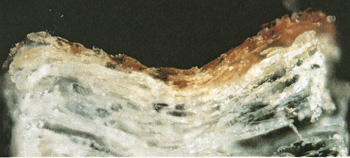
Cross section of parchment from the Archimedes PalimpsestConservation and restoration of the Archimedes Palimpsest is an enormous and ongoing task.  Progress is slow and the work is meticulous and painstaking.  To prepare the manuscript for imaging, the codex had to be taken apart because the hidden text continued under the folds of the parchment in the spine of the book.  Because some of the glue was from the late 20th century, it was particularly difficult to remove.  It took 4 years just to take off the glue!   Next, the parchment was analyzed chemically to determine the condition of the collagen, the main component of parchment.  Here you see an image of an enlargement of a cross-section sample of the parchment, the size of a pinhead, from  the Archimedes Palimpsest.  The Archimedes text is the dark stain at the top of the parchment.  In this sample, the collagen is sound.  But where the manuscript has mold, the collagen is breaking down and disintegrating.

 Imaging and Digitization

Archimedes Palimpsest with multi-spectral imaging

Modern technology allows us to view the underlying text of the Archimedes Palimpsest through various techniques.  One technique is multi-spectral imaging.  In ultraviolet light, both the overlying and underlying texts are visible.  Ink blocks ultraviolet light, but the parchment flouresces, causing another light source.  There is then, two light sources, one going into the page, and one coming from the page going out, which allows us to see the underlying text.  When the images are merged together, the underlying text becomes red, and enlarging the image allows the underlying text to be legible. The only way to access the text underneath the gold-leaf illustrations added to the codex in the twentieth century, was to use the particle accelerator at Stanford University.  Ink used for the Archimedes manuscript contained a high amount of iron, which could be recognized and captured only by the strongest xrays such as those generated by the particle accelerator. In the following image, an abstraction of an object or a boat in the sea, one can see that Archimedes considered the world to be round.

X-ray of a diagram from the manuscript.


Principles of Digitizating Cultural Artifacts

William Noel explained the basic principles that formed the foundation for the many decisions made during the Archimedes Palimpsest project.   His principles are based on ethical considerations, digital use and sustainability, and economic value for the institution undertaking the project.  Taking the example of the Mona Lisa, Noel explained that thousands of people visit the Louvre every year to see the Mona Lisa, even though they already know what the painting looks like.  In fact, the reason that the Mona Lisa has so many visitors is precisely because so many know the painting already and want to see the original.  Therefore, making digital images as broadly available and usable as possible to the largest audience benefits the institution in name recognition, visitors, and financially.  The Walters Museum in Baltimore has already benefited this way because many of their medieval manuscripts are so freely available, and that they appear at the head of results in Google image searches.  Thus, the Walters Museum gains name recognition, prestige, and popularity.

The sustainability of the data benefits from Noel’s philosophy of wide availability and use. As he explains, data from digitized cultural documents must be:

1. well documented
2.  free
3.  just take it
4.  just use it

The data from the Archimedes Palimpsest is licensed in the Creative Commons, and images also appear on Flickr.  As a result, the data from the Archimedes Project is preserved, not only at the Walters Museum, but at Stanford, and at other universities as well.

Noel also explained the importance of presenting such data as data, pure and simple, allowing others to create interfaces for study and exhibition.  Why?  Because interfaces have a shelf-life of only about three years, but the pure data can be used and re-used.  Noel said that too often institutions are busy creating “boutiquey” interfaces for their digitized data, that these institutions are presenting “apple pie” to the researchers, when simply presenting the raw data in many cases would be more helpful.  In addition, Noel gave an amusing way to think about data.  Dr. Noel says that data should be:

Sustainable
Usable
Complete
Known

The criteria for data to be sustainable is that it should be cheap to maintain, in an interface that should last, and be simple, not relational.  By complete, Dr. Noel explained that images must be presented at full resolution (with derivatives as an option), with all descriptive metadata and all technical metadata.  And to make the data known, a discovery layer for human readers should be developed.  Raw xml can be presented that is machine readable, with a style sheet that combines images with the xml, to give a traditional type of presentation.

Dr. Noel ended the presentation discussing new ways for social media to further scholarship and knowledge.  For example, jokes are often hidden within medieval manuscripts.  If a scholar finds a joke in a manuscript, they tweet it!  The Penn Provenance Project uses social media to help identify the provenance, or historic background of the ownership of precious books and manuscripts by crowdsourcing.  Scholars writing blogs about the images are important, too.  Another project, t-pen.org, will, in the next few years, make manuscripts texts searchable.

Using these techniques, we can all share in William Noel’s mission, “to bring art and people together for learning, discovery, and enjoyment.” 

William Noel posing with a group at the Center for Humanities at Temple.

William Noel answering questions at the Center for Humanities at Temple.

For more information see:

The Archimedes Palimpsest; 2004; 2 May 2013 <http://archimedespalimpsest.org/about/>

Archimedes Palimpsest.  2 May 2013 <http://www.digitalpalimpsest.org/>

Archimedes.  Works.  New York; Dover, 195-?.

Noel, William. Revealing the Lost Codex of Archimedes; TED: Ideas Worth Spreading; Apr 2012; 2 May 2013 <http://www.ted.com/talks/william_noel_revealing_the_lost_codex_of_archimedes.html>

“Archimedes.” Encyclopaedia Britannica.  Encyclopaedia Britannica Online Academic Edition.  Encyclopaedia Britannica Inc., 2013.  Web. 02 May 2013. <http://www.britannica.com/EBchecked/topic/32808/Archimedes>.

Krock, Lexi.  Inside the Archimedes Palimpsest; NOVA; 09.30.03; 2 May 2013 <http://www.pbs.org/wgbh/nova/physics/inside-archimedes-palimpsest.html>

Netz, Reviel and William Noel.  The Archimedes Codex: How a Medieval Prayer Book is Revealing the True Genius of Antiquity’s Greatest Scientist.  Philadelphia; Da Capo, 2007.

 -Anne Harlow, May 2 2013.

Whitman, Poe and Sushi: Exploring Poetry at Paley

As students traverse the main floor of Paley Library, rushing to and from classes this spring semester, a few stop every now and then to experience the poetry. Spread among the display cases on the first floor of Paley are books and documents from the Temple University Libraries Special Collections Research Center (SCRC) that invite us to explore 20th century alternative and small-press American poetry. As the crush of exams and final projects arrives, exploring this poetry display can be a great way to clear one’s mind and do a bit of de-stressing.

According to Margery Sly, Director of the SCRC,all the material in the exhibit comes from SCRC manuscript and rare book holdings. She adds that the display was designed as a journey into our poetry collections that begins with Philadelphia-region forefathers Walt Whitman and Edgar Allen Poe, who were considered radical in their day and moves forward into the work of 20th century poets. The display was also intended to coordinate with a lecture about Whitman, and to also promote the use of the poetry collection for research by Temple students.

Moving among the cases provides insight into poets who be less familiar to us but whose work is significant in the world of poetry. The work of accomplished poets such as John Burnett Payne, Lyn Lifshin, Dorothea Grossman and Tony Quagliano are featured in this display. Browsing the poems, letters and related documents one senses the importance the small press has played in expanding the dissemination of poetry in 20th century America. A small (literally) book of verse, such as Grossman’s “The First Time I Ate Sushi” communicates “the fun of speaking English” (a line from her poem Future Past).

Glass display case in library with texts and photos for the Alternative American Poetry exhibition (links to larger version).

If you want to explore those other iconoclasts and innovators of American poetry, scattered among the display cases are rare artifacts for Poe and Whitman found in our Special Collections Research Center. Then proceed up the stairway to the mezzanine level where you will find several cases dedicated to Poe and Whitman. There you will find some unique items documenting the lives and works of these great writers. This exhibit will remain in Paley Library through August. Be sure to take some time to explore before it returns to the SCRC.