Use Google Scholar to Find Full-Text @ TU

Google Scholar has become a useful search tool because it allows you to search across the content of many different databases, including JSTOR, Project MUSE, Blackwell Synergy, Cambridge Journals Online, SpringerLink, HighWire Press, Journals@Ovid Full Text, Sage Journals Online, ScienceDirect, and many more. That is not to say that the entire content of these databases is available through Google Scholar (which has never released a complete list of its sources or the extent of its coverage) but at least some of it is there. Google Scholar also includes books from Google Book Search in its search results.

Up till now, one of the problems with Google Scholar for Temple students, faculty, and staff has been the difficulty in retrieving the full-text of articles. You might find a juicy article in Google Scholar but after clicking on the link get a message that the article is blocked, even for many databases that you know Temple subscribes to. Well, this process has just gotten a whole lot easier.
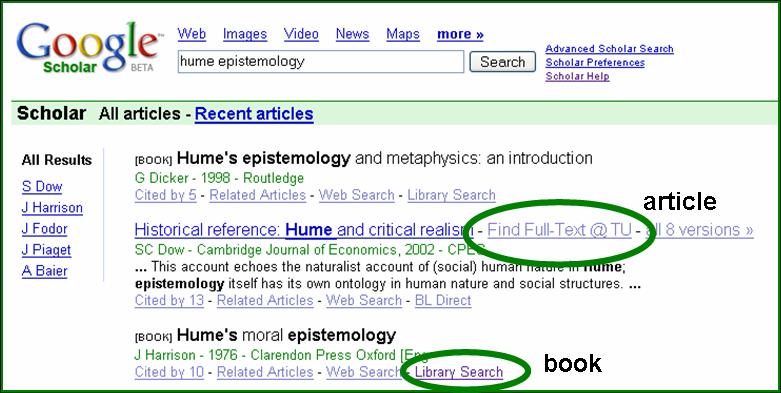
Scholar.jpg

Now Temple has registered its TUlink service with Google Scholar, which means that you can link directly from Google Scholar into the library’s subscription databases. Look for Find Full-Text @ TU right after the article title and click on it. You will see the TUlink interface pop up with links for full-text if we have it online or in print, or a link to Temple’s Interlibrary Loan Form if we don’t.

From within any of Temple’s campuses, links to Find Full-Text @ TU will appear automatically. From off-campus you need to do one of two things:

    1. Just click HERE and it will automatically set your Google Scholar preferences for Find Full-Text @ TU, or


  1. Go into the preferences of Google Scholar and select Temple University fromLIbrary LInks.

You will find that Google Scholar is a nice addition to your research toolkit. Including it when researching a subject often brings some unusual and unexpected results. Set up your Find Full-Text @ TU preference and give it a whirl.

Find Full-Text @ TU will NOT appear for books. For books, click on the link toLibrary Search at the bottom of the citation. This will take you to the record of the book in WorldCat.org, where you can input a local zip code (Temple’s is 19122) to find a local library with the book.

You can set your Google Scholar preferences to use Refworks as your citation manager. In Google Scholar Preferences, just select Refworks as theBibliography Manager.

–Fred Rowland

Creating Research Assignments That “Stick” With Students

Why would the author of a paper start off by relating a story about a lab exercise involving the autopsy of a pig that she experienced as a college student? While it’s not particularly attractive imagery, it certainly does send a powerful message about the tremendous value that authentic learning has for college students. That new paper from EDUCAUSE is titled “Why Today’s Students Value Authentic Learning”.

The author readily admits that authentic learning methods have existed for decades, but with new technologies that can allow it to happen in virtual environments there is resurgence in interest. A 10-point list suggests what constitutes authentic learning:

“has real-world relevance;is ill-defined, requiring students to define the tasks and subtasks needed to complete the activity;

comprises complex tasks to be investigated by students over a sustained period of time;

provides the opportunity for students to examine the task from different perspectives, using a variety of resources;

provides the opportunity to collaborate;

provides the opportunity to reflect;

can be integrated and applied across different subject areas and lead beyond domain-specific outcomes;

is seamlessly integrated with assessment;

creates polished products valuable in their own right rather than as preparation for something else; and

allows competing solutions and a diversity of outcomes.” (3)


While creating a course or instruction program that offers opportunities for authentic learning is more time consuming for both the instructor and student, research supports that students cite relevance as the key value to authentic learning in the classroom. It creates the linkage between course content and how a student envisions and experiences a possible future career. As the report states, “students say they are more likely to engage with the material because they do not regard it as busy work.”

Two skills that all educators know students will need in the 21st century workplace are cross-disciplinary problem solving and critical thinking. Achieving success at both involves gaining proficiency as a researcher. You can’t solve problems or think critically about them if you don’t have high quality information with which to work. Temple University librarians are skilled in helping faculty to develop authentic research assignments that integrate real problem solving into coursework. Working collaboratively, faculty and librarians can develop research assignments that are far more than “busy work” for students. Great research assignments, like the research memories of the author, should be “sticky” so that they stay with students throughout their years at Temple and beyond. Talk to a librarian about constructing a research assignment that is made to stick.

-Steven Bell, Associate University Librarian

CBS 3 Donates Video Archives to Libraries

CBS 3 DONATES VAST VIDEO ARCHIVES TO TEMPLE UNIVERSITY LIBRARIES

Philadelphia, September 26, 2007 – CBS 3 (KYW-TV) will donate its vast Video archives, a virtual diary of the history of the region during the last thirty years, to Temple University’s Paley Library, CBS 3 President and General Manager Michael Colleran and Temple University President Dr. Ann Weaver Hart announced today.

The station’s collection of more than 20,000 videotapes, which includes daily local newscasts and video clips from the last thirty years of Eyewitness News as well as 15 years of the local lifestyle show, Evening Magazine, will be housed in Temple University Libraries Urban Archives and, once catalogued, will be available to students and local residents alike.

Colleran officially presented the videotapes to Dr. Hart in a ceremony held today at Paley Library.

The station’s archival tape contain many of the most memorable moments in Philadelphia history – from the Pope John Paul II’s visit to Philadelphia in 1979 and the Phillies World Series victory in 1980 to the MOVE bombing in 1985 and the Blizzards of 1983 and 1996. Many national and international stories are also included from the Reagan years in the While House to the fall of Communism in Europe.

“The University is honored to be chosen as guardian of what amounts to a historical record of the last three decades of the 20th century in Philadelphia,” Hart says. “We hope that this collection will encourage others to preserve this type of material, so that future generations will have a first-hand account of the times in which we lived.”

“Anyone interested in the history and culture of 20th century Philadelphia must use the incredible resources held in the Urban Archives,” Dean of University Libraries Larry Alford adds. “Those resources are deepest for the first 80 years of the 20th century because of the archives of The Philadelphia Evening Bulletin, which ceased publication in 1982. The KYW footage will fill in the gap of that last 20 years.”

Colleran says that, in addition to chronicling local history, the tapes are also a dynamic example of the evolution of local television since the 1970s. “Not only do we see the evolution of news coverage from the anchor desk to live coverage in the field, but we can witness the birth of a whole new genre in television through Evening Magazine, a program that was imitated across the country and became a precursor to such shows as Entertainment Tonight, Access Hollywood and the celebrity journalism of today.”

The station’s contribution of the tapes to Temple University Libraries corresponds with its relocation earlier this year from its 35 year-home on Independence Mall to its new state-of-the-art High Definition studios in the Spring Garden section of Philadelphia. Coincidentally, this is not the first time astation relocation has benefited the University. When KYW moved from its Walnut Street studios to Independence Mall in 1972, the company donated its building there to the University which used it as a Center City campus for many years.

CBS 3 is part of CBS Television Stations, a division of CBS Corporation.

Watch the CBS 3 (KYW-TV) coverage of this momentous event in Philadelphia history online.

Index of Christian Art

The library now has The Index of Christian Art, the result of a project begun by Professor Charles Rufus Morey at Princeton University in 1917. He believed that the development of Early Christian art could be more deeply understood through the study of themes rather than artistic styles, which during the Greco-Roman period were too “uniform” (more information on the ICA). From a humble beginning of a few shoe boxes of index cards he crafted an indexing system which today falls under five broad thematic groups, FiguresScenesNatureObjects, and Miscellany.

The current online database covers all additions to the collection since 1991 when digitization began and thirty percent of the items indexed before 1991. It grows yearly and the retrospective digitization will eventually bring all pre-1991 content into the database. In addition to indexing Christian art, the database contains over 60,000 images both in color and black and white. For those who need to examine content that has not been digitized, they can still go to Princeton, Washington, DC, Los Angeles, Utrecht, or the Vatican to view the entire collection. The Index of Christian Art includes works of art from the early years of Christianity up through 1400 AD and recently the decision was made to expand the coverage up through the sixteenth century.

The Index of Christian Art contains three different record types, which are called “databases” or simply “bases”: Work of Art records (over 57,000), Subject records (over 28,000), and Bibliographic records (over 57,000). The Work of Art records provide detailed descriptions and links to the images. Although there are multiple ways to search and browse, I found it confusing for the novice user (myself) since it’s often hard to distinguish between the actual record types and the individual fields in the records, especially when constructing a search and interpreting the results. I trust that greater knowledge of Early Christian art and more familiarity with the database would ease this burden a little (if not, feel free to let me know). The new user should start with the Multi-Base search because it lets you search across all fields and you can select which record type you’d like to search. Your results are unambiguous: if you search Work of Art records (or Subject or Bibliography records) you’ll get just that type of record in the results set.

Index of Christian Art is a nice addition to our other art bibliographic and image databases, which can be found on the Arts & Humanities database list. Feel free to contact me with any questions.

—Fred Rowland

JSTOR vs. ABC-CLIO

JSTOR is the premier scholarly journal database. It is a full-text, interdisciplinary archive of only the most highly respected journal titles. By comparison, ABC-CLIO’s two scholarly databases — America: History & Life and Historical Abstracts— seem to be less frequently used, even by historians. There are several reasons for this, but perhaps the most important is that JSTOR provides direct access to the full-text, full-page image of all articles in the database. Consider, however, the following advantages of the ABC-CLIO databases:

1) America: History & Life and Historical Abstracts between them index over a thousand scholarly journals, including 65 of the 72 history titles available in JSTOR. A researcher using the ABC-CLIO databases will thus find nearly all citations to JSTOR articles and thousands of additional citations not available in JSTOR.

2) The Libraries’ new TUlink service enables two- or three-click access to the full-text of thousands of articles indexed by America: History & Life and Historical Abstracts. This means that JSTOR’s previous “full-text advantage,” described above, no longer holds.

3) Citations to articles in America: History & Life and Historical Abstracts contain human-generated subject headings; JSTOR’s article citations do not. Why does this make a difference? A researcher using the ABC-CLIO databases could perform a subject search for “Gates, Horatio,” easily finding all 34 citations to articles about the Revolutionary War general. This type of search simply cannot be done in JSTOR.

4) JCR Online assesses the impact of scholarly journals on various academic disciplines. The higher a journal’s “impact factor” the more important that journal is within its discipline. Between them, the two ABC-CLIO databases index all sixteen journals identified by JCR Online as having the highest impact factors in History. These journals are: Environmental HistoryAmerican Historical Review,Journal of American HistoryJournal of Modern HistorySocial Science History,Past & PresentJournal of African HistoryComparative Studies in Society & HistoryJournal of Social HistoryJournal of Interdisciplinary HistoryHistory Workshop JournalInternational Review of Social HistoryEthnohistoryJournal of the History of SexualityZeitgeschichte, and Mouvement Social. JSTOR indexes only twelve of these same sixteen “high impact” history journals.

It certainly is not my objective to sour anyone on the use of JSTOR, which by any measure is a stellar scholarly resource. The point of this post is rather to say that both databases have much to recommend them. The choice of which to use ultimately depends upon the individual needs and preferences of the researcher. A comprehensive history article search will likely require the use of both.

Do you have a favorite history database?

David C. Murray

Islam and the Byzantines

Index Islamicus is a great source for Islam, obviously, but it’s also good for all the lands and peoples that have come into contact with Islam, which is a pretty vast field. Look at the six citations I quickly retrieved from Index Islamicus and downloaded into Refworks.

  • Islam and the Byzantines (Take note of the TUlink icon on the far right of the citations that will lead you to options for obtaining the complete article or book.)

—Fred Rowland

Introducing: TUlink

Have you encountered frustration in fetching the full text of an article when using the library’s research databases? We have some good news for you. We are pleased to announce the arrival of TUlink, a new service of the Temple University Libraries.

With TUlink, the research process is greatly streamlined. TUlink acts as a bridge between a citation in a database and the full-text of the article in a different database–removing a number of formerly necessary steps.

When the citation you find in a database doesn’t have the full-text immediately attached to it, look for the TUlink icon:

icon120-25.jpg

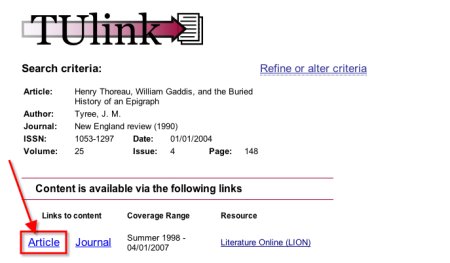
Clicking on this icon will perform a search of our full-text resources and when possible give you an “Article” link directly to the full-text of the article. In other cases you will see a “Journal” link to the electronic copy of the journal in which your citation was published. TUlink can also get you to information on journals held in the library on paper.

tulink-blog.jpg

If no full-text is available you will be offered an interlibrary loan link to request the article from another library.

TUlink is a work in progress. Currently enabled databases include all the EBSCO databases (Academic Search Premier, ERIC, MLA, PsycInfo, etc) and CSA databases (Criminal Justice Abstracts, Sociological Abstracts, etc) and numerous others. Other databases will be enabled on an ongoing basis.

See more details on using TUlink.

Derik A Badman, Digital Services Librarian

The Greatest Invention

Has any human achievement topped the invention of writing? Without it History, defined as “all that is remembered of the past as preserved in writing,” couldn’t exist. And neither could libraries. As Margaret Atwood states in the first episode of the Writing Code, a new 3-part series about the evolution of writing now airing on WHYY: “Writing is a code. It is the making of marks. You then have to understand that these marks can be retranslated into speech.” Uniquely among the many different systems of visual signification, writing captures spoken language. Writing appears to have evolved independently in as many as five locations around the world: Mesopotamia, Egypt, the Indus Valley, China, and Mesoamerica. Early writing served several functions. Among the Sumerians writing developed as an accurate method of keeping accounts; for the Maya its primary purpose was to aggrandize the institution of kingship. No matter what its purpose, writing transformed every society that it touched. The following books tell the story of how three of the world’s earliest writing systems — Egyptian and Mayan hieroglyphics, as well as Sumerian cuneiform — were deciphered by modern scholars.

Breaking the Maya Code by Michael D. Coe, c1992
The Invention of Cuneiform: Writing in Sumer by Jean-Jacque Glassner, c2003
The Story of Writing by Andrew Robinson, c1995

The next time you find yourself struggling through 200 pages of assigned reading for an Anthro, History, Poly Sci, Psych, or other college course, remember those long-ago geniuses who invented writing, without whom none of it would be possible!

David C. Murray

Luciano Pavarotti, 1935-2007

On September 6th, 2007, opera singer Luciano Pavarotti, arguably the most amazing tenor since Caruso, died at age 71 of pancreatic cancer at his home in Modena, Italy. Pavarotti had a voice that was immediately recognizable; tender, expressive, and yet brilliant and clear at the same time. Born in Modena, his father an amateur singer and baker and his mother a worker in a cigar factory, Pavarotti transcended his modest beginnings and had a persona that was in many ways larger than life. He broke barriers between the frequently perceived high-brow culture of opera and, through his gregarious personality and exquisite voice, opened up the art form to be enjoyed by non-expert listeners everywhere. To accomplish this, Pavarotti, much to the chagrin of classical critics, performed in large stadiums, combined popular songs with serious operatic arias in concerts such as the series of “The Three Tenors”, and performed with the Spice Girls, Sting, Elmo on Sesame Street, and on Saturday Night Live with Vanessa Williams. He constantly reached out to bring the public into the concert hall. Pavarotti’s efforts were so successful that he enjoyed the popularity and celebrity normally associated only with rock stars. Music lovers around the world joined together to mourn and to commemorate this much-beloved musician, who will be greatly missed.

In Philadelphia, Pavarotti established the Pavarotti International Voice Competition in the 1980’s. Young singers competed in cities around the world and winners traveled to Philadelphia to participate in final rounds. Winners received financial rewards, concert contracts, and a role singing alongside Pavarotti in upcoming Opera Company of Philadelphia performances. One such performance, the 1982 performance of La Bohème, won an Emmy for the “best classical program in the performing arts”.

In addition to his work to encourage young talent, Pavarotti was also a great humanitarian. He worked tirelessly to provide funds for victims of wars in Bosnia, Guatemala, Kosovo, and Iraq. With Diana, Princess of Wales, he helped raise funds to eliminate land mines. His humanitarian efforts won him numerous awards including the Freedom of London Award, the Red Cross Award for Services to Humanity, and the Nansen Medal from the UN High Commission for Refugees.

Although Pavarotti is no longer here physically, his voice continues to live through countless sound recordings and videorecordings of his performances, widely available commercially and in libraries. Pavarotti was careful that nearly all of his performances were recorded in some fashion, leaving behind a legacy for listeners to continue to enjoy.

Paley Library has books about the great maestro, in addition to recordings of his performances on discs, and DVD’s. Streaming audio to some of his recordings is provided in the databases Classical Music Library (Verdi Requiem) and Naxos Music Library.

For more information see

Obituaries
BBC
(London )Times
New York Times
Philadelphia Inquirer
Washington Post

-Anne Harlow

RefWorks with Attachments

RefWorks, the online citation manager, is a valuable and easy-to-use tool for all kinds of researchers from students to faculty. A brand new feature makes it even more useful.

Every RefWorks user now has 100MB of storage space to attach files to their citations. This means that not only can you store citations but also the full-text of articles, songs, images, or short videos. Files are limited to 5MB each, which should be sufficient for most uses.

With files stored in RefWorks you’ll never misplace that article you need for quoting in a paper or have to deal with a usb drive filled with unorganized files. RefWorks can keep them sorted in folders and searchable.

In case you missed it, we also added the RefShare module to RefWorks over the summer. For more information see this post on our blog. Also: see shared bibliographies from Temple on RefShare.

Questions? Contact Fred Rowland or Derik Badman.

–Derik A Badman