Welcome Caitlin Shanley

In January, Temple Libraries welcomed new Instruction Librarian and Team Leader, Caitlin Shanley. Caitlin is the Libraries’ primary coordinator for library instruction for the First Year Writing program and library liaison to Women’s Studies, Asian Studies, and American Studies. She will also provide staff development, training and assessment for the Libraries’ overall instruction program.

Caitlin comes to us most recently from the University of Pennsylvania Libraries where she was the Educational Technology Librarian at the Weigle Information Commons. Prior to that she served as the Instructional Design and Technology Librarian at the University of Tennessee at Chattanooga where she led initiatives related to instructional technologies in the library. Of note is her work on UTC’s redesign of first-year English composition instruction, and her role as co-creator of a zombie video game to complement library orientation tours which won the Association of College and Research Libraries President’s Program Innovation Award.

Caitlin is an active member in the Philadelphia community. She volunteers for Girls Rock Philly (GRP), a volunteer-based non-profit organization that empowers girls and young women through music education. Last year Caitlin served as a camp counselor and band manager during GRP’s week-long summer camp where girls ages 9-17 learned to play instruments and to compose and perform an original song. Since joining GRP Caitlin has developed a personal interest in music; she’s currently learning to play the bass guitar.

When she is not learning new songs on the bass or thinking about information literacy, she’s most likely hanging out with her two furry friends Maisie and Miss Mandible.

Caitlin holds a Master of Science in Library Science from the University of North Carolina at Chapel Hill and a BA in Literature and Women’s Studies from the University of North Carolina at Asheville.

Welcome, Caitlin!

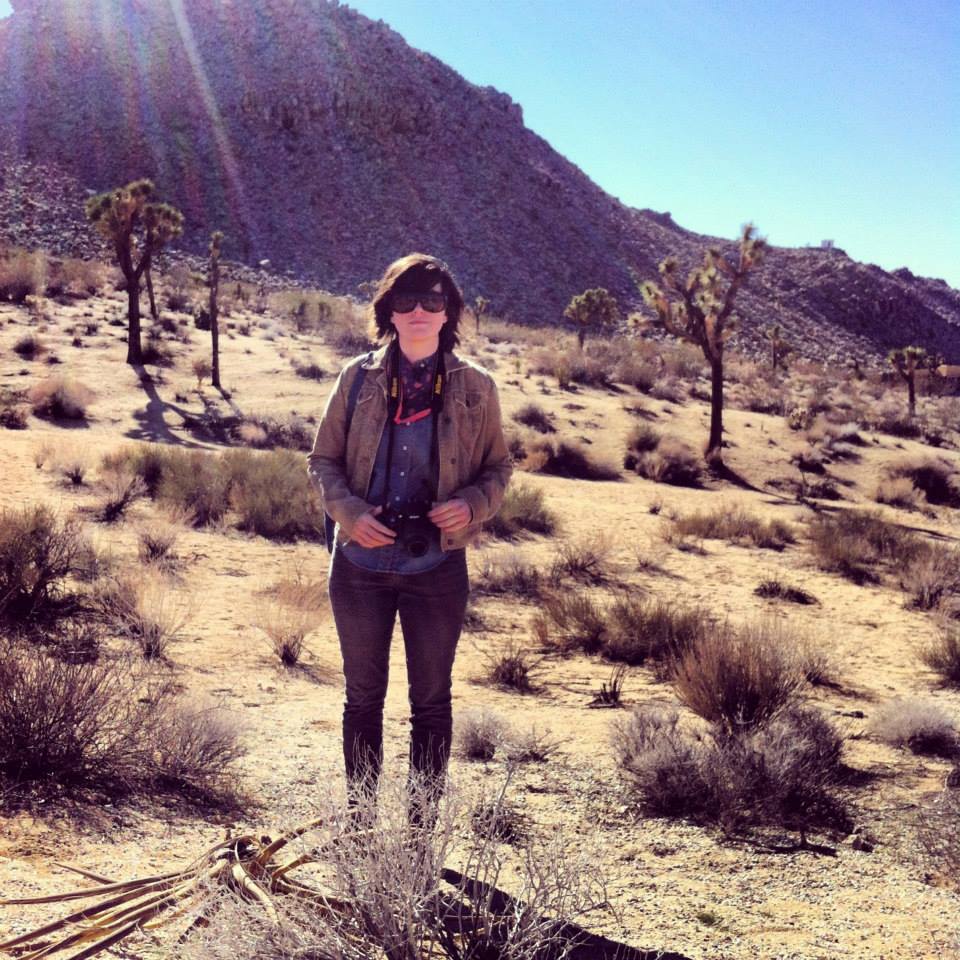
Caitlin at Joshua Tree National Park

Caitlin at Joshua Tree National Park

America’s Other Deficit – The Innovation Deficit

Here’s an informative four-minute video to help you understand a new type of deficit that threatens the U.S. economy. Innovation helps to grow the American economy through the discovery of new products and services that will bring value to consumers and industry. Many of these innovations, ranging from GPS technology to MRIs or life-saving medicines, were the result of higher education research. We now find ourselves facing an innovation deficit that weakens our capacity to produce the research that leads to innovation.

In a nutshell, the innovation deficit is the difference between actual federal funding for scientific research and education and the amount of funding actually needed for those activities to produce a sufficient level of innovation. The point of the video is that while this may seem like an effective strategy in the short-term to reduce the budget deficit by cutting research funding to higher education, in the long-term it’s actually hurting the economy by reducing our national capacity for innovation. Because we also compete in a global economy, fewer funds domestically decreases the attraction of American universities to the world’s best scientists and innovators and instead encourages them to seek research opportunities in other countries offering more funding. That compounds the problem over time.

InnovationDeficit.org, the producer of the video, is a coalition of higher education, business and public health associations, including the Association of Public and Land-Grant Universities, the American Association for the Advancement of Science, the American Council on Education and the Business and Higher Education Forum. The Coalition hopes to use their site and video to alert members of Congress to the serious problems that may result if we allow the innovation deficit to grow.

It’s For the Birds

It is well documented that the Temple University campus, with it’s many buildings with large windows, is hazardous to birds. Thousands meet their demise when they mistakenly fly into the windows. Paley Library is recognized as one of the most dangerous buildings for birds because of the trees surrounding the building and the extremely large main level windows. Many of the birds don’t stand a chance.

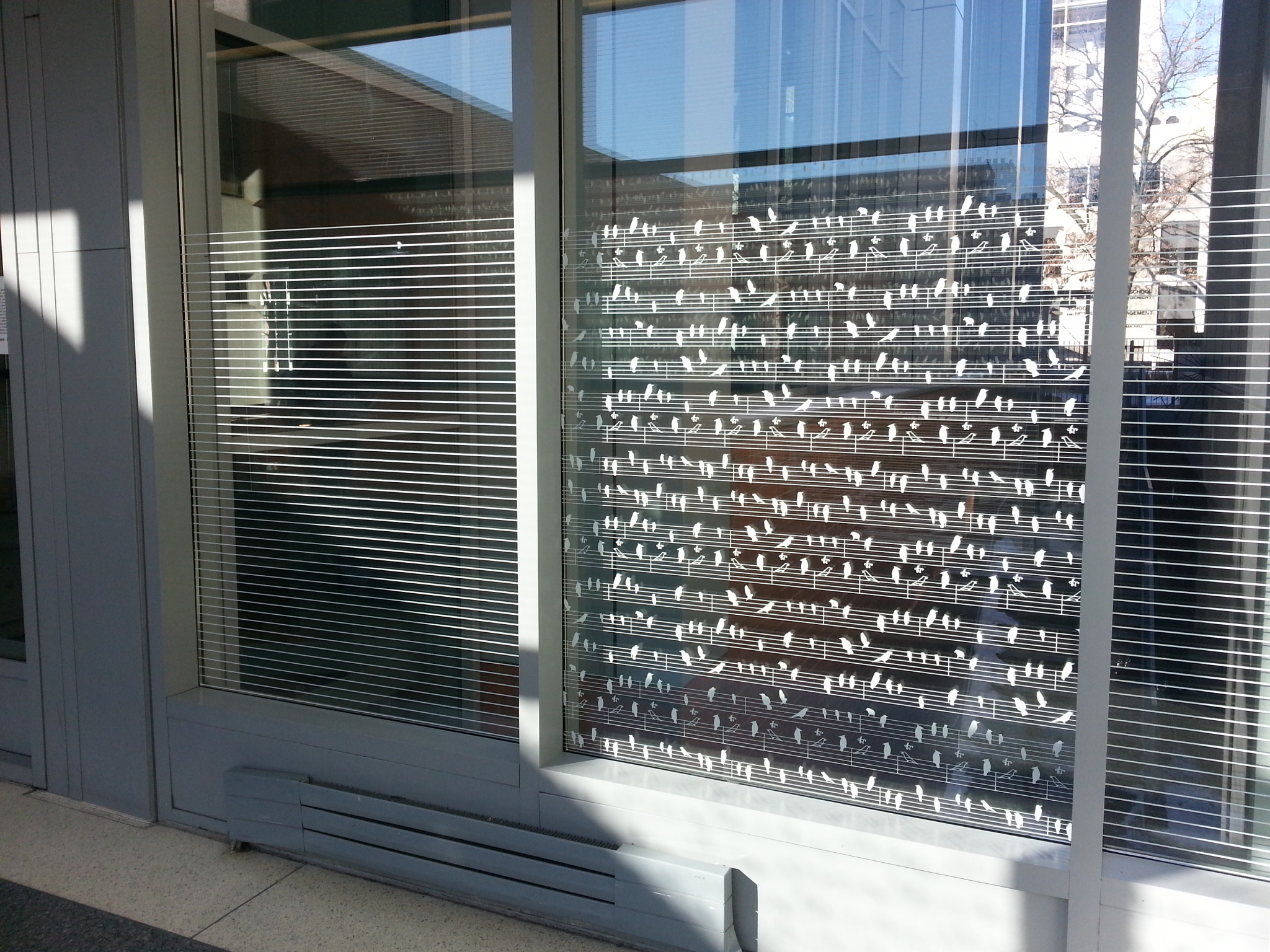
Over the years the University has tried different strategies as deterrents. Unfortunately, attaching plastic hawk figurels to the building exterior and putting a few bird decals on the windows has made minimal difference. In 2012, a new strategy was devised. Students at the Tyler School of Art designed a new type of stencil to apply to windows that proved more effective in repelling the birds before they made contact. The good news is that we are finally beginning to install these decals on windows around the Paley Library. Here is an example of the decal’s appearance on windows in the corridor between Paley and Tuttleman.

birddecal


No solution has yet proven to be100 percent effective in ending all bird strikes, but we hope this will help to decrease the numbers of birds that meet an untimely death because of Paley Library.

Something New for Spring 2014 – A Redesigned Catalog Interface

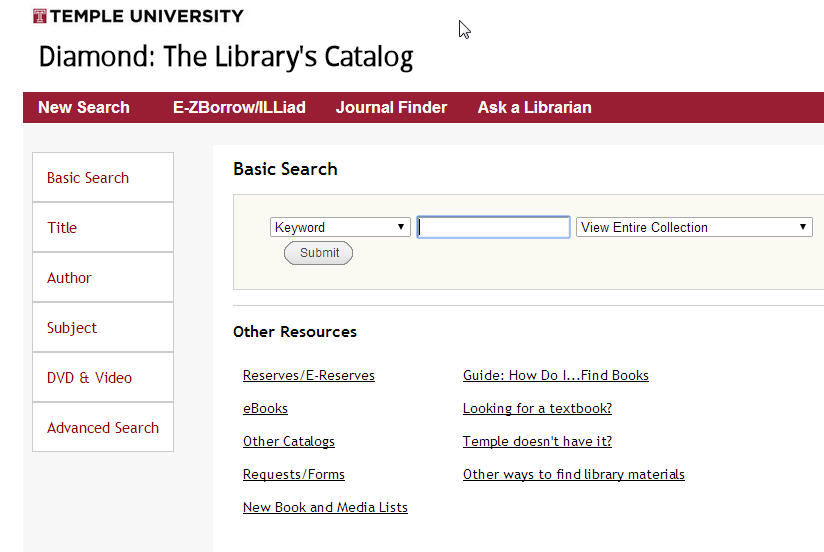
In an effort to constantly improve your ability to get good results when you search for books, DVDs and more in our library catalog (AKA the “Diamond Catalog”), we have redesigned the interface to simplify the search and improve your library research experience. The transition from our existing catalog to the newly redesigned one will take place on Tuesday, February 4, 2014.

The intent of the new design is to offer a streamlined appearance that minimizes clutter while providing easy access to the mostly frequently used resource links. For example, we’ve made the links to E-ZBorrow and Journal Finder much more prominent at the top of the page. Instead of our current small tabs for title, author and subject searches running along the top of the search box, we’ve made them much more visible by enlarging them and adding them to the left side of the page – where they are more likely to be seen and used.

newcat1


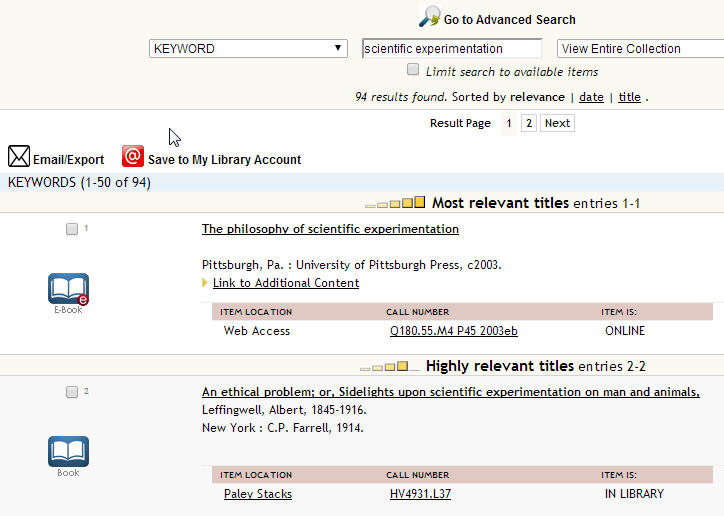
The effort to simplify and streamline carries over to the display of records:

opac2


We hope you will find our new catalog design easy to use. If you would like to give it a try in advance of the official debut on February 4 you can visit the preview site. If you would like to provide feedback on the appearance or functionality of our redesigned catalog interface please leave your comment to this post or use our “What’s Your Suggestion” blog to share your feedback.

Paley Library, a place to be during finals

Classes end this week, which means Paley Library is gearing up for a 24-hour schedule during study days and finals. Beginning tomorrow, Tuesday, December 3rd, Paley Library will stay open continuously until we close at 5PM on Saturday, December 14. We’re here as your study headquarters! Check the schedule for information on other locations, staffed service points, and our hours subsequent to December 14.

During finals we’ll have some additional ways to relax and refuel. Every evening from Sunday, December 8 through Thursday, December 12 we’ll have coffee and cookies available beginning at 9PM Sunday and 10PM the following days. While supplies last!

The Libraries are also excited to welcome, for the first time, the pups of Therapy Dogs International. These furry friends will be at Paley Library Lecture Hall to help you relax and de-stress at the following dates and times: Monday, December 9 – 10AM-1PM, Tuesday, December 10 – 2PM-5PM, Wednesday, December 11 – 10AM-1PM.

Good luck with finals, and we’ll see you at the Libraries!

Veterans Day and Temple’s World War I Poster Collection

While the First World War officially ended at the signing of the Treaty of Versailles on June 28, 1919,  major hostilities  concluded on November 11, 1918,  at the eleventh hour of the eleventh day of the eleventh month.  November 11 was thereafter observed as Armistice Day  in many of the allied nations, including France, the United States, Belgium, Great Britain, Canada, Australia and other Commonwealth nations.   The day originally served to remember the  9 million combatants who had died  during the war.  After the Second World War, veterans of that conflict pressed in the United States to have November 11 become a day on which all veterans of military service would be honored, irrespective of  when they served in the U.S. Armed Forces.   President Dwight D. Eisenhower, himself a veteran of both the first and second World Wars,  signed the enabling legislation into effect in 1954.

Today, although all combatants from “war to end all wars”  have died,  we grapple still with the legacy of that terrible conflict which spawned several national revolutions,  reshaped the map of Europe, led  to the Second World War, and  directly or indirectly occasioned the creation of the modern states of Iraq, Saudi Arabia, Jordan and ultimately Israel.

The First World War is regarded  as a watershed event in the history of warfare, society and culture.  Government powers (taxation, rationing, conscription) significantly expanded in many nations in order to mobilize entire economies to fight a technologically advanced and industrially intensive war of such great geographic extent and duration.   Propaganda reached new heights of pervasiveness and persuasive power as governments increasingly saw the necessity to garner and maintain broad public support  in favor of war policies in the context of  broad literacy rates and mass suffrage.

One of the most prominent manifestations of the new propaganda was the war poster, many of which have survived in the collections of libraries and historical societies, as well as in private collections.   The Special Collections Research Center of the Temple University Libraries hold  a magnificent collection of over 1,500 World War I posters which were donated to Temple in 1937 by George F. Tyler who had been a Major in the U.S. Army Field Artillery during the War.  Temple’s Tyler School of Art is named for Tyler’s wife Stella Elkins Tyler.    Virtually all these posters have been digitized and are now freely available for study in our Digital Collections.      An interpretive online exhibition is also offered at:  http://exhibitions.library.temple.edu/exhibits/ww1/ .  

Jonathan LeBreton, Senior Assoc. University Librarian

How is scholarly publishing like using Facebook?

One absurdity of the current scholarly communications system consists of the arrangement by which faculty hand the products of their research over to publishers, who then charge university libraries enormous sums to repurchase access to the resulting articles. Publishers also ask faculty for uncompensated work as anonymous peer reviewers. In a curious disconnect, faculty function as part of a “gift economy”, giving away work in exchange for prestige and potential career advancement, while publishers function squarely as part of the “market economy”.

In truth, almost all of us take part in a similar exchange on a daily basis.

Free web services like Facebook or Google apps can operate as free sites in part because they sell details about your online behavior to companies known as “data brokers”. Facebook alone sells information to four separate companies: Acxiom, Datalogix, Epsilon, and BlueKai. Details on how to opt out of this data collection can be found on this post by the digital rights organization Electronic Frontier Foundation. And you thought keeping your regular Facebook privacy settings up-to-date was difficult!

The primary customers of the data brokers are advertisers who use information collected by online services for targeted marketing campaigns. That’s why, following the revelations of NSA data collection, the Onion ran a piece with the ironic headline “Area Man Outraged His Private Information Being Collected By Someone Other Than Advertisers”. However, it isn’t hard to imagine that large scale data collection might lead to worse abuses than advertisers sending cheese coupons based on grocery store loyalty card data.

Some scholars predict that “big data” collection could sometimes benefit the public. For instance, epidemiologists could use mobile phone GPS data to track and predict the spread of an infectious disease, thus halting the disease’s progress. Nonetheless, many of the same scholars acknowledge that, due to the potential for misuse of “big data”, an open discussion must occur about the many privacy issues involved.

One such thinker, MIT’s Alex Pentland, has coined the phrase the “New Deal on Data” to describe his proposal for resolving this issue. His plan consists of three tenets: you should have the right to possess your own data, the right to control use of your data by opting-in (with plain language explanations of any possible uses), and the right to dispose of or distribute your personal data as you see fit. Also, just as in other research studies, “big data” projects should anonymize their data sets. Imagine how empowering it would be to control how corporations or scientists make use of the data traces you leave behind in everyday online life.

In Pentland’s proposed data policy, I see yet another similarity to Open Access publishing. The Open Access movement encourages authors to retain copyright on their work, so that they can continue to make use of it as they see fit. And most scholars will choose to distribute their work broadly if it will benefit the public good, for instance, by giving doctors in the information-poor developing world knowledge of a life saving treatment. Perhaps we would do the same with data on our online behavior…it would be nice to have a choice.

Further reading:
Everything We Know About What Data Brokers Know About You

Legislative Update – Open Access Advances

Each year more faculty and more institutions acknowledge the importance of reforming scholarly communications by creating a new system that better supports publicly open access to research. One way in which this happens is when faculty senates approve Open Access Resolutions that encourage the open sharing of research articles by depositing them in institutional or disciplinary repositories. Significant progress also happens when federal law creates new guidelines and requirements for public sharing of research funded by taxpayers.

In 2007, with the passage of the Consolidated Appropriations Act of 2007 (H.R. 2764), federal law mandated that all articles published as a result of grant funding from the National Institutes of Health (NIH) be made available to the public on PubMed Central no later than 12 months after publication. Known as the “Public Access Policy”, it was a major advancement in open access. As a result close to 100,000 research articles are publicly accessible. However, since then, there has been no additional legislation passed to expand the Public Access Policy to other fields. It is not for lack of trying.

The Federal Research Public Access Act (FRPAA) was first introduced in 2006, reintroduced in 2009, and reintroduced again in the 112th Congress on February 9, 2012 (as S. 2096 and H.R. 4004). FRPAA aimed to expand public access policies to other departments/agencies. Despite setbacks experience wiht FRPPA, the effort to pass new public access legislation continues. On February 14, 2013, The Fair Access to Science and Technology Research Act (FASTR, HR708 and S350) was introduced. This bipartisan legislation would require federal agencies with annual extramural research budgets of $100 million or more to provide the public with online access to research manuscripts stemming from funded research no later than six months after publication in a peer-reviewed journal.

While it was beneficial for the White House, in 2013, to request the Office of Science and Technology Policy to direct each Federal agency with over $100 million in annual conduct of research and development expenditures to develop a plan to increase public access to funded research results published in peer-reviewed scholarly publications, it is still necessary to pass the FASTR bill in order to ensure that the expansion of public access requirments to other federal agencies is mandated by law. Despite the number of legislators from both parties co-sponsoring FASTR, in the current legislative environment, the prospect for it being approved this year is questionable. Whatever happens, the momentum continues to grow for public access legislation in both the library and higher education communities. With the undeniable success of the NIH Public Access Policy, in time we are likely to see the passage of FASTR.


Why Open Access Matters

Today marks the start of Open Access Week, a global event celebrated each year to acknowledge the importance of continuing to work towards reform in our system of scholarly communication. There are two significant reasons why it is important for faculty, researchers and librarians to work together to create change in a system that is in need of change and demands our collective attention.

The first is economic. The current system is not financially sustainable for higher education. The cost of tuition is already unaffordable for too many students. The irrational high cost of many scholarly journals, particularly in the fields of science, technology and medicine, contributes to the expense of a college education. The budgets of academic libraries are challenged to support these costs. Even with the advent of digital technologies that make new and more open systems of distribution possible – well proven by hundreds of viable, highly respected open access journals – we still scratch our heads and wonder why higher education continues to give away faculty research only to buy it back from publishers at inexplicable high costs.

The second is openness. The current scholarly publishing system keeps important research information behind subscription pay walls. While there is notable progress in making scientific research available to the public, it still represents a small portion of all published scholarly content. There are already many examples of the benefits of making this content openly accessible to the public. Taxpayers certainly have the right to the information their tax dollars fund. If higher education transforms the scholarly communication to advance openness, we all benefit.

Open Access Week is designed to create awareness. It is about more than economics or creating access for the public. It also brings attention to the importance of higher education supporting its right to use copyrighted content under the guidelines for fair use. We must defend the right of faculty to use copyrighted information to support student learning. It is also a time to remind faculty of their rights as authors. Instead of surrendering the rights to their intellectual property to publishers, faculty will want to think about adding language to author agreements that allows them to retain their rights to reuse or share their published content. Too many Temple University faculty have signed standard author agreements only to discover later on that they had no right to use their own content or could only do so for hundreds or thousands of dollars.

We hope that members of our Temple University community will take some time this week to think about the current scholarly publishing system and how we can work collaboratively to improve it. Temple University librarians are available to meet with faculty members who would like to learn more about open access, fair use or author rights. Take advantage of Open Access Week webinar events. Visit the Open Access Week website to learn more about what you can do to create change. And watch this blog for more posts about open access throughout this week as Temple University Libraries honors Open Access Week.


Get Ready For Open Access Week – Oct.21 – Oct.25

Each October academic librarians set aside a week to promote and celebrate the open access movement. Across the globe events are held to remind scholars of the importance of reforming the scholarly communications system in order to make the results of research and scholarship widely available to all the world’s citizens. According to the Open Access Week website:

Open Access Week, a global event now entering its sixth year, is an opportunity for the academic and research community to continue to learn about the potential benefits of Open Access, to share what they’ve learned with colleagues, and to help inspire wider participation in helping to make Open Access a new norm in scholarship and research.Open Access” to information – the free, immediate, online access to the results of scholarly research, and the right to use and re-use those results as you need – has the power to transform the way research and scientific inquiry are conducted.

In recognition of Open Access Week, Temple University Libraries will use its website and this blog to share information about open access. We hope this will create more awareness about open access issues and opportunities across our institution.

There are two webcasts scheduled for Open Access Week that may be of interest to you. On Monday, October 21 at 3:00 pm ET the Open Access Week Kick Off Event is sponsored by SPARC (The Scholarly Publishing and Academic Resources Coalition) and the World Bank. The webcast is “Open Access: Redefining Impact” and will feature a panel discussion of multiple experts from different disciplines discussing their open access experiences. You can view a listing of other Open Access Week live events being sponsored by SPARC.

The live webcast “Protect Your Patrons From Predatory Publishers” will be held on Tuesday, October 22 at 3:30 pm ET, and it will feature Jeffrey Beall speaking about low quality open access journals that use misleading techniques and claims to lead faculty to publish for outlandish fees. It is important for researchers and scholars to be aware of predatory publishers.

Stay tuned for more information on open access the week of October 21, 2013.