Recently a number of patrons have asked about the differences and similarities between EndNote and RefWorks, two programs that help writers and researchers organize their references.
Here are some differences between RefWorks and EndNote:
1) RefWorks is free because the university has a site license to the RefWorks web site. You just have to go to RefWorks to create an account. EndNote costs about $100 for students and about $180 for the exact same software at the regular price. But when you leave Temple, Endnote will still be on your computer, while your Refworks account will be inaccessible.
2) RefWorks is web-based so you can access your account from any computer with an Internet connection. If you are on a computer that does not have Internet access, you will not be able to get to RefWorks. EndNote in contrast is loaded onto the hard drive of your computer so it is not accessible from other computers. However, EndNote licenses do allow you to load a copy onto your “work” computer as well as one on your home computer. Check your license for details.
3) EndNote is probably faster because it resides on your computer. RefWorks will be slow if your Internet connection is slow.
Here are some similarities between RefWorks and EndNote:
1) Both EndNote and RefWorks are databases that allow you to organize the references you use for your research. You can enter references manually or download them.
2) For both, there are two ways to download records. You can start from an external library database, save selected records, and import them into EndNote or RefWorks. The second method is to use either EndNote or RefWorks’ native search interface to search external library databases. Downloading of records can be problematic with some library databases, so for questions on specific databases, get in touch with one of the contacts at the end of this entry.
3) You can output your references into the form of a bibliography in many different styles, including APA, MLA, Chicago Style, as well as hundreds more, including many for the sciences. For each program, you can take an output style and customize it for your own purposes, or you can create a new style from scratch.
4) Each program has an MS Word plugin that allows you to insert in-text citations as you write your paper while your bibliography is automatically constructed at the end of the paper. EndNote’s plugin is called Cite-While-You-Write, while RefWorks’ is called Cite-N-Write.
5) You can transfer records between EndNote and RefWorks, so if you start by using one of these programs, you can switch at a later date to the other one.
So, which one to select? One of my colleagues called RefWorks “clunky” compared to EndNote. Another colleague said that she could use RefWorks after 1.5 hours of training and still had trouble with EndNote after 9 hours of training. She says that RefWorks is much more intuitive. I like EndNote but have spent a long time learning it. I’ve also used RefWorks recently and found it very useful.
The only surefire advice is that if you don’t have EndNote already, start with RefWorks and see how you like it. But above all, if you are doing a lot of research writing, try one of these products out because it could save you a whole lot of time.
For more information, email Fred Rowland or George Fowler.
–Fred Rowland
 Everywhere you look in the library, you see the little red signs:

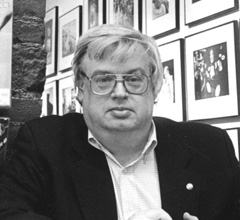 Salvatore C. DiMarco, Jr. was born in 1947 in Drexel Hill, PA. He learned photography from his father, a portrait painter in Philadelphia. In 1970, he graduated with a B.S. degree from the School of Communications and Theater at Temple University. Mr. DiMarco first joined the staff of the Philadelphia Evening Bulletin in 1967 as a summer intern. He eventually became Chief Photographer, overseeing a department of more than 30 photographers, editors, and technicians. After the Bulletin closed in 1982, he became a free lance photographer and divided his time between editorial, corporate and industrial magazine assignments. His photographs have appeared in many of the world’s leading magazines, including Time, and he won more than 150 international, national and regional awards for his work. He passed away on June 11, 2004.
 Gilbert J. Tucker was born in Philadelphia in 1930. From an early age, he showed an interest in illustration. Upon graduating from Simon Gratz High School, he was awarded a scholarship to the Philadelphia School of Industrial Art, now called The University of the Arts. In 1951, he graduated from the Philadelphia School of Industrial Art with a diploma in illustration. Later, he continued his education at the Philadelphia Museum College of Art, where he received a Bachelor of Fine Arts degree in 1962. After working for a number of years as a technical and commercial illustrator, Mr. Tucker joined the staff of the Philadelphia Evening Bulletin‘s Editorial Art Department from 1968 to 1980. There, he was able to exercise the full range of his abilities by providing illustrations to accompany articles and editorials. Since retiring in 1993, he devotes much of his time to watercolor painting, including landscapes and cityscapes around Philadelphia and the New Jersey shore.