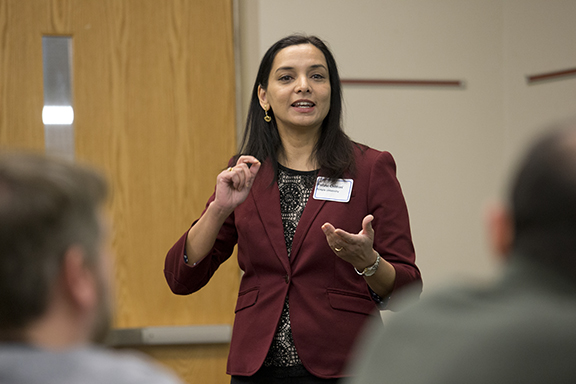
Johanna Inman, Assistant Director, TLC
This semester the TLC and the General Education Program are co-sponsoring a faculty Teaching Circle on the topic of Integrative Learning. This teaching circle is an opportunity for faculty who teach General Education courses to come together and discuss the significance of GenEd, how to motivate students in these courses, and how to help students connect learning in these courses to courses in their majors, their careers, and their personal lives. Johanna Inman is an Assistant Director at the TLC and co-facilitates the Integrative Learning Teaching Circle.– – – – –
Anyone who has taught a general education course at Temple University, or at any university, is familiar with the “just get through it” attitude students often arrive with on the first day of class. Many students do not value these courses and as a result, see them as a fairly low priority.
Yet, GenEd equips students with the information literacy, communication and critical thinking skills they will need for university-level work. Most of us teaching these courses also recognize the long-term impact that liberal education can have on our students’ professional and personal lives. In a recent survey conducted on behalf of AAC&U, an overwhelming majority of employers surveyed said they seek to hire graduates with the abilities to innovate, think critically, communicate clearly, solve complex problems, and draw on a broad range of knowledge—all learning goals commonly found in general education courses.
AAC&U and higher education leaders across the nation are working hard to change students’ perception of general education, while improving curriculum to make certain it actually helps students improve skills they need to be successful. Curricula nationally are undergoing re-evaluation in order to intentionally build in integrative projects, assignments, and learning experiences. This approach to learning helps students “connect, reflect, and apply learning so that the whole becomes more than the sum of the parts.”
While higher education leaders work towards improving integrative learning across the curriculum, faculty play an instrumental role in helping students value learning in all courses, make meaningful connections between them, and develop a holistic view of their learning experience throughout their entire academic career.
Strategies you can use to help students value and make meaningful connections across all learning experiences.
1. Teach transparently.
As Linda Nilson points out in her book Creating Self-Regulated Learners, students see value in assignments when “they believe it will help them receive a good grade in the course, obtain a job, achieve success in a career, or learn about something important to them.” On the contrary, they will not work hard on tasks they believe to be meaningless busywork.
What does your course promise to students? What will they learn? How will it help them be better learners, professionals, and citizens? First, make sure you know the answers to these questions, and then tell them to your students!
For every assignment, help students clearly understand the task, purpose and criteria. Students are more motivated when they know what is expected of them and there is a clear pathway to improvement. However, they cannot know these things unless we explicitly tell them.
2. Model integrative learning.
Modeling—thinking, demonstrating, or problem solving out loud in front of students—is one of the most simple, yet effective, teaching techniques. It has been proven to improve students’ metacognition and critical thinking skills and it can be an effective strategy to help students make connections among general education courses, courses within their major, and their personal experience.
Heard something in the news that relates to a course discussion? Is there a link between a lecture topic and your current research? Did you have an interesting conversation about a course reading with a colleague in another department? Tell your students! Explain the connections. When students hear faculty making these connections, they are more likely to do so themselves.
3. Provide opportunities for reflection.
Too often students graduate from college having learned a great deal—but not necessarily realizing what they’ve learned or knowing its value. Students need time and space to consider what they’ve learned, how they’ve learned it, and how they’ve grown as a result.
Provide students the opportunity to reflect on their learning by assigning learning journals, reflective essays, or a learning portfolio. Worried about the extra grading? Create opportunities for students to reflect on their learning in class with ungraded one-minute papers or ask students to submit assignments with reflective annotations or a reflective memo.
4. Reward integrative learning.
If making connections between courses or between course content and students’ personal experience is something you value, it should be included in your grading criteria. When a student mentions a link between your course content and something they learned previously—celebrate it. When students make meaningful connections, point them out and make a big deal about it. Ultimately, the goal of integrative learning is to help students realize that learning happens over time, inside of the classroom and out—to understand learning as holistic, constant, and lifelong.
Let’s Exchange Edvice
What strategies have you used to help students make meaningful connections across courses? What strategies have you used to help students make meaningful connections between learning in your course and their personal experience?