Congrats to Yunhui on our new book chapter “Markov State Models to Elucidate Ligand Binding Mechanism”, now available in MIMB: Protein-Ligand Interactions and Drug Design, vol 2266 (Humana Press) https://doi.org/10.1007/978-1-0716-1209-5_14
Congrats to Matt on Q-Pro macrocycle paper
Congrats to Matt Hurley and the multi-disciplinary team of Temple researchers from the Schafmeister, Zdilla, and Baxter groups on this new manuscript describing Metal-Binding Q-Proline Macrocycles. As Matt shows in a companion theory paper (still in review, stay tuned), these highly-functionalizable molecules slowly pre-organize in the presence of cations to an all-trans amide conformation. Interestingly, a solid-state racemic crystal structure obtained by first author JD Northrup and team does NOT show all all-trans backbone, underscoring the need to model solution-state conformational properties.
Metal-Binding Q-Proline Macrocycles
Justin D. Northrup, Jesse A. Wiener, Matthew F. D. Hurley, Chun-Feng David Hou, Taylor M. Keller, Richard H. G. Baxter, Michael J. Zdilla, Vincent A. Voelz, and Christian E. Schafmeister
J. Org. Chem. 2021, 86, 6, 4867–4876
doi:10.1021/acs.joc.1c00116
SARS-CoV-2 COVID Moonshot absolute free energy calculations generated on Folding@home now released as an AWS Open Data Set
Folding@home has teamed up with Amazon Web Services’ (AWS) Disaster Response Program to publicly release all of our COVID-19 protein simulation data as an AWS Open Data Set. These data, which include COVID Moonshot absolute free energy calculations performed by our lab, represent one of the largest databases of trajectory data ever simulated. We hope access to this these results will continue to help researchers’ understanding of the SARS-CoV-2 viral proteome, and the search for new therapies.
You can access the data here: https://registry.opendata.aws/foldingathome-covid19
Huge kudos to graduate student Matt Hurley in our lab for collecting and releasing this huge amount of data!
Voelz Lab awarded XSEDE allocation
Our lab has just been granted 192,500 node hours on the TACC Stampede2 (Dell/Intel Knights Landing, Skylake) supercomputer. This 6-month allocation (TG-MCB200214) will be a huge boon to our research efforts in Markov Model methods, modeling PAH activation, and much more. Thanks to everyone who helped with benchmarking, especially Tim and Jason!
Matt presents at the Fall ACS
Congrats to Matt Hurley, who presented an initial analysis of our COVID-19 related work, “Massively parallel absolute free energy perturbation calculations on Folding@home to screen potential SARS-CoV-2 protease inhibitors”, at the Fall 2020 (Virtual) Meeting of the American Chemical Society.
Although our analysis is still ongoing, Matt’s work takes an initial look at the ability of large-scale FEP simulations to screen possible inhibitors of the SARS-CoV-2 main protease (Mpro), many of which were designed as part of the open-science COVID Moonshot project. Matt found that simulations can indeed enrich for good binders, and correctly predict the binding poses seen in co-crystal structures that were later solved for inhibitors that were later experimentally tested.
Stay tuned for more updates on this work, which will be coordinated with a public release of data we have generated on Folding@home!
Yunhui gets his PhD!
Congrats to Yunhui Ge on getting his newly minted PhD! On April 13, he successfully defended of his thesis, “Using molecular dynamic simulations and statistical models to understand biomolecular conformational dynamics.” Dr. Yunhui Ge will soon be off to sunnier vistas in California to pursue postdoctoral work.
Shahlo presents at the The Symposium for Undergraduate Research and Creativity
On April 13-14, Shahlo Solieva presented her work, “Using Molecular Simulation to Understand the Role of Conserved Residues in an Extremophilic β-galactosidase,” at the Symposium for Undergraduate Research and Creativity. It is a distinct honor to be selected for this University-wide showcase of top undergraduate work.
Due to social distancing, the symposium was held virtually. The upshot: you can see Shahlo’s talk online at https://voicethread.com/share/14064486/
Voelz Lab COVID-19 research in the news
Here’s a roundup of recent articles about the work our lab has been doing with Folding@home and the COVID Moonshot projects to help fight coronavirus:
4/07/20 Temple Now
A distributed computing project takes on COVID-19
4/06/20 Leaps Magazine
Anyone with a computer can join the fight against COVID-19 right now
4/06/20 Bismarck Tribune
Bakken Gas helps power the search for coronavirus drugs
4/02/20 New Statesman Tech
How a supercomputer network of 700,000 PCs is helping to find a Covid-19 cure
3/29/20 Sunday Times (UK)
Gamers against coronavirus
Fighting COVID-19 with Folding@home
Things at Temple have taken an unexpected turn as the global coronavirus pandemic continues to affect all our lives. All classes have moved online and non-essential personnel have been asked to leave campus. Many of our communities are on “lockdown” to enforce social distancing as a measure to prevent the spread of the virus.
At the same time, our lab has embarked on some exciting efforts to use our expertise in biomolecular simulation to help fight COVID-19.
Our lab helps to run Folding@home (http://foldingathome.org), a distributed computing platform enabling us to perform massively parallel simulations. Now, our Folding@home research consortium is focusing efforts on simulating many of the COVID-19 viral proteins that have been recently solved, to inform new drug discovery efforts. The outpouring of support for Folding@home’s fight against COVID-19 has been truly overwhelming, expanding the number of participants by ten-fold, and making Folding@home now the largest supercomputer in the world with > 470 petaFLOPS of processing power.
What can we do with this enormous computing power? Specifically, the Voelz Lab has been working with an international team of researchers to computationally screen potential inhibitors of the COVID-19 protease. Timely high-throughput crystallization work by Diamond Light Source XChem project and the Frank von Delft group at University of Oxford have identified drug fragments that bind the protease, and now the race is on to use these initial hits to drive computational prioritization of compounds to synthesize. Our group, in collaboration with the Chodera Lab and the COVID Moonshot initiative are gearing up to screen tens of thousands of compounds using free energy perturbation calculations. The best of these will be synthesized.
If you want to know how you can contribute by helping at running simulations at home, visit: http://foldingathome.org
If you are a medicinal or computational chemist and would like to submit inhibitor designs for the Moonshot team to synthesize, see: https://covid.postera.ai/covid
If you would like to donate money towards making and testing chemical compounds against COVID-19, visit https://www.gofundme.com/f/covidmoonshot .
Voelz Lab crushes BPS meeting in San Diego!
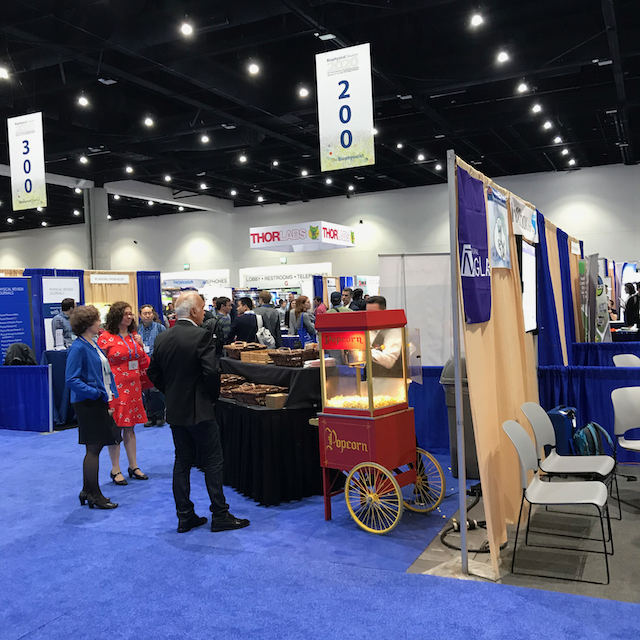
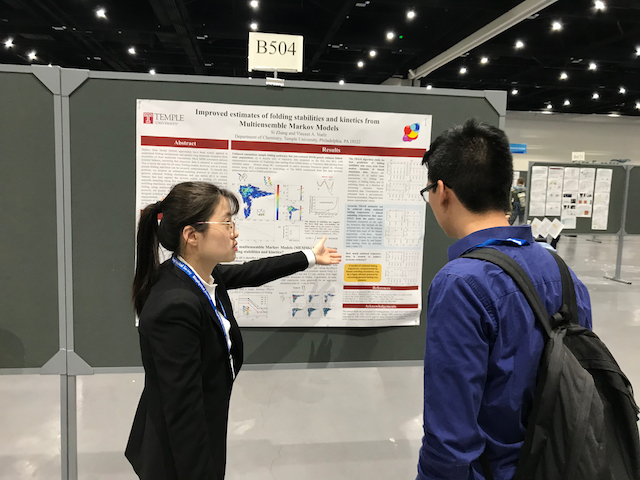
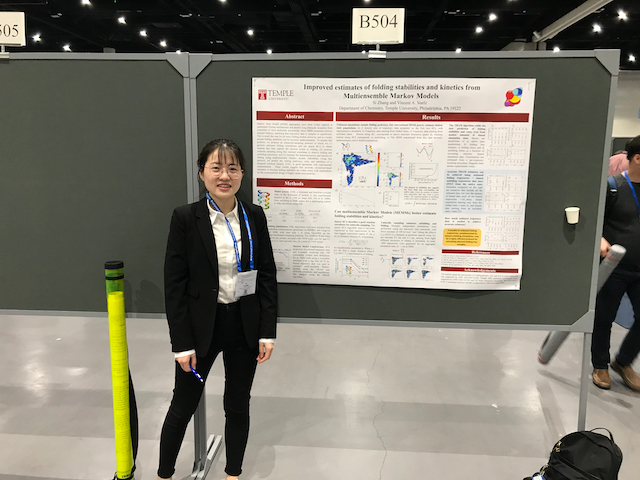
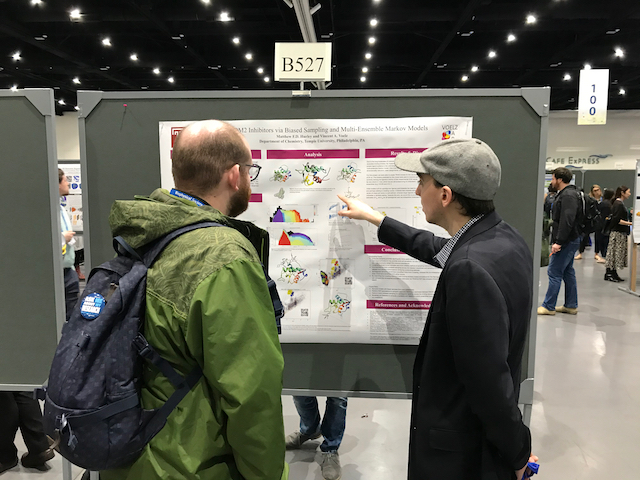
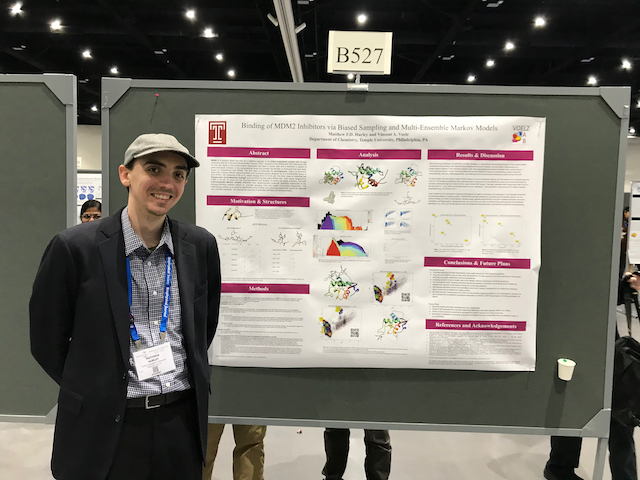
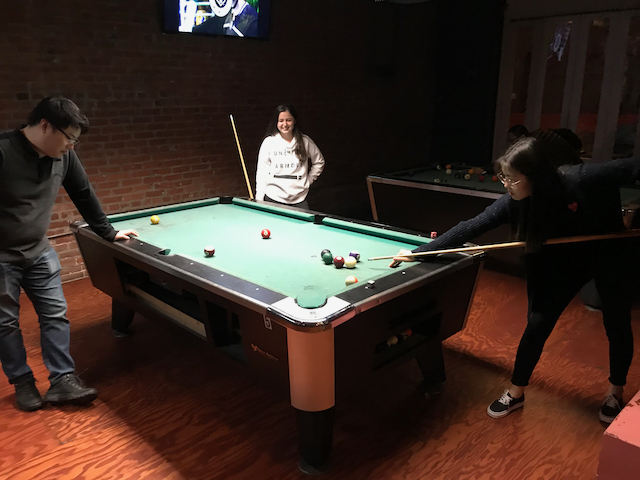
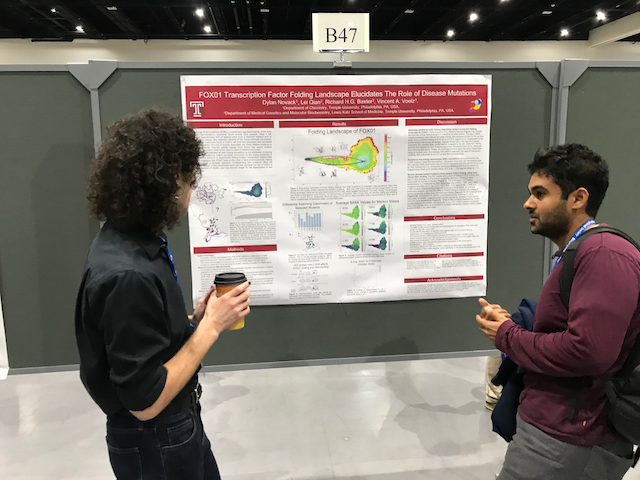
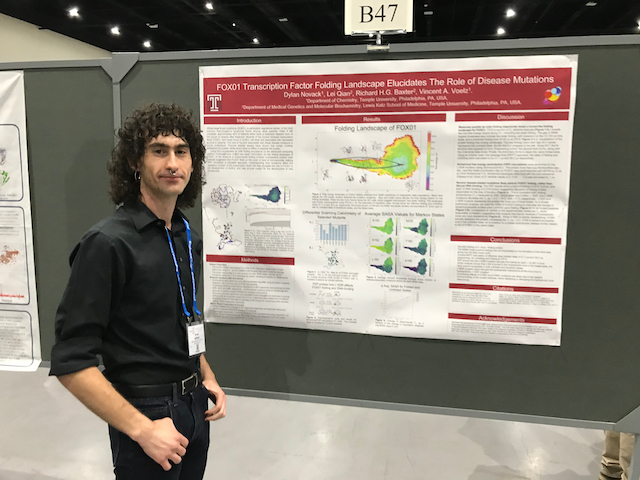
The Voelz Lab made an unprecedented showing at the 64th Annual Meeting of the Biophysical Society in San Diego last week, with eight of us attending! Congratulations to everyone on their presentations! It’s very exciting to see all of the great science coming out of our lab.
Presentations:
- “BICePs 2.0: new tools for Bayesian Inference of Conformational Populations from Theory and Experiment”. Yunhui Ge, Robert M. Raddi and Vincent A. Voelz
- “Efficient estimation of binding kinetics using scaled non-bonded interactions and harmonic restraints”. Yunhui Ge and Vincent A. Voelz
- “Using Molecular Simulation to Understand the Role of Conserved Residues in an Extremophilic Beta-galactosidase”. Shahlo Solieva and Vincent A. Voelz
- “Markov State Model approach to estimating rates and mechanisms of VSL12 peptide to Src-family kinase SH3 domains”.
Robert M. Raddi and Vincent A. Voelz - “Binding of MDM2 inhibitors via Biased Sampling and Multi-Ensemble Markov Models.” Matthew F. D. Hurley and Vincent A. Voelz
- “Improved estimates of folding stabilities and kinetics from Multiensemble Markov Models”. Si Zhang and Vincent A. Voelz
- “FOX01 transcription factor folding landscape elucidates the role of disease mutations”. Dylan Novack, Lei Qian†, Richard H. G. Baxter†, and Vincent A. Voelz