New Organic Letters paper on peptoid oligomer folding

In collaboration with Jiwon Seo‘s group at GIST, we are pleased to be co-authors on a Just Accepted manuscript in Organic Letters:

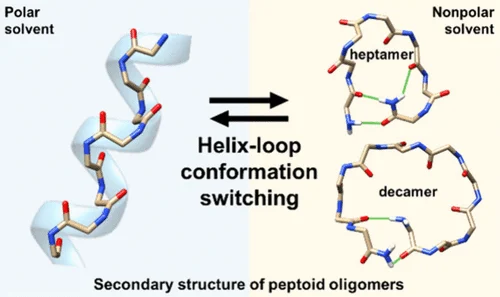
Noncanonical Folding of Peptoid Oligomers: Formation of a Closed Conformation in Nonpolar Solvent. Jinyoung Oh, Min June Yang, Xingyu Chen, Juhye Shin, Bradley S. Harris, Robert M. Raddi, Suhyun Park, Marcel D. Baer, Hohjai Lee, Chin-Ju Park, Vincent A. Voelz, and Jiwon Seo. Organic Letters, ahead of print, June 22, 2026. https://doi.org/10.1021/acs.orglett.6c02040.

Peptoids (N-subsituted oligoglycines) are versatile peptide mimetics that can fold into specific three-dimensional structures.

In this work, the Seo group used extensive NMR spectroscopy to study an number of N-(S)-1-phenylethylglycine (Nspe) oligomers in chloroform. Nspe homooligomers were already known to form helices in polar solvent, and an Nspe nonamer to form a “threaded loop” structure in acetonitrile. After systematically investigating a series of oligomers (Nspe)n ranging from lengths n=3 to n=12, the Seo group surprinsgly found evidence that (Nspe)7 and (Nspe)10 folded to distinct conformations in chloroform.

To solve the structure of the folded peptoids, we performed Hamitonian replica exchange molecular dynamics simulations with NMR-derived distance restraints using GROMACS, followed by conformational clustering and reweighting of simulated ensembles agasint the experimental data using the BICePs algorithm. For the force field , Marcel Baer’s group at PNNL provided the excellent STEPs-SOL, a peptoid-specific parameterization of GAFF that includes solvent effects.

The BICePs results reveal structures of (Nspe)7 and (Nspe)10 in chloroform reminiscent of the “threaded loop” structure, stabilized by end-to-end interactions that mask polar surfaces, with specific patterns of cis and trans amides along the chain. This chameleonic behavior (folding to different structures in polar vs. nonpolar media) is characteristic of macrocyclic compounds that can permeate membranes, and indeed, PAMPA measurements show marginal membrane permeability for (Nspe)7.

This work adds to the growing catalog of peptoid sequences with folded structures. A long-term hope is that continued elaboration of sequence-structure relationships for peptoids, using a combination of simulation and experiment, will lead to better (and perhaps AI-enabled) computational algorithms to design peptoids with specific molecular architectures and functions.

Voelz Lab receives R35 MIRA award from NIGMS

We are happy to report that our lab has ben awarded funding for the next five years though the National Institutes of Health MIRA (Maximizing Investigators’ Research Award) program (1R35GM163789). This funding will support our work using deep learning and molecular simulation to model conformational ensembles, dynamics and binding interactions.

New JCIM paper on optimizing alchemical intermediates

Excited to share work now out in Journal of Chemical Information and Modeling :

Novack, Dylan, Robert M. Raddi, Si Zhang, Matthew F. D. Hurley, and Vincent A. Voelz.Simple Method to Optimize the Spacing and Number of Alchemical Intermediates in Expanded Ensemble Free Energy Calculations. Journal of Chemical Information and Modeling 65, no. 12 (2025): 6089–6101. https://doi.org/10.1021/acs.jcim.5c00704

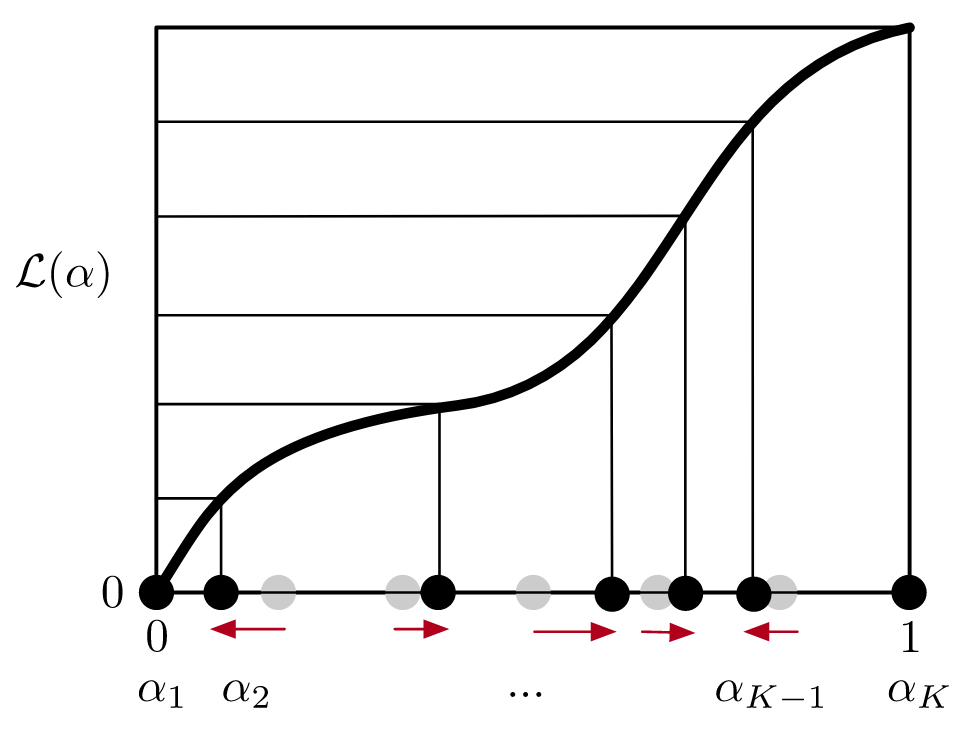
First, we estimate the thermodynamic length between intermediates using a short expanded-ensemble (EE) simulation, and then use a cubic spline fit to do gradient-based optimization of the spacing.

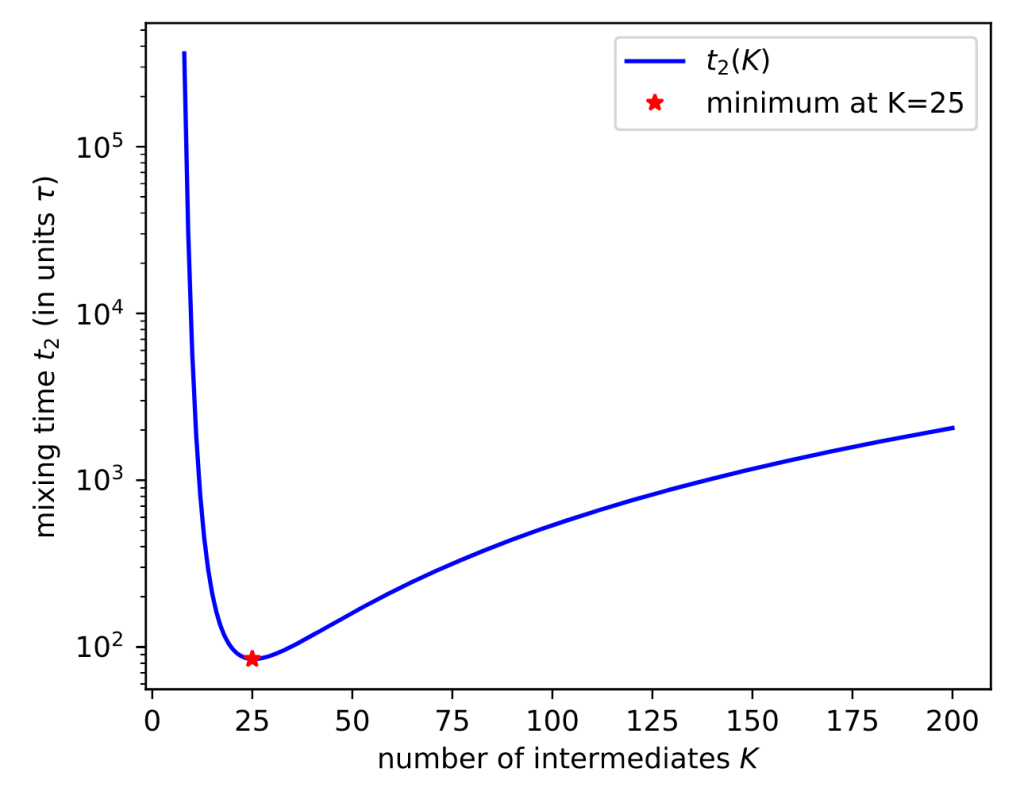
Using the same approach, we also optimize the number of intermediates used in EE simulations, which sample all intermediates during a simulation by proposing/accepting transitions between ensembles using Monte Carlo. Modeling this Markov process reveals the optimal number of intermediates that minimize the mixing time.

Here’s a result for a toy system of 1D harmonic potentials:

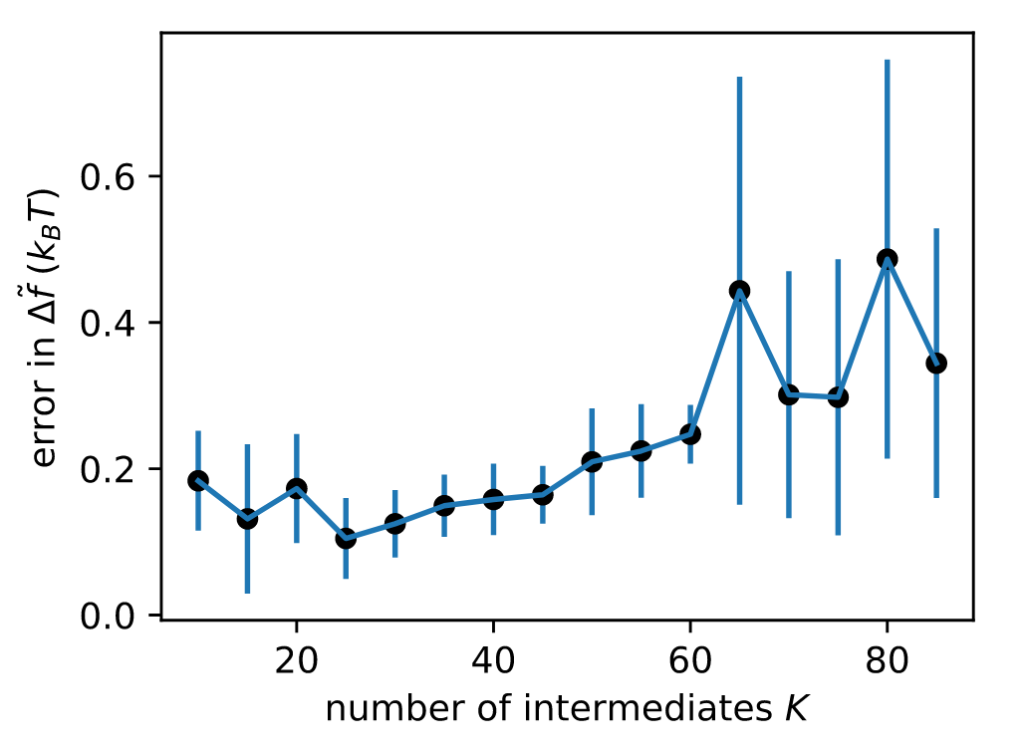
More mixing leads to smaller uncertainties. Sure enough, EE sampling with the optimal number of intermediates (K*=25) gives the lowest uncertainty.

Does it work in realistic systems?  You bet!   Here’s a relative binding free energy calculation where we alchemically transform Ala to Phe using pmx in GROMACS.  Optimized intermediates yield EE simulations that converge faster to accurate estimates.

Want to try it yourself? Check out our freely available Python scripts at https://github.com/vvoelz/pylambdaopt

We also note that this approach should also work well for other methods using exchanges between thermodynamic ensembles (REMD or HREX), with some adjustments. It could also improve uncertainties in NEW.  If you are interested, let us know!

–Vincent Voelz

Highlights from 2024

2024 has been quite a busy year, yet somehow I’ve managed to avoid posting anything! Here’s a round-up of some of the many facets of the lab from 2024 (so far):

  • January 2024: Chemistry PhD student Starwing Chen joins the Voelz Lab — welcome Starwing!
  • February 10–14, 2024: The Biophysical Society Annual Meeting comes to Philadelphia. Five Voelz Lab members attend, four present!
  • March 17–20, 2024: Dylan Novack and PI Vincent Voelz give dueling talks (same time, different sessions) at the American Chemical Society Spring Meeting in New Orleans, LA. Dylan’s talk: “Can massively parallel free energy calculations improve in silico affinity maturation of de novo designed miniproteins?” (COMP Drug Design session) Vince’s talk: “Multi-ensemble Markov Model approaches for folding, binding, and design” (COMP invited symposium on Markov State Modeling of Conformational Dynamics in the Wake of Machine Learning)
  • May 6, 2024: Robert Raddi gets a Ph.D! His thesis, “A Bayesian Inference/Maximum Entropy Approach for Optimization and Validation of Empirical Molecular Models” is focused on major theoretical advances to our BICePs algorithm and its applications. Congratulations Rob!
  • May 23, 2024: Chemistry grad student Julie Nguyen advances to candidacy with a successful defense of her Original Research Proposal “Exploring the Mechanism of Molecular Glues in Modulating CRBN’s Selectivity in CK1α Degradation Using Computational Methods”. Congrats Julie!
  • June 11, 2024: Dylan Novack gets a Ph.D.! Their thesis, “Molecular Simulation of Mutation Effects on Protein Folding and Function” focused on Markov model and alchemical free energy approaches made possible though distributed computing on Folding@home.
  • July 2024: PI Vincent Voelz is promoted to Full Professor of Chemistry at Temple University.
  • August 2024: Starwing Chen presents a poster and flash talk at the 12th Peptoid Summit: “Benchmarking peptoid force fields against solution NMR data”
  • September 2024: Temple Bioinformatics Ph.D. student Jason Cargill joins the lab — welcome Jason!
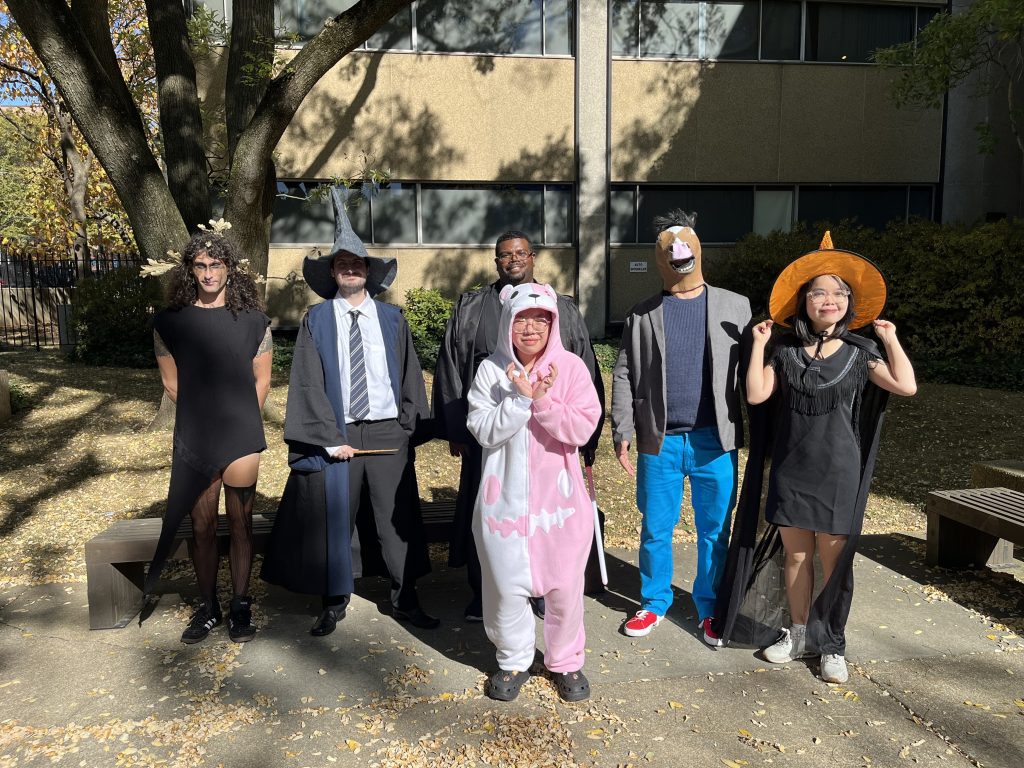
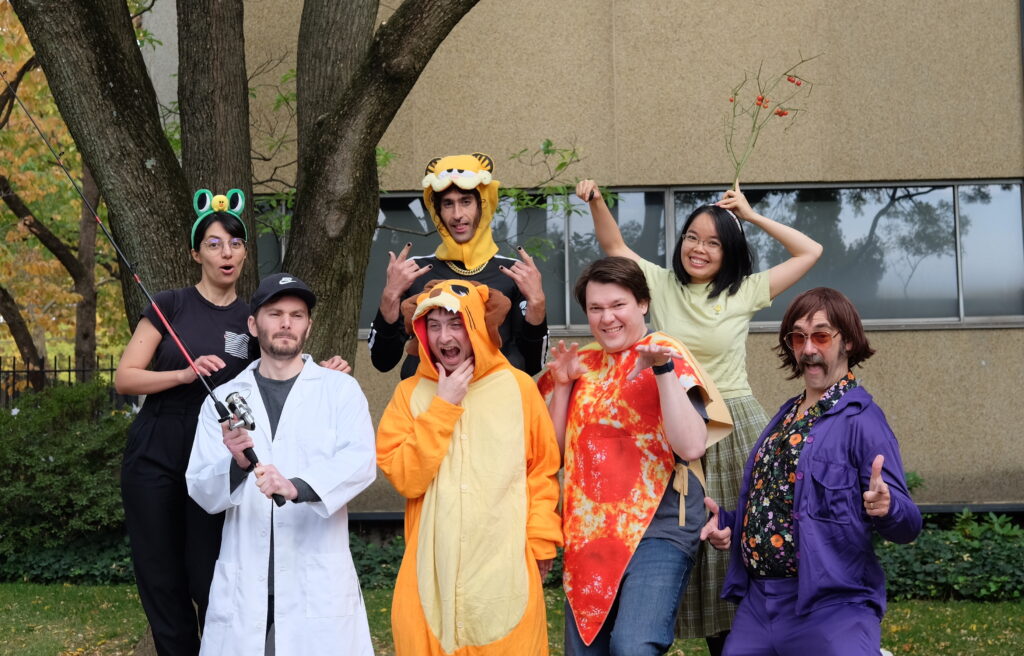
  • October 2024: The Annual Voelz Lab Halloween Group Meeting is a unmitigated success.

Happy Halloween from the Voelz Lab!

New paper in Biochemistry

We have a new paper out that has just been published in the journal Biochemistry, for inclusion in a special issue “Computational Biochemistry”. Check it out:

Improved Estimates of Folding Stabilities and Kinetics with Multiensemble Markov Models. Si Zhang, Yunhui Ge, and Vincent A. Voelz. Biochemistry, Biochemistry 2024, 63, 22, 3045–3056. https://doi.org/10.1021/acs.biochem.4c00573

Learn more from a Folding@home blog post that we wrote explaining our work! https://foldingathome.org/2024/11/16/better-folding-through-biased-simulations/

New FAH blog post: Predicting drugs’ lipophilicity with Folding@home

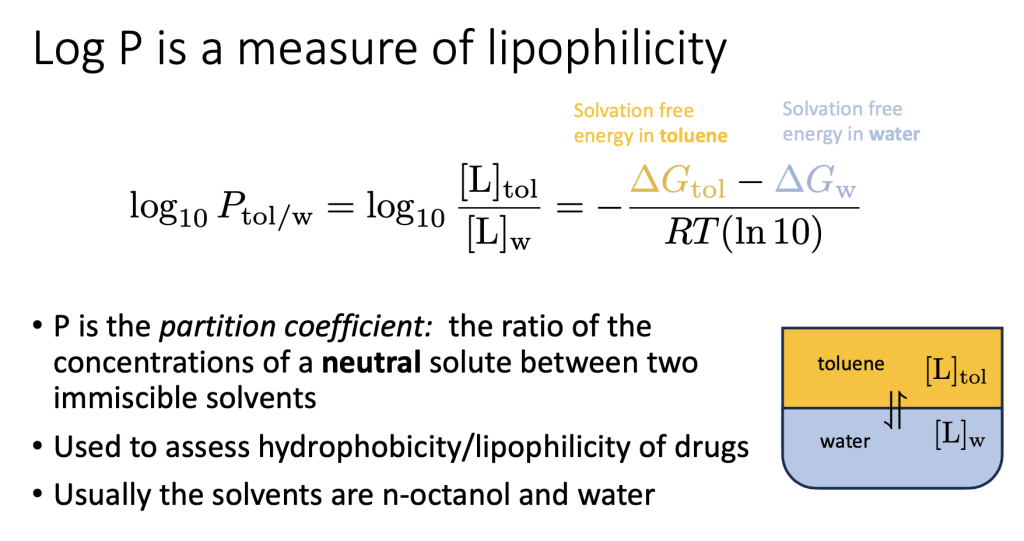
We wrote a new blog post on Folding@home! To accompany the release of a new preprint, we wrote an explainer about “logP” and our work using distributed simulations to estimate chemical properties for drug discovery. Check it out: https://foldingathome.org/2024/10/03/predicting-drugs-lipophilicity-with-foldinghome/

Expanded ensemble predictions of toluene–water partition coefficients in the SAMPL9 LogP challenge. Steven Goold, Robert M. Raddi, and Vincent A. Voelz. ChemRxiv https://doi.org/10.26434/chemrxiv-2024-rfkkp

Tim gets a PhD!

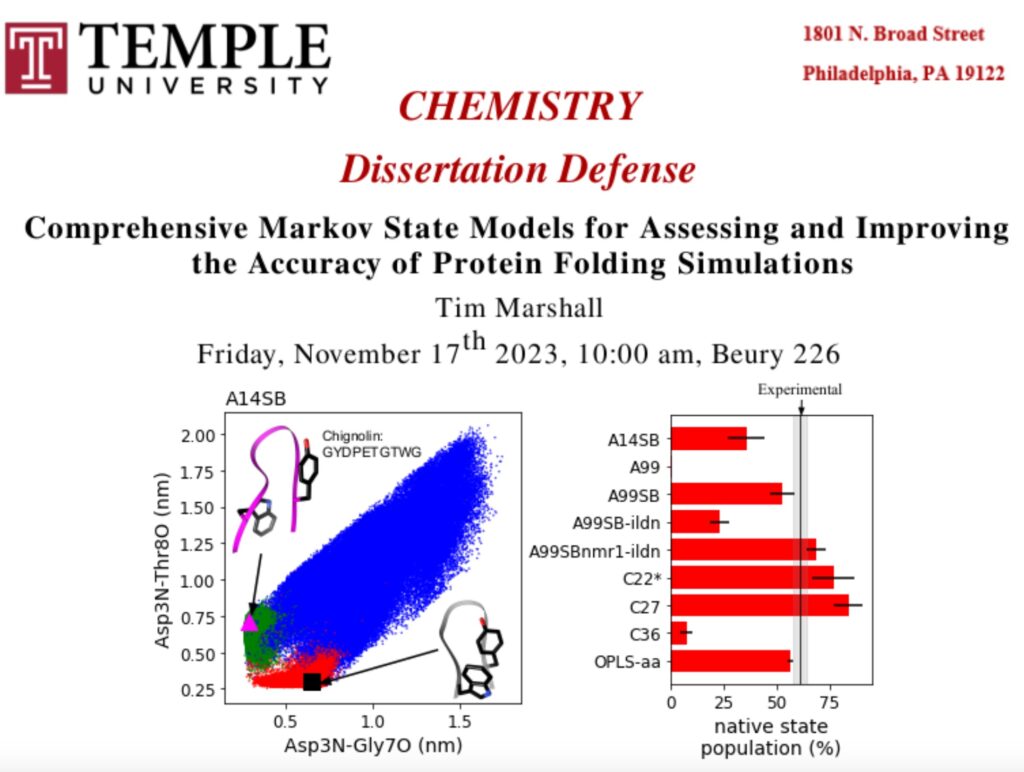
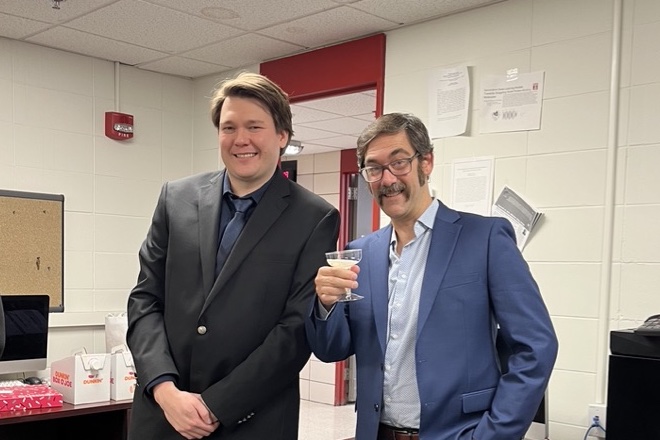
On Friday, November 17, Tim Marshall successfully defended his Ph.D Thesis “Comprehensive Markov State Models for Assessing and Improving the Accuracy of Protein Folding Simulations”.

Tim’s work has focused on using MSMs as a platform for evaluating force fields and for examining the ability of molecular simulations to quantitatively predict how mutations affect folding stability, toward the prospect of simulation-based virtual screening for protein design. Tim is still preparing several manuscripts describing this work, so stay tuned for preprints.

Congratulations Tim!

New preprint on BICePs with Replica-averaging

Our new preprint just dropped on ChemRxiv:

Model selection using replica averaging with Bayesian inference of conformational populations.
Raddi RM, Marshall T, Ge Y, Voelz V. https://doi.org/10.26434/chemrxiv-2023-396mm

In this work, we describe and demonstrate with examples how equipping our BICePs algorithm with a replica-averaged forward model makes it a Maximum-Entropy reweighting method with some key advantages:

  • It is a post-processing method that does not require restraints implemented inside simulations
  • Heuristic estimates of uncertainty are not needed; posterior sampling enables learning uncertainties from the data
  • BICePs has improved likelihood models to account for outliers
  • The BICePs score can be used for objective model selection
  • Automated force field and forward model parameterization can be performed using the BICePs score as an objective function.

I recently spoke about this work at the ACS Fall 2023 symposium “Emerging Techniques to Quantify Biomolecular Conformational Ensembles” symposium.