By J. Stephen Bergquist
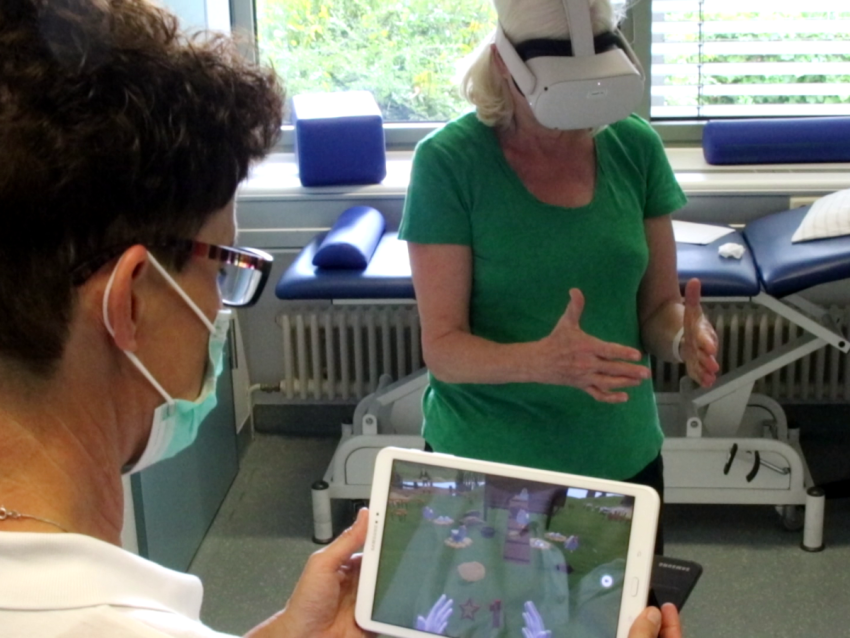
Can you imagine getting a medical prescription for playing video games? It’s more likely than you think! Some pioneering clinics are making physical rehabilitation fun by translating prescriptive movement tasks into movement-controlled video games.
Why turn therapy into a game? It is a public health strategy to increase patient compliance with therapy homework. The sad truth is that most patients who are tasked with performing daily at-home rehabilitation exercises simply don’t do them. If the rehabilitation assignment is a fun game rather than a printout of instructions, hopefully more patients are inspired to spend a small piece of their day following their doctor’s orders.
For my Graduate Externship research project at the Scholar’s Studio, I’m creating an open-source smartphone-based rhythm game for gait rehabilitation. “Gait” is the technical term for how you walk, so gait rehabilitation aims to make people more effective walkers. People may require gait therapy after an injury or due to a neuromotor condition that affects the lower body. Common goals of gait therapy include removing a limp, walking faster, and improving stability.
The concept of this rhythm game is to take proven gait therapy techniques and translate them to a video game format. Imagine a simplified version of Guitar Hero or Dance Dance Revolution where, instead of clicking buttons or tapping a screen to play, you earn points by matching the timing of your steps to the beat of a music track as you walk. Unlike a typical rhythm game, visual cues won’t be necessary. Because it’s a smartphone application, this can be done either on a treadmill or as the user walks outside in the real world.
Metronomes can be Medicine
Matching step times to music is a trivial task for a typical adult walker but is not so easy for anyone suffering from conditions like Parkinson’s Disease or stroke that cause weakness in one or both legs (Gonzalez-Hoelling, 2024). This app will be a gamified take on Rhythmic Auditory Stimulation, a proven gait rehabilitation technique for helping neuromotor patients walk faster and more symmetrically (Thaut, 2014).
People with neuromotor conditions like Parkinson’s Disease often benefit from music-based interventions because there is heavy overlap between brain regions that control movement and brain regions that interpret musical rhythm (Ye, 2022). Giving these affected walkers a clear timing target for steps activates brain areas like the basal ganglia that assist with walking, which explains why Rhythmic Auditory Stimulation is so beneficial for these populations.
Designing My Game
Basic gameplay will involve these elements –
- Game provides audio track
- Player walks, their steps are detected
- Steps are translated into video game inputs
- Game gives feedback based on performance
Thankfully, I do not have to build rhythm game software from scratch. There are several currently supported free and open-source platforms for rhythm games built by enthusiast developers that allow for using custom audio and beat maps (the “levels” of rhythm games). I currently plan to build this game using Osu, which operates natively in both PC and Android environments. This would solve elements 1 and 4 from my list.
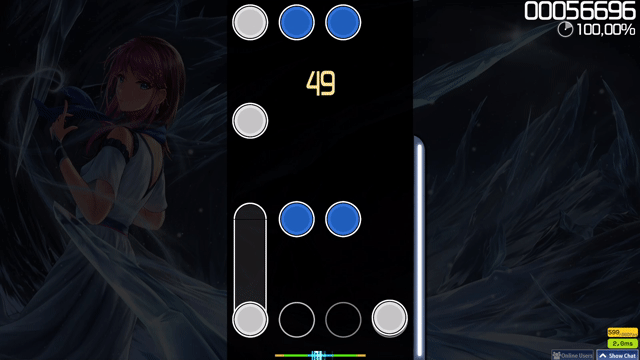
This leaves me to solve elements 2 and 3, which are detecting steps and translating them into game controls. With an eye toward being inexpensive and open-source friendly, I plan to build a Python-based application for smartphone devices to act as the pedometer (step-detector) for this game, which will also accomplish step three of translating steps into a signal that the game platform recognizes for inputs.
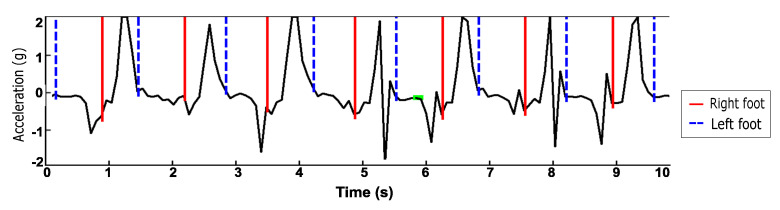
What do I expect will be my biggest hurdle? At a fundamental level, detecting steps is simple – you look for distinctive peaks in acceleration caused by the heel striking the ground. (See image below.) However, it is crucial to establish the correct sensitivity. A step-detector being either too sensitive or not sensitive enough can produce faulty results and lead to a frustrating game/therapy experience. The phone app may require an adjustable sensitivity function to be tailored to individual users.
Next Steps
If basic gameplay comes together quickly enough, I have a stretch goal of making the game adapt in real time to the user’s walking pattern. This reflects cutting-edge best practices in gait rehabilitation where the patient is always encouraged to walk with high step-to-step consistency but is allowed to gradually speed and slow their steps over time, which is how healthy walkers behave under ideal conditions.
The concept of turning Rhythmic Auditory Stimulus therapy into a rhythm game could take many shapes. While I am prototyping this as a phone application that is focused on the audio domain, perhaps this open-source digital infrastructure will find a future home in a visually stimulating game that someone could play while walking on a treadmill at home or in a clinic.
References
Thaut, M. H., & Hoemberg, V. (Eds.). (2014). Handbook of neurologic music therapy. Oxford University Press.
X. Ye, L. Li, R. He, Y. Jia and W. Poon, “Rhythmic auditory stimulation promotes gait recovery in Parkinson’s patients: A systematic review and meta-analysis,” Frontiers in Neurology, 2022.
S. Gonzalez-Hoelling, G. Reig-Garcia, C. Bertran-Noguer and R. Suñer-Soler, “The effects of rhythmic auditory stimulation on functional ambulation after stroke: a systematic review,” BMC Complementary Medicine and Therapies, 2024.