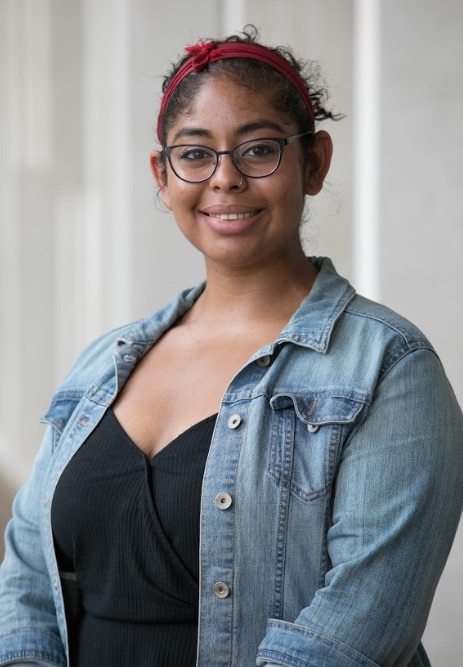
by Jasmine Clark
Hello Jasmine! Tell us a little about yourself.
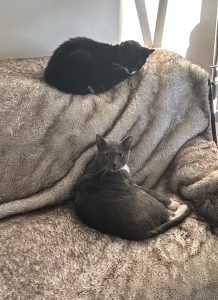
Hello! I went to Temple University for undergrad and double majored in art history and African American studies. I went on to complete my master’s at Drexel. I have 2 cats and often take care of my aunt’s dog, Talcum X. I hope to adopt another dog in the next couple of years; my last dog passed away from old age a couple years ago. I also love horror and sci-fi. I’m a big fan of the Alien and Predator franchises and really want to learn more about practical effect design.

What do you do at the LCDSS?
I’m the Digital Scholarship Librarian. I perform consultations, lead workshops, and host programming for students, faculty, and other TU staff. I generally collaborate with others in my department to help visitors think about how they can use the technologies, games, and tools we offer. In addition, I conduct research on the indexing and preservation of our digital assets. Since we produce so many non-traditional assets, it’s interesting to think about how we can circulate and preserve the work being done here.
What kinds of projects/technologies do you work with the most?
I run SketchUp workshops pretty regularly. SketchUp is a 3D modeling software for architecture. It has a free cloud version and is very beginner-friendly. I also work with Omeka, which is used for online exhibits. I work with VR in different research capacities and am currently leading the Virtual Blockson, a VR project a project that utilizes virtual reality (VR) to teach high school students primary source literacy using materials from the Charles L. Blockson Afro-American Collection (Blockson Collection). The Blockson Collection, part of the Temple University Libraries, is comprised of over 700,000 items related to the African Diaspora and includes a multitude of materials types such as books, sheet music, manuscripts, photographs, sculptures, and films. These materials cover a broad range of topics and time periods making them suited to gamification via a multi-modal medium like VR. In addition to the VR game itself, accompanying teaching guides, onboarding materials for teachers and players, and stand-alone 3D models will be created to situate the game within a broader social studies curriculum.
My VR work led me to research metadata and asset management for the different types of projects produced here. Because 3D assets seemed so challenging, I started there. I’ve been working on metadata standards and workflows for 3D data for a while now. 3D data is diverse and complicated. There are models created for artistic purposes, 3D simulations with multimedia components, and 3D scans like MRI’s, photogrammetric models, and even deep-sea scans created via underwater rovers. I’m currently leading a group that is trying to develop a tool to make metadata management for different types of 3D data easier and more straightforward. This will help make these data easier to find for reuse and ensure that crucial information about them isn’t lost, assisting in long-term preservation going forward.
In addition to these specific technologies and projects, I’m also heavily involved in accessibility for disability. Accessibility is a complicated topic in a space like this. There are guidelines for standard web content, but the technology we use in the LCDSS goes beyond that. While the disabled community has a well-established presence in the maker scene, technology tends to develop at a pace that excludes disabled users. I help manage the technology purchase process so that we are aware of the limitations and challenges these technologies face. I also help faculty, looking to integrate them into their teaching, think of ways to be more inclusive when doing so. I enjoy reading about new developments in technology by disabled developers and gamers.
What is your favorite type of technology to work with in the LCDSS?
I’m horrible at cutting things so I really appreciate the laser cutter. I’ve also been 3D printing more.
What project have you enjoyed working on/helping with the most?
My own! As I previously mentioned, I’m working on building a virtual reality (VR) game to teach high school students primary source literacy using materials from the Charles L. Blockson Afro-American Collection (Blockson Collection). This round of the game focuses on Black art of the early 20th century, a personal passion of mine. In addition to the VR game, I’m working with Dr. Tim Patterson in the College of Education to produce accompanying teaching guides and onboarding materials for teachers and players. Jordan Hample is our lead developer and we’ve received a grant from The Getty Foundation to build a prototype.
What’s an example of a time you’ve supported a student or faculty (or class) learning a new method that felt particularly successful and rewarding?
I’ve worked with Dr. Emily Neumeier, and other faculty in Tyler, to incorporate SketchUp and Omeka into their coursework. Students use floorplans, provided by Dr. Neumeier, to recreate whole architectural structures, or isolated architectural components, as part of their coursework. The students have produced some really amazing projects and I always enjoy seeing what they come up with.
What is your favorite thing to eat on campus?
For convenience, I grab a slice at Maxi’s. Otherwise, I eat at Honeygrow. I’m a sucker for a kale salad with lots of jalapenos.
What game are you most enjoying playing right now?
I just started playing Betrayal at House on the Hill with friends. It’s proven to be a lot of fun. There’s a Pennywise expansion that I’m looking forward to trying. When we’re not physically together, we look into multi-player games like Bigfoot.
What technologies are you most excited to learn more about at the LCDSS?
I am spending more time in the makerspace. I want to learn more about electronics at some point.