By Ye Ju Ki
From Screen, Forum, to Spreadsheet: Building the Metadata
In the recent Netflix series, Sex Education, Florence Simmons says that she “might be broken” because she doesn’t want to have sex at all. In response, Dr. Milburn introduces asexuality and validates how Florence is feeling: “It’s when someone has no sexual attraction to any sex or gender. Sex just doesn’t do it for some people. […] Some asexual people still want romantic relationships, but they don’t want the sex bit. And others don’t want either. You know, sexuality is fluid. Sex doesn’t make us whole. And so, how could you ever be broken?”
In terms of openness to discussing asexuality on television, this conversation in a 2020 TV show has come a long way since Gregory House from Dr. House in 2012 called people who don’t want to have sex “sick, dead, or lying”, after an asexual patient was shown to have a tumor growing in his brain, lowering his libido and causing erectile dysfunction.
This recent shift from discussing asexuality as a pathological mystery to offering asexuality as a valid sexual orientation represented a victory for the asexual community, and yet, it is only a partial one. According to the Where We are on TV reports published by GLAAD, there have been less than ten asexual characters represented on cable networks and streaming services between 2017 and 2025. To name a few, they are Raphael from Shadowhunters, Todd Chavez from BoJack Horseman, Drea from Everything’s Gonna Be Okay, Greta from genera+ion, Elijah from Big Mouth, Ca$h from Hearbreak High, Issac from Heartstopper, and Florence Simmons and O from Sex Education.
Inspired by the scarcity of asexual characters readily available in contemporary media, I am gathering explicit and implicit asexual characters scattered across popular media. In my previous post, I explained the general scope and goal of my Scholars Studio fellowship project. In this post, I explain the workflow of compiling a structured list of asexual characters in film and television, in order to build a dataset that could be visualized on an interactive website. Here are the steps I took to create metadata for building an online archive:
- Step 1: Scraping data using Web Scraper from various lists and websites, including AVEN World Watch Archive, Wikipedia, LGBTQIA+ Characters Wikia, and LezWatch, for gathering discussions online
- Step 2: Cleaning the scraped data using OpenRefine and coding the data using ATLAS.ti
- Step 3: Creating a dataset description and filling in the spreadsheet, for organizing the data into a structured list
Scraping Data from AVEN
I started with the Web Scraper to bring together lists of and discussions on asexual characters in media. The Web Scraper does not require any coding, and it is available as a Chrome extension. While I scraped available lists on Wikipedia, LGBTQIA+ Wikia, and LezWatch using the Web Scraper, I mainly referred to AVEN’s World Watch forum as the main part of the metadata, as it contained the most lively and extensive discussions on media portrayals of asexuality. For my research project, I informed and obtained permission from the AVEN Project Team, in compliance with the community’s guidelines and their rules for using AVEN for research.
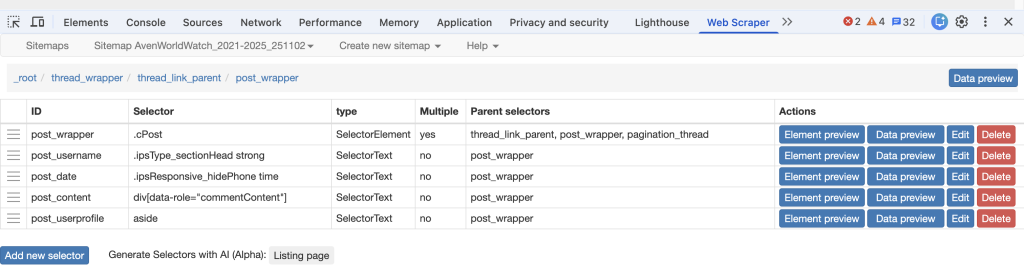
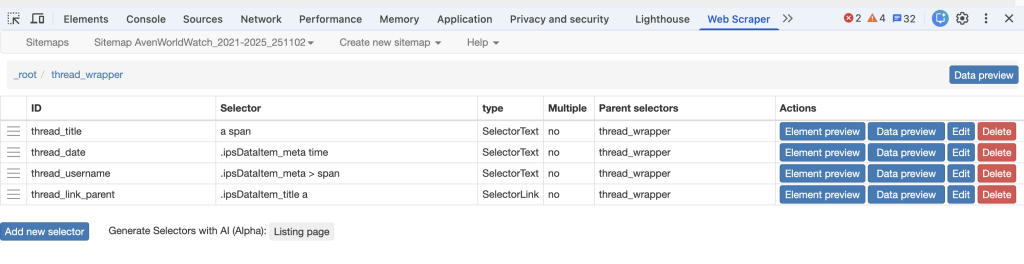
Instead of relying on the Web Scraper’s automated AI Wizard, I used the Advanced Sitemap Builder, so I could build a more detailed sitemap for navigating the AVEN forum with over 12,000 posts. While I had to familiarize myself with elements like “wrapper” and “parent-child” to build a sitemap, the Web Scraper was an easy and straightforward tool for scraping organized data from websites. I first analyzed how the forum was structured between posts, threads, and pages, so I could map out a path for the scraper to follow. I then defined and designated different elements I wanted to scrape in each post on a sitemap. Once the data was scraped, I exported them as CSV files.
Cleaning and Coding the Scraped Data
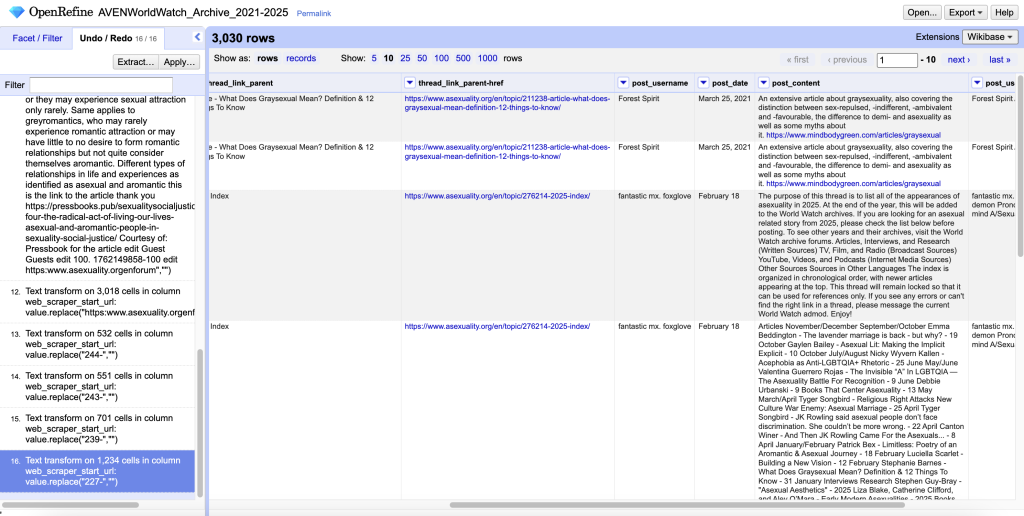
Once the scraped data was exported as CSV files, I cleaned them using OpenRefine to get rid of unnecessary elements, columns, and texts from the CSV file. For instance, I removed the pagination column and unnecessary spaces in each cell, using the “text transform” function in OpenRefine. This was crucial for making the following steps easier, considering the amount of data in the spreadsheets.
After the scraped data was cleaned, I exported them as CSV files, so I could code each post. While it was quite a tedious step to manually code each post, this was a necessary step for categorizing the asexual characters, turning posts into a structured list, and possible data visualization. I also needed a point of reference and to be able to locate the exact post each character was mentioned in, in case I needed to refer back to the post for more details.
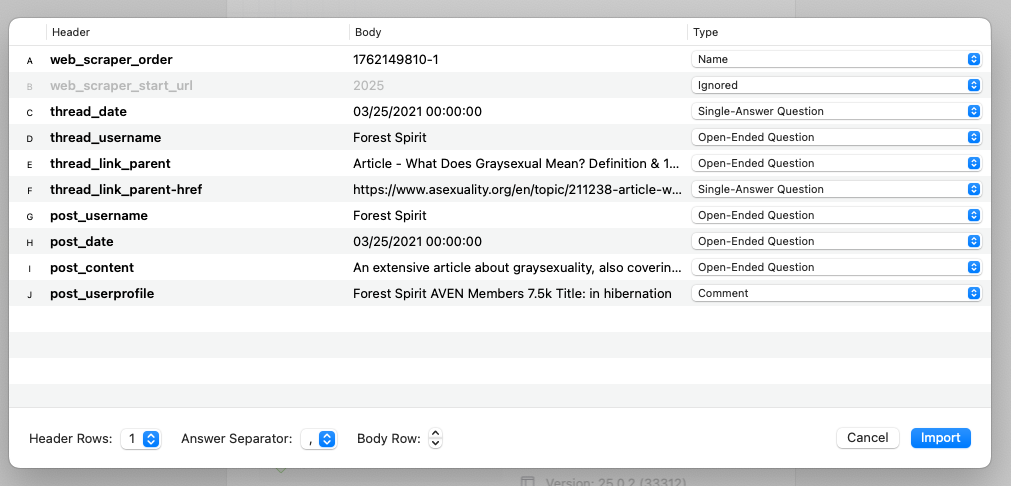
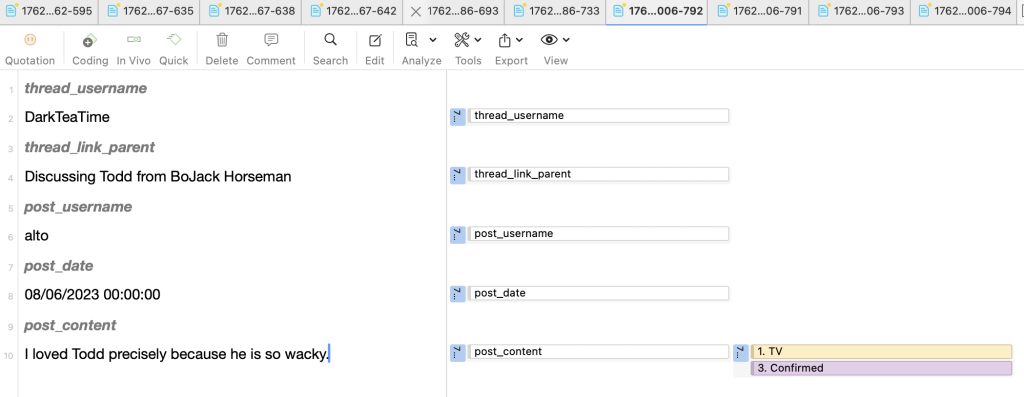
I started with importing the cleaned data into ATLAS.ti as survey data, so that each post in its respective row would be read as a survey response. Then, I proceeded to go through each post and code them manually based on the type of media (television, film, audio drama, book, comics, game, manga, YouTube, and research article) and asexuality status (confirmed and speculated).
Metadata Profile and Completing the Metadata
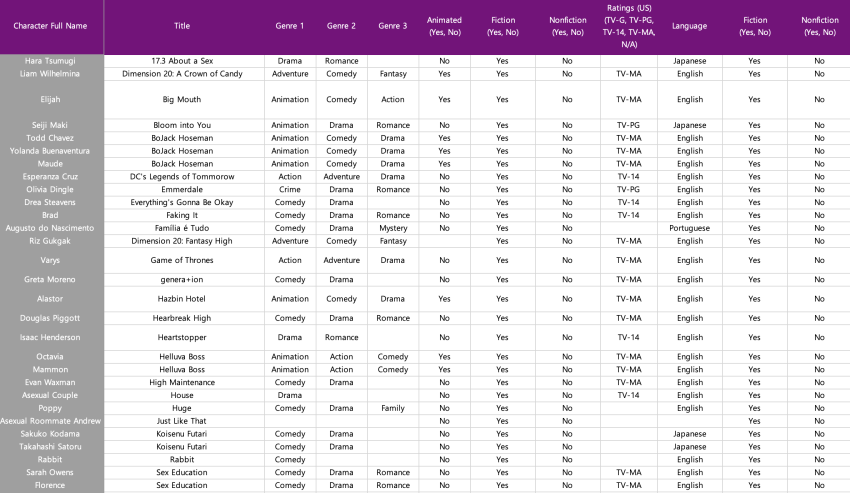
During the process of coding, I also developed a detailed metadata profile to determine which data would be meaningful for creating an archive dedicated to asexual characters in media. The goal was to move beyond simply listing basic information about each asexual character like character names, release years, and genres.
The metadata profile included factual data, interpretative data, and character data. Factual data refers to objective data about each character, Interpretative data refers to data on how asexuality is represented through the character, and character data refers to data related to each character’s asexuality.
Based on the metadata profile and the dataset descriptions, I started filling out the cells in the spreadsheet. This was a manual process of looking up each character online, watching relevant television shows and films, and referring to respective Wikipedia and IMDb pages.
From Metadata to Website: Building an Online Archive
While I am still coding and completing the metadata, I have started working on the final step: designing and creating a website that would function as an online archive that is crowdsourced and accessible to the public. Utilizing both Python and AI-assisted coding through Claude Code, I am building a website that uses the Hugo framework to host and visualize the list of asexual characters in film and television.
The website is still in its infancy, but once completed and launched, it will provide a valuable resource for people on the asexual spectrum by making the dataset publicly available and readily accessible. Moreover, it will serve as an online space for visualizing the invisible orientation and fostering a community. For now, the dataset only includes asexual characters from film and television, but I hope to expand it to include asexual characters found in other types of media, such as video games and literature.