
The TULUP AI Community of Practice gathered this month to talk about our activities around generative artificial intelligence. I asked the group, “Are you seeing changes in how instructors or students are using AI?” Van Bich Tran, Public Health and Social Sciences Librarian, was the first to speak up, describing the changes she’s seen in student feedback on AI tool usage.
Van shared her data and her approach to understanding the library resources and services students are using. She incorporates these findings for more effective class instruction and more targeted consultations. Through these assessments she’s also able to gauge trends in the use of AI tools.
As the liaison to Public Health, Van supports the Masters in Public Health Fieldwork Capstone class. Before one on one meetings, Van surveys each student. She asks about the use of library resources and services. Has a librarian met with their class? Have they used a library libguide? What is their awareness of the library databases and search tools relevant to their discipline? What search strategies do they use?
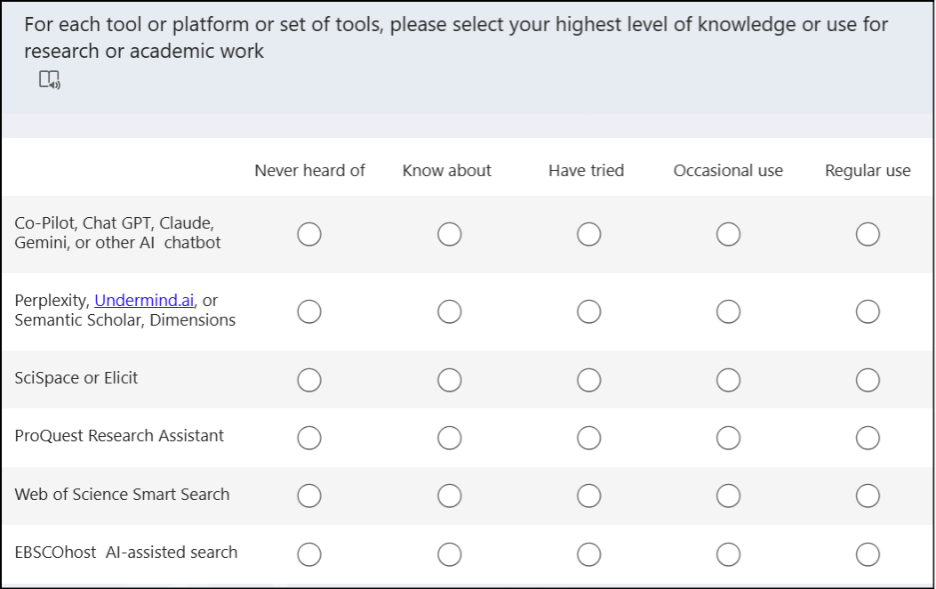
Van also includes a question related to AI tool awareness.
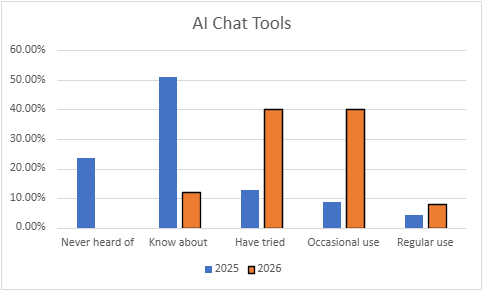
We see at least two interesting things. In 2025, over 23% of students had never heard of AI tools like Chat GPT or Co-Pilot. The following year, that is 0%, while occasional or regular use is 48%.
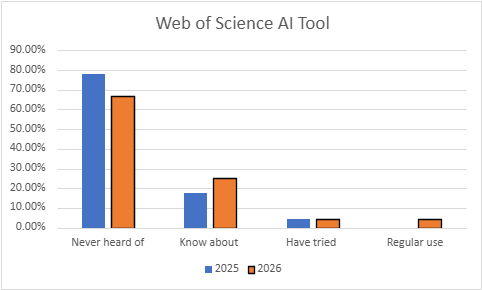
Another important finding was that while students were familiar with generative AI tools like ChatGPT or Gemini, they were less aware of the AI tools embedded in general databases like EBSCO and ProQuest, much less familiar with those in more specialized databases like Web of Science – important tools for graduate students in public health.
Van has developed an array of forms designed to support her various teaching interactions. Prior to class instruction, she surveys the class on their use of the library resources and search strategy. She also conducts post-instruction surveys. And as described above, she gathers data prior to one-on-one consultations.
As a social scientist herself, Van is very intentional about the questions she asks so findings are actionable. She shares with her students her general findings, and how those translate into what she is teaching.
While library staff engaged in instruction all conduct regular assessment, Van’s effort stands out. Students’ search behaviors are changing rapidly. Tracking on their strategies is ever more essential to our effectiveness towards navigating this complex information environment.