Skip to content

Loretta C. Duckworth Scholars Studio

⠀

Menu
  • Scholars Studio Blog
    • Digital Methods
      • coding
      • critical making
      • data visualization
      • digital pedagogy
      • immersive technology (AR/VR)
      • mapping
      • textual analysis
      • web scraping
    • Disciplinary Fields
      • Anthropology
      • Archaeology
      • Architecture
      • Art History
      • Business
      • Computer Science
      • Critical Digital Studies
      • Cultural Studies
      • Dance
      • Economics
      • Education
      • Environmental Studies
      • Film Studies
      • Gaming Studies
      • Geography
      • History
      • Information Science
      • Linguistics
      • Literary Studies
      • Marketing
      • Media and Communication Studies
      • Music Studies
      • Political Science
      • Psychology
      • Public Health
      • Sculpture
      • Sociology
      • Urban Studies
      • Visual Art
    • Cultural Analytics Practicum Blogposts
  • Current Staff
  • Newsletter
  • About
    • Games Group 
Menu

Impressions in the Land: An Exploration of Digital Modeling

Posted on January 22, 2019March 16, 2026 by Saragrace Stefan

Posted on January 22, 2019 by Vivien Wise

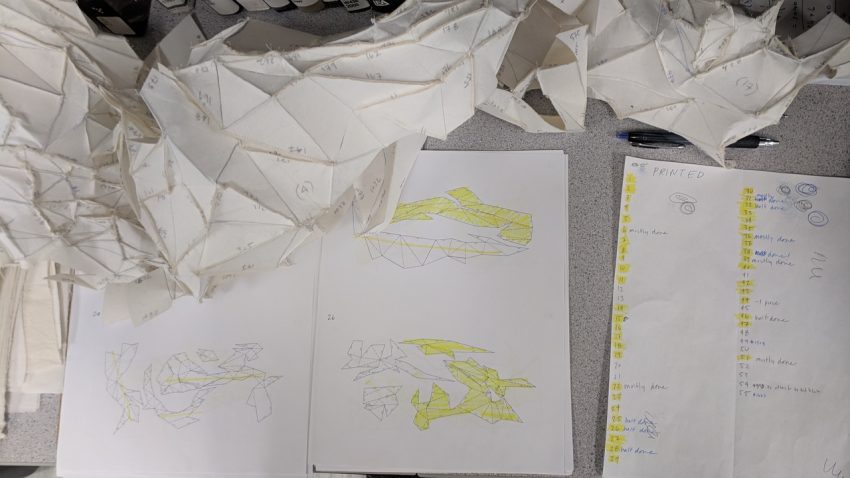
During the first semester of my fellowship in the Digital Scholarship Center, I focused on learning how to make a physical, fabric object from a digital, 3D model. In my last blog post I went over the process of figuring out a way to make this happen. You can read it here.

Now, I have more than just samples!

Modeling Myself in a Mountain

My goal was to create a three dimensional, fabric object that depicted my body embedded in a mountain range at human scale.

I started with a digital 3D model of myself (created using photogrammetry in the DSC) and a digital 3D model of a mountain range (pulled from Sightline Maps)
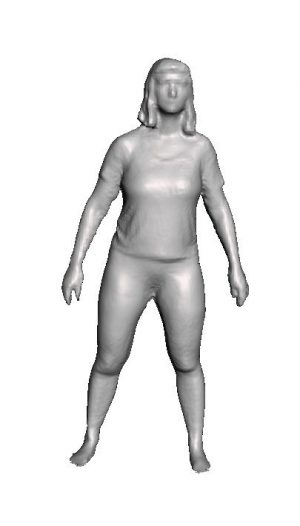
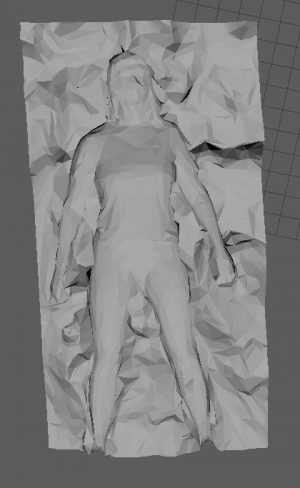
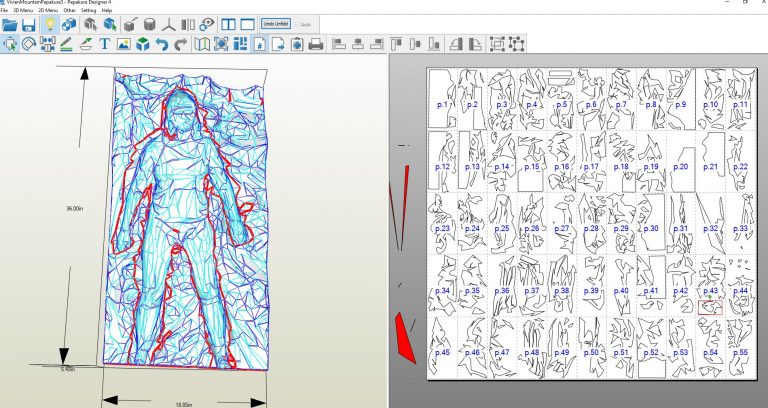
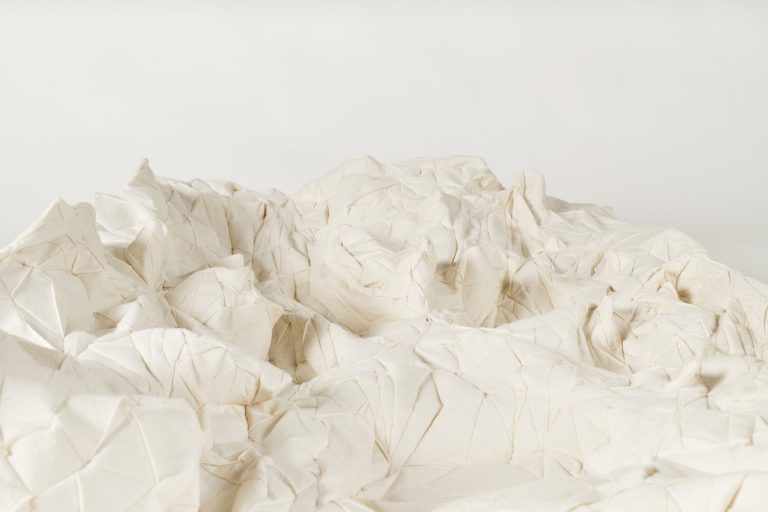
I used 3D modeling softwares Maya and Meshmixer to combine my body with the mountain range, creating an impression of me in the land; an additional topography in the mountainscape. I then imported the 3D model into Pepakura, where the application turned it into a flat pattern for me that could be saved as a PDF. The PDF provides a few different pieces of information — cut lines, fold lines (mountain and valley), and edge IDs (to match edge to edge). This took a fair bit of tweaking, to find the right number of pages and position all the shapes correctly.

Possibly the biggest game-changer in the whole process was that I realized I could set the PDF pages to 12” x 24”, the size of the laser cutter bed. Withy my parameters, Pepakura is able to create a PDF of all the cut lines in addition to a PDF with the fold lines and edge IDs. Once the PDF was completed, I prepared 55 pieces of cotton muslin with a stiff interface and ran them through the laser cutter. I then used a projector to trace the fold lines and transfer the edge IDs.
Sewing the Pieces

After all this prep work was done, I could finally start sewing! The thing I’ve been waiting to do all semester!

After this life size fabric mountain version of me was all sewn together, I built a cardboard frame to hold the sides up and then slid it on. This finished piece is approximately 6′ x 4′ x 1′.
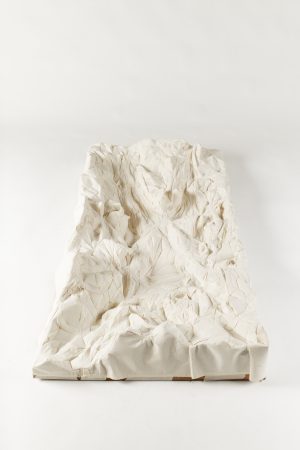
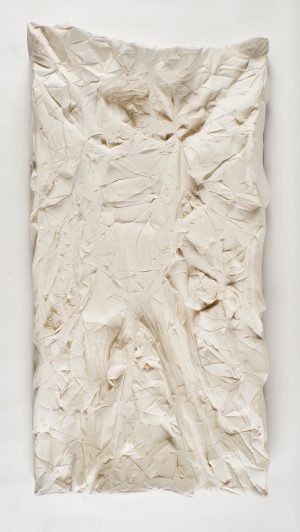
The idea behind this project came from asking myself how I find topographical intimacy (a term coined by Lucy Lippard). What does it mean to find intimacy within a landscape? How can I connect to the land? The mountains are a place with which I feel connected, grounded. This led me to considering a sort of self portrait within the land, an intimate embedding of myself within a topography. What would it be like if I could lie down amongst these bodies of land, like lying in tall grass but at a different and impossible scale? Is the topography of my body that different from the topography of these mountain bodies?

This piece would not have been conceived or constructed in this manner without my work in the Digital Scholarship Center. The way I came about this project is unique to a digital process that is not the standard way of creating 3D fabric objects, and is not necessarily the fastest way to accomplish the task. The outcome is unlike anything I would have considered prior to my time here and I’m excited about what it means for my art practice and upcoming projects.
Recent Posts

  • Envisioning Metamorphosis: Simulating Habitats of Worms with Point Clouds and Unity VFX Graph  April 20, 2026
  • Meet the LCDSS Staff – Jasmine Clark April 15, 2026
  • Building a Metadata for Asexual Representation in Media March 27, 2026

Tags

3D modeling 3D printing 3D scanning arduino augmented reality coding corpus building critical making Cultural Heritage data cleaning data visualization digital fabrication Digital Preservation digital reconstruction digital scholarship game design games gen con GIS linked open data machine learning makerspace makerspace residency mapping network analysis oculus rift omeka OpenRefine Photogrammetry physical computing Python QGIS R SketchUp stylometry text analysis text mining textual analysis top news twitter virtual reality visual analysis voyant web scraping webscraping

Recent Posts

  • Envisioning Metamorphosis: Simulating Habitats of Worms with Point Clouds and Unity VFX Graph  April 20, 2026
  • Meet the LCDSS Staff – Jasmine Clark April 15, 2026
  • Building a Metadata for Asexual Representation in Media March 27, 2026

Archives

Meta

  • Log in
  • Entries feed
  • Comments feed
  • WordPress.org

Archives

Blog Tags

3D modeling (19) 3D printing (20) 3D scanning (6) arduino (8) augmented reality (5) coding (11) corpus building (4) critical making (8) Cultural Heritage (10) data cleaning (4) data visualization (11) digital fabrication (3) Digital Preservation (3) digital reconstruction (9) digital scholarship (18) game design (3) games (7) gen con (3) GIS (3) linked open data (4) machine learning (6) makerspace (8) makerspace residency (4) mapping (30) network analysis (17) oculus rift (8) omeka (3) OpenRefine (4) Photogrammetry (8) physical computing (3) Python (8) QGIS (9) R (8) SketchUp (4) stylometry (8) text analysis (10) text mining (3) textual analysis (31) top news (99) twitter (5) virtual reality (22) visual analysis (5) voyant (4) web scraping (14) webscraping (4)

Recent Posts

  • Envisioning Metamorphosis: Simulating Habitats of Worms with Point Clouds and Unity VFX Graph  April 20, 2026
  • Meet the LCDSS Staff – Jasmine Clark April 15, 2026
  • Building a Metadata for Asexual Representation in Media March 27, 2026
  • Imperfect Archives: 3D Scanning Stories in Art Education March 24, 2026
  • Meet the LCDSS Staff – Hannah Tardie March 18, 2026

Archives

©2026 Loretta C. Duckworth Scholars Studio | Design: Newspaperly WordPress Theme