
Our new publication led by Caroline Merheb et al. (2026) in Environmental Research Letters. Smallholder agricultural growers and entrepreneurs play a vital role in global food systems, contributing nearly 30% of crop production and sustaining dietary diversity. Yet, these farms remain highly vulnerable to climate extremes like heat and drought, which threaten both livelihoods and food security.
Read: https://iopscience.iop.org/article/10.1088/1748-9326/ae6672
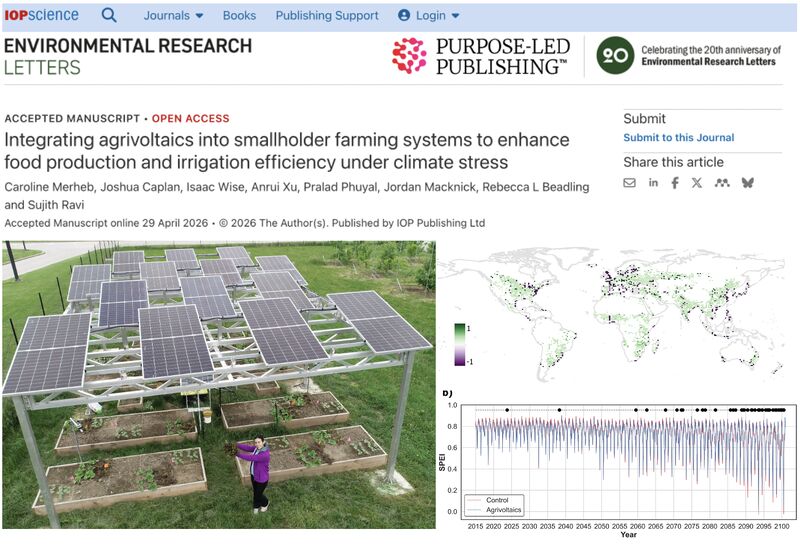
Our study, combining field experiments and global analysis, explores agrivoltaics—the co-location of solar panels and crops—as a practical solution for small-scale farms facing climate stress. By moderating heat and conserving water, agrivoltaic systems protected carefully selected high-value crops like leafy greens, boosted yields, and reduced irrigation needs.
Importantly, this approach can help expand agriculture into previously unsuitable areas and extend seasonal and geographic crop ranges, reducing losses from climate extremes in some areas.
Beyond resilience, agrivoltaics creates new income streams through decentralized solar energy—offering a scalable pathway to strengthen food security, support farmer livelihoods, and unlock multiple co-benefits from clean energy adoption