New Publication in ERL

Our new publication led by Caroline Merheb et al. (2026) in Environmental Research Letters. Smallholder agricultural growers and entrepreneurs play a vital role in global food systems, contributing nearly 30% of crop production and sustaining dietary diversity. Yet, these farms remain highly vulnerable to climate extremes like heat and drought, which threaten both livelihoods and food security.

Read: https://iopscience.iop.org/article/10.1088/1748-9326/ae6672
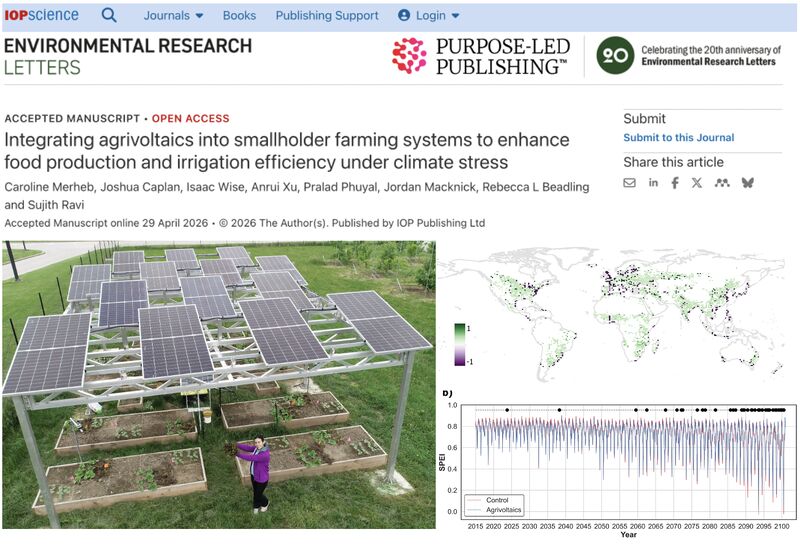

Our study, combining field experiments and global analysis, explores agrivoltaics—the co-location of solar panels and crops—as a practical solution for small-scale farms facing climate stress. By moderating heat and conserving water, agrivoltaic systems protected carefully selected high-value crops like leafy greens, boosted yields, and reduced irrigation needs.


Importantly, this approach can help expand agriculture into previously unsuitable areas and extend seasonal and geographic crop ranges, reducing losses from climate extremes in some areas.
Beyond resilience, agrivoltaics creates new income streams through decentralized solar energy—offering a scalable pathway to strengthen food security, support farmer livelihoods, and unlock multiple co-benefits from clean energy adoption
New Publication in npj Urban Sustainability

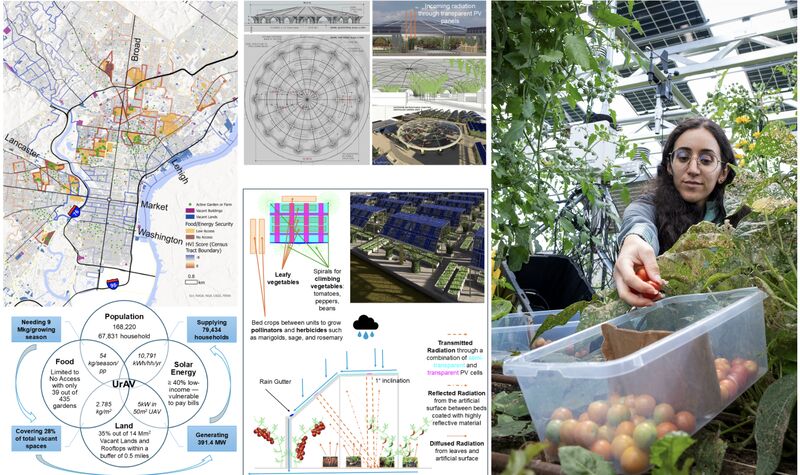
Our new study (Caroline Merheb et al., 2026, in @npj Urban Sustainability Nature Portfolio explores how integrating solar photovoltaics with urban agriculture can address two major urban challenges: food and energy insecurity. We conducted this research using a range of methods, including yield trials across multiple crops, sensor networks to evaluate microclimatic modifications, physiological measurements, nutrient quality analysis, and GIS-based assessments, to evaluate the potential co-benefits and trade-offs of this innovative approach.

Read; https://doi.org/10.1038/s42949-026-00381-6

The study, the first evaluation of ground-based urban agrivoltaics, shows that while early-season yields may decline in temperate climates due to reduced light, productivity rebounds during summer. This extension of harvest windows and increased crop resilience is especially beneficial in arid cities facing water stress.

Converting even a fraction of vacant land and rooftops to multi-use systems (solar PV, crop, pollinators) could generate renewable energy for thousands of households, while also improving access to fresh produce in urban communities. Beyond that, urban agrivoltaics provides additional co-benefits, including the creation of green community spaces, reduced urban heat vulnerability, and more decentralized, resilient energy systems.

New Publication in Water Research !

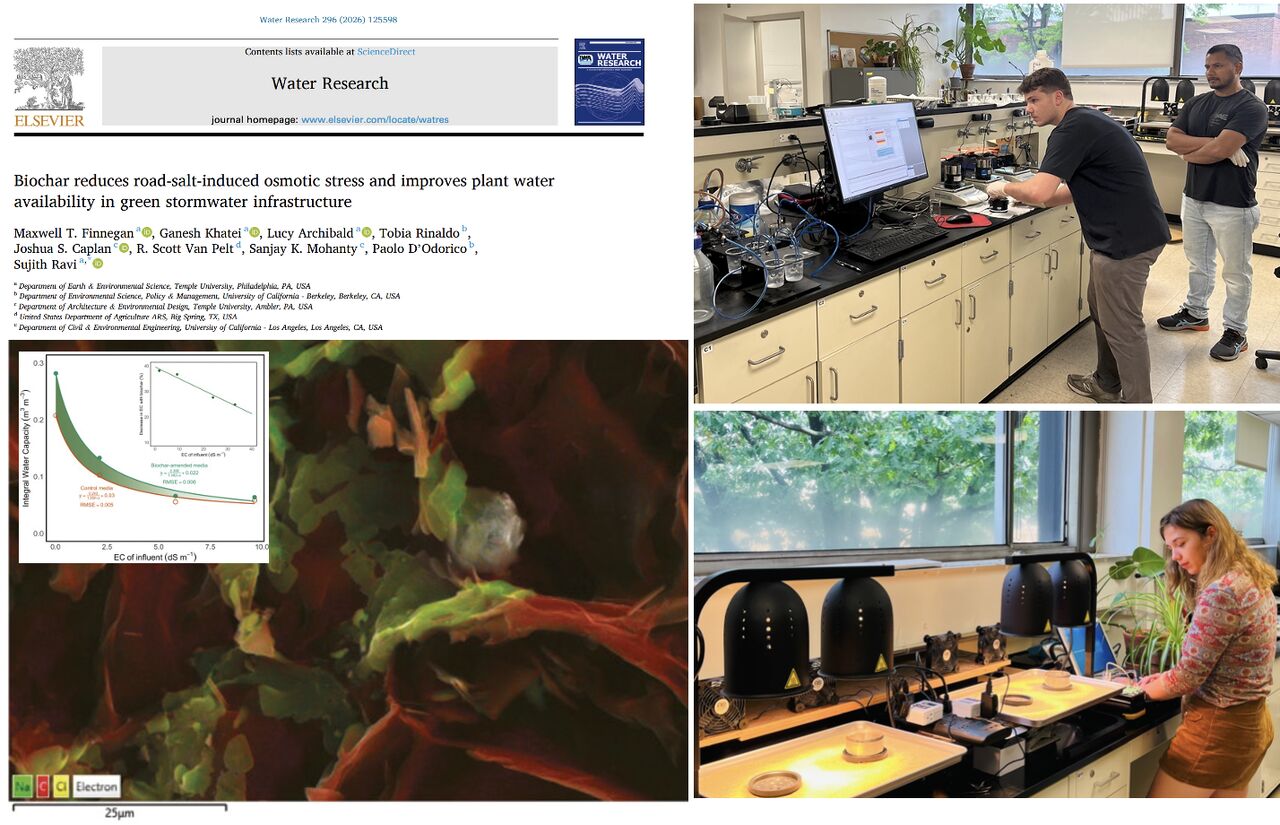
Our new publication in Water Research (Maxwell Finnegan et al; 2026), explores soil moisture availability for plants in salt-affected green stormwater infrastructure (GSI). We adopted a quantitative metric—the integral water capacity—to evaluate basin health in regions influenced by winter road-salt runoff from deicing applications. Our findings indicate that biochar can help mitigate both osmotic and matric stresses in GSI exposed to road-deicing salts, highlighting its potential as an effective management strategy for saline roadside environments.
Read full paper: https://doi.org/10.1016/j.watres.2026.125598

This undergraduate research project was led by Maxwell Finnegan (BS-ES, CARAS Fellow) and Lucy Archibald (BS-Geology, NSF GEOREPS).
Max is now a PhD student (NSF Graduate Fellow GRFP) at UCLA, and Lucy is an ORISE Fellow at US EPA.

Publication in Sustainable Cities & Society

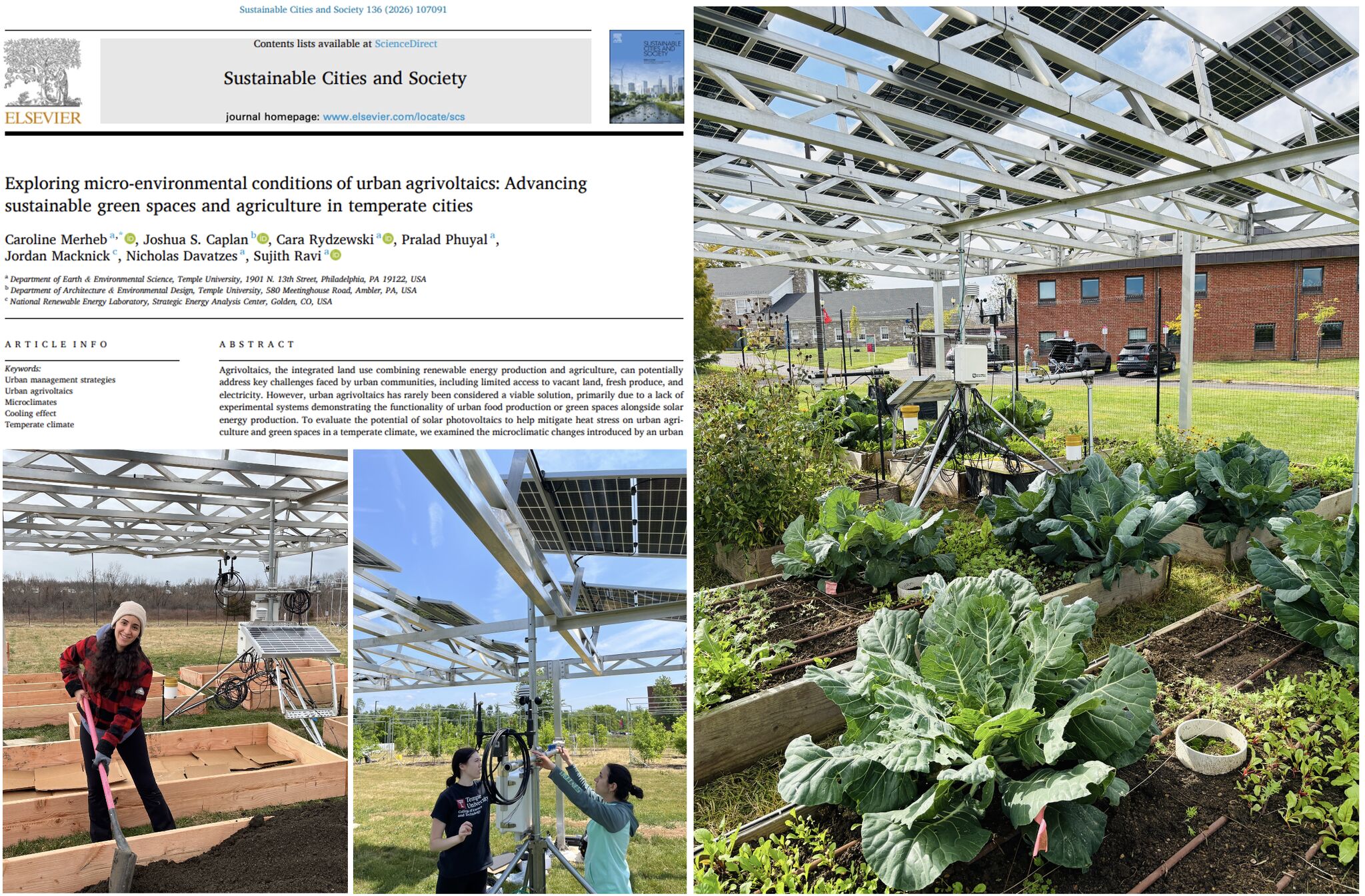
Our new publication led by Caroline Merheb (Merheb et al., 2026, Sustainable Cities and Society) explores how urban agrivoltaics—combining solar panels with small-scale food production or turf—reshape microclimates. We find that solar panels moderate temperatures, reduce water stress, and enhance the resilience of urban green spaces—supporting both renewable energy and sustainable food systems. Forthcoming papers will examine crop yields, zones and temporal windows of productivity, irrigation savings, resilience to extreme events, tradeoffs, and pathways for scaling agrivoltaics across climate zones.

Read the paper: https://doi.org/10.1016/j.scs.2025.107091

New Publication in Nature Sustainability !


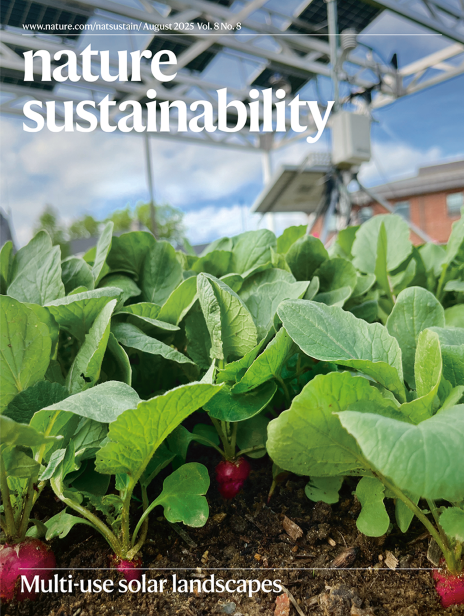
Merheb et al. (2025)  Research on combining solar energy with agriculture (agrivoltaics) or natural vegetation (ecovoltaics) is growing rapidly. Using a data-driven approach, we synthesize available evidence of the potential synergies and trade-offs of implementing these multi-use landscapes and offer recommendations to move the field forward. We made it to the cover ! 

Visiting Professor in Italy

Dr. Ravi will be on sabbatical leave (2024-2025) and will be a visiting professor at the Department of Civil & Environmental Engineering at the Politecnico di Milano, Italy (Jan – Aug 2025). The research will focuse on the relationship between soil properties, grazing activities, and carbon sequestration potential in regions utilized for renewable energy (solar) projects. Understanding the role of site management and soil texture in carbon storage, particularly in regions where renewable energy sites are prevalent, is crucial for developing strategies that enhance carbon capture and mitigate the effects of climate change. The project aims to model carbon sequestration potential and hydrological benefits.

AGU 2024, Washington DC, Presentations

Screenshot
  1. Merheb, C, et al., Effect of an Urban Agrivoltaics System on Various Crops in a Temperate Climate
  2. Phuyal, P., et al., Poster Agrivoltaics for Socioeconomic and Environmental Co-benefits in Geographically Isolated Agrarian Communities in Nepal 
  3. Merheb, M., et al.,Poster A Learning Community  Model Focused on Agrivoltaic Research (Education Section Session)
  4. Finnegan, M et al., Poster On the Effect of Biochar Application on the Hydraulic Properties of Salt-affected Green Stormwater Infrastructure
  5. Ravi, S., Particulate Matter Emissions from Agricultural Soils Amended with Biosolids and Biochar: A Potential Health Risk (Invited)
  6. Khatei, G. et al., On the Differential Effects of Salinity and Sodicity on Particulate Emissions from Agricultural Soils
  7. Li J. et al., Fire and human-induced disturbance to the shrub-grass dominance in desert grasslands: What the recovery pace and processes hold?

Contributed Session:
Convener & Chair: Sujith Ravi, Lixin Wang
H31B – Advances in Ecohydrology of Water-Limited Environments I Oral
H32B – Advances in Ecohydrology of Water-Limited Environments II Oral
H33B – Advances in Ecohydrology of Water-Limited Environments III Poster

Contributed Session:

GC14C – Dual-Use Agrivoltaics for Climate-Resilient Landscapes and Food-Energy-Water Security II Oral
Conveners: Chong-Seok Choi, Caroline Merheb

GC065 – Dual-Use: Agrivoltaics for Climate-Resilient Landscapes and Food-Energy-Water Security
Conveners: Chong-Seok Choi, Caroline Merheb

Science News documentary about our work !


New Science News documentary by Luke Groskin, featuring our labs research on agrivoltaics/multi use solar. Over the past decade, we studied the co-location of solar energy with crops/biofuels, grazing and/or pollinator-friendly native plants at multiple sites around the world, and the highlighted the environmental and socio-economic co-benefits and trade-offs.

https://www.sciencenews.org/article/solar-agriculture-farming-argivoltaic

Winner of Agrivoltaic design competition

Congratulations Caroline !


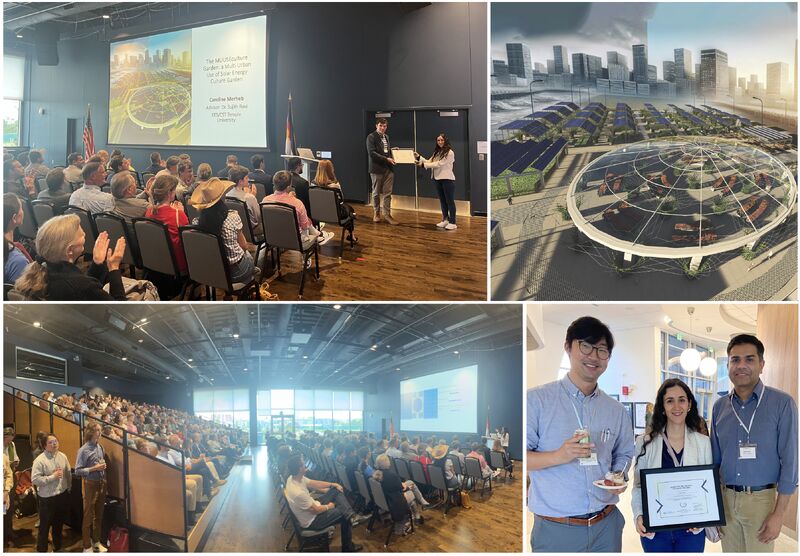
Caroline Merheb (PhD) is the winner of the student design competition as part of The AgriVoltaics World Conference 2024 The purpose of this competition was to develop innovate agrivoltaic design concepts that address community sustainability challenges across the food-energy-water nexus. Caroline’s design for an urban setting is aimed at (1) enhancing access to fresh food in low-income areas/food deserts, (2) reducing surface temperatures and urban heat islands, and (3) increasing green community spaces and improving the urban aesthetics. The AgriVoltaics World Conference, now in its 5th year and spanning all five continents, provides high-level scientific exchange and great networking opportunities. This is the first time this meeting is held in the US, hosted by the National Renewable Energy Laboratory in Denver, Colorado (11-13 June).

New Publication: Leonard et al., Env. Sci. Tech 2024

Leonard, J., S. Ravi and S. K. Mohanty, (2024) Preferential Emission of Microplastics from Biosolid-Applied Agricultural Soils: Field Evidence and Theoretical Framework, Environmental Science & Technology Lett. https://doi.org/10.1021/acs.estlett.3c00850

Featured on the front page of Los Angeles Times !

*Media Coverage:  Los Angeles TimesAmerican Chemical Society (ACS Press Room), PÚLICO, Scienmag, WPN, MSN, EcoWatch, ScienceDaily, AAAS EurekaAlert, Science News Explores, Phys.Org