During their time in the White House as the First Lady and President, Jackie and John F. Kennedy changed everything about how Americans see their First Family. Of course, their visibility as they arrived in Washington had owed a great deal to the fact that it coincided with the growth in popularity of television, but a huge factor in their popularity and their cultural relevance was how Jackie wanted herself and her family to be represented.
[1]
Jackie’s famous style has become iconic in its own right. The way she presented herself gave rise to the Kennedy’s image of royalty, or as close as they could get in the United States. The focus on fashion in the White House was something that Americans had never seen before and naturally led to high levels of fascination. Despite things lurking beneath the public’s point of view, such as John F. Kennedy’s poor health and myriad of extramarital affairs, Jackie Kennedy was great at exhibiting elegance and poise. Even in the face of tragedy, she exuded these traits.
The day of JFK’s assassination, she was adorned in her now famous pink jacket and pillbox hat. During Lyndon B Johnson’s swearing in session following the traumatic moment of his death, she kept her outfit on, still stained in her John’s blood. It is a wonder that she kept her cool enough to choose to show the world what had happened to her husband. Newly widowed and covered in her husband’s blood, she remained the Jackie Kennedy people had expected. During the planning of the funeral procession, she still showed her strength and her awareness that the image of her husband’s time as president was paramount. She fought to have a dramatic and marvelous funeral to honor JFK because she truly believed he deserved it.
[2]
Jackie Kennedy set the new standard for First Ladies both in the spotlight and behind the scenes by being extremely marketable and popular to the average citizen and by being strong willed and resolute with her family and peers. She created a feeling of majesty for the First Family and engineered the viewpoint of JFK’s term as president as the United States of America’s Camelot. Her achievements for the image of her family are something that future First Families will strive for, but in all likelihood will never attain.
When I learned about the Kennedy Assassination in high school, I read a report from a British journalist, who attended Kennedy’s funeral and claimed that “Jacqueline Kennedy has today given her country the one thing it has always lacked, and that is majesty.”[1] This statement left me with a deep first impression about this prominent first lady. Historian Michael Hogan points out that after President Kennedy was assassinated, not only did Jackie bury his body at Arlington National Cemetery, she also helped to establish the Kennedy Center for the Performing Arts in Washington D.C. and the Kennedy Library and Museum in Boston.[2] Jackie wanted the American public to remember President Kennedy as a war hero and a charming intellectual leader who demonstrated an appreciation of art. However, Jackie played a critical role to construct the public memory of President Kennedy even before he was assassinated.
https://tinyurl.com/yd8grn93
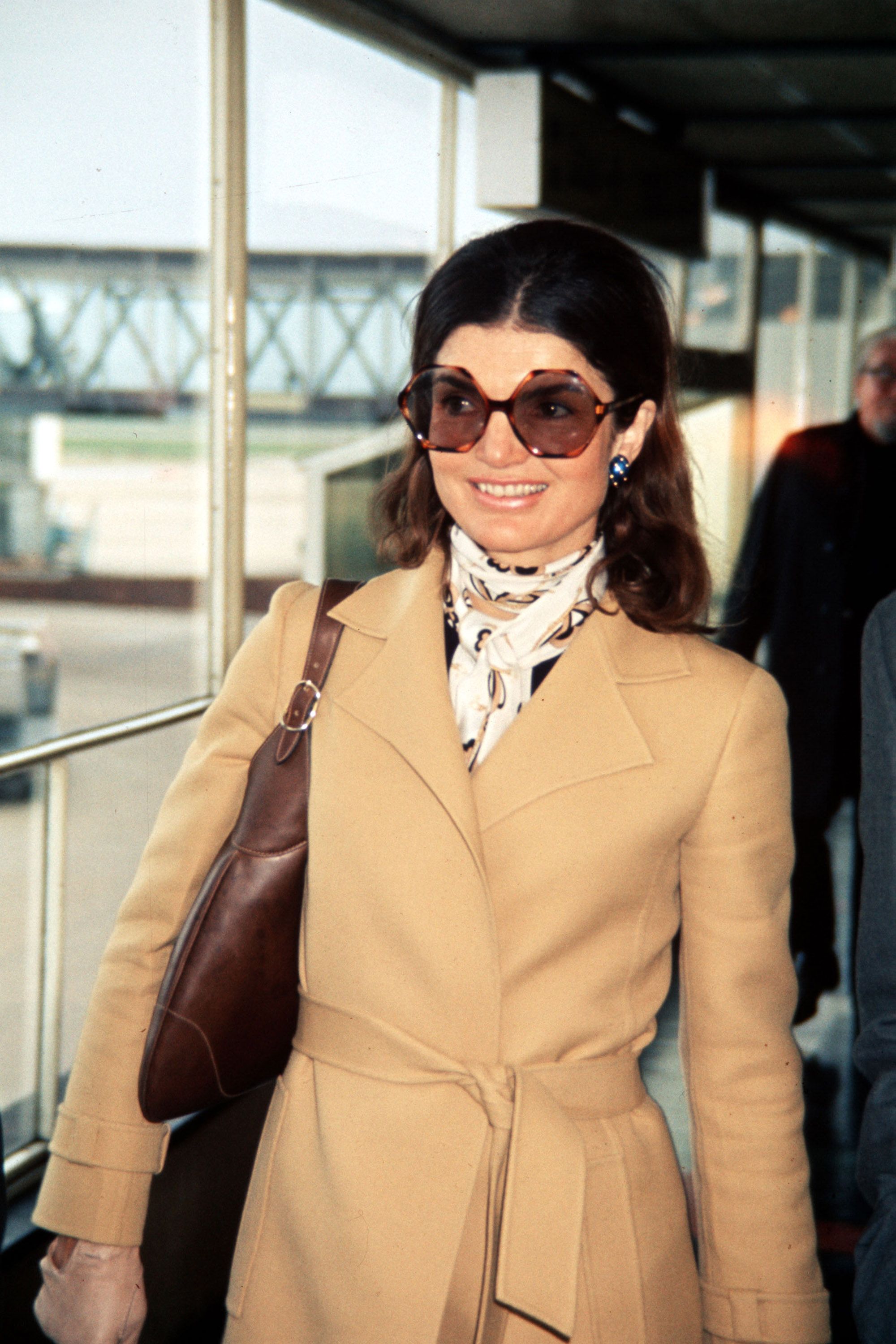
During Kennedy’s presidency, Jackie had become an American icon through her fashionable appearance. Jackie’s iconic fashion reflected Americans’ obsession with the appropriate demonstration of gender. Her elegant appearance demonstrated how her gender role became an important element that made a positive influence on her husband’s collective memory. Oleg Cassini was Jackie’s costume designer and he claimed that Jackie’s clothes “could reinforce the message of her husband’s administration.” [3] In addition, her role as a wife and a mother of two children helped the public to link President Kennedy with the image of a loving husband and father.[4] Along with the image of President Kennedy’s charming youth, Jackie’s iconic fashion style reinforced a positive public memory of President Kennedy. Jackie presented a new fashion look that combines American style with European elegance, which established an appealing American version of royalty and turned herself into a graceful American “queen”.[5] Because Jackie’s dignified fashionable appearance presented the vigorous image of the United States as a powerful modern nation, her elegant costumes emphasized the growth of American power and the prosperity during Kennedy’s presidency. Jackie played a significant role to help construct the image of President Kennedy and herself as a flawless couple and perfect family. This idealized version of American life appealed to the American public and strengthened people’s positive memory of President Kennedy.
https://tinyurl.com/y9htpdmc
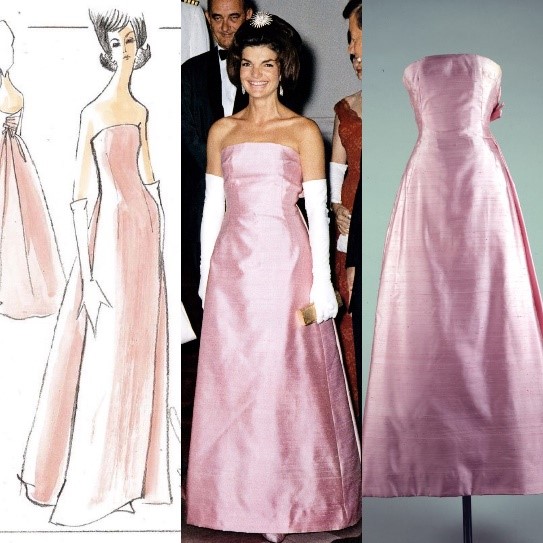
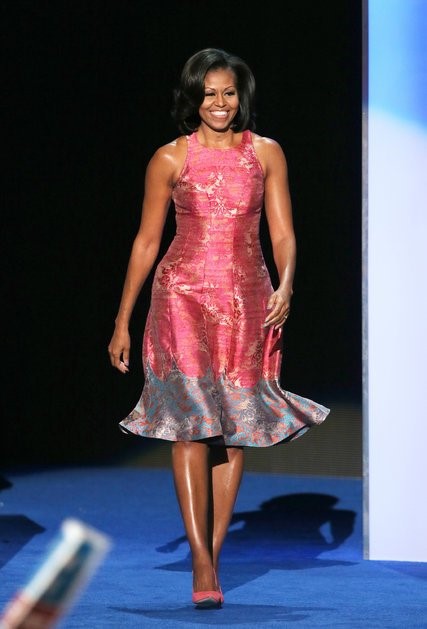
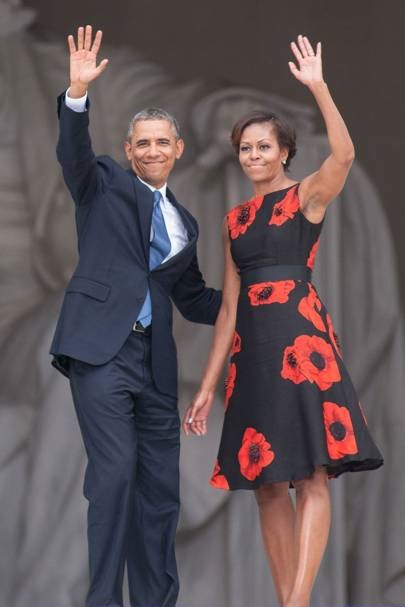
Similar to the way that Jacqueline Kennedy became an icon of fashion, social emphasis on the wardrobe choices of former first lady Michelle Obama also shows how female icon can be associated with the expectations of gender appearance in American society. Even though they came from different backgrounds, Michelle Obama is considered the second Jacqueline Kennedy due to the comparison of their fashion choices.[6] The dressing style of both first ladies have made different impacts on the American society in their times. For instance, Jackie’s strapless gown became the popular “Jackie Look” across the country in the 1960s.[7] The “modified A-line gown of pink-and-white silk” that she wore in a White House dinner became the most eye-catching news of the event.[8] Likewise, Michelle Obama wore a “custom-made pink and gold silk dress” during her speech at the Democratic National Convention in 2012 and it became the best-selling dress of the designer.[9] Another dress, the “black dress with big red poppies” that she wore during the 50th anniversary of the 1963 march on Washington D.C., is displayed at the National Museum of African-American History and Culture.[10] These examples show how the American public obsession with the dressing choices of first ladies can turn them into fashion icons. The connections between notable female icons and the way they present themselves reflect the social expectations placed on the appropriate appearance of females.
https://tinyurl.com/y8e54h7c
Jacqueline Kennedy and Michelle Obama are both beloved first ladies throughout American history. Moreover, they are popular female icons that represent the American fashion style. Jacqueline Kennedy demonstrates how gender role became an element in shaping the public memory of President Kennedy. Jacqueline Kennedy and Michelle Obama rose to the status of fashion icon based on similar characteristics. The historic representations of both first ladies demonstrate a potential social expectation of gender appearance in American society.
[1] Peggy Noonan, The Time of Our Lives: Collected Writings (New York: Grand Central
Publishing, 2015), 210.
[2] Michael J. Hogan, The Afterlife of John Fitzgerald Kennedy: A Biography (Cambridge:
 [1]
[1] [2]
[2]