Econometrics
Recommendation
- Article
- China
- Econometrics, Big Data
Fengjun Tian; Mengyuan Lei; Yang Yang; Lan Jiang
- Article
- US
- Econometrics, Spatial Modeling, Big Data
Gyusang (Kevin) Hwang; Yang Yang
- Article
- US
- Econometrics, Spatial Modeling, Big Data
Gyusang (Kevin) Hwang; Yang Yang
Related Presentations
- Keynote
- 07/21/2024
Review of research in tourism economics
2nd Xishan Economics Forum
Guiyang, China
- Presentation
- 06/04/2018
Econometric and big data analytics in tourism research
Workshop in Guilin Tourism University
Guilin, Guangxi, China
- Invited Talk
- 03/04/2024
COVID19tourism Index and its application in tourism management
University of Perpignan
Perpignan, France
- Invited Talk
- 06/16/2014
Spatial econometrics in tourism and hospitality management
CICtourGUNE research center
San Sebastian, Spain
Related Resources
- Tool
Poetry Explorer
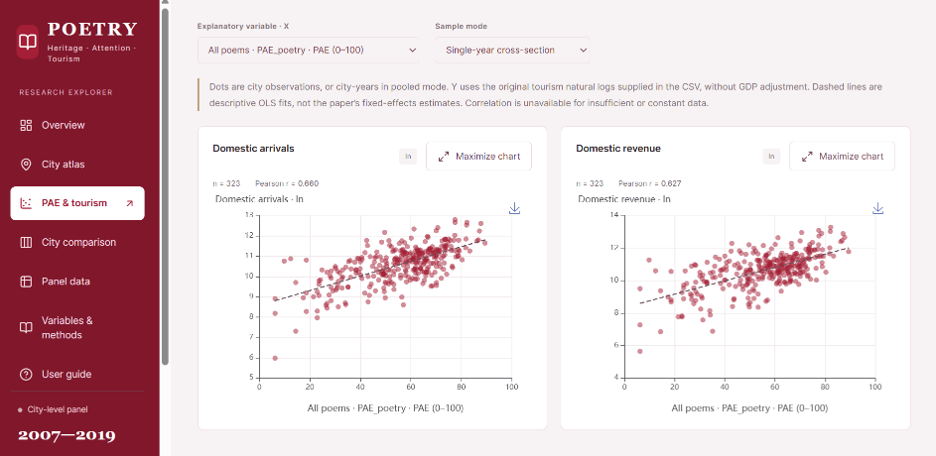
Tool Link: https://uflyy.github.io/poetry/
Poetry Explorer is a bilingual, interactive platform for exploring the relationship between poetic heritage and tourism demand across Chinese cities. Drawing on data for 337 cities from 2007 to 2019, it combines historical poetic endowments with contemporary attention to poetry. Interactive maps, city rankings, scatter plots, and city comparisons allow users to explore different poetry and dynasty measures alongside domestic and inbound tourist arrivals and revenues. Users can filter cities and years, select indicators, and download data for research presentations, teaching, and cultural tourism analysis. The visualisations show descriptive relationships rather than causal effects.
**诗词与旅游数据探索工具(Poetry Explorer)**是一款中英文交互式平台,用于探索中国城市诗词文化遗产与旅游需求之间的关系。工具基于2007—2019年337个城市的数据,将历史诗词禀赋与当代诗词关注度相结合,通过地图、城市排名、散点图和城市对比,展示不同诗词及朝代指标与国内、入境旅游人次和收入的关联。用户可筛选年份与城市、切换指标并下载数据,适用于研究展示、课堂教学和文化旅游分析。图表提供描述性探索,不代表因果效应。
- Tool
Restaurant Week Impact Explorer
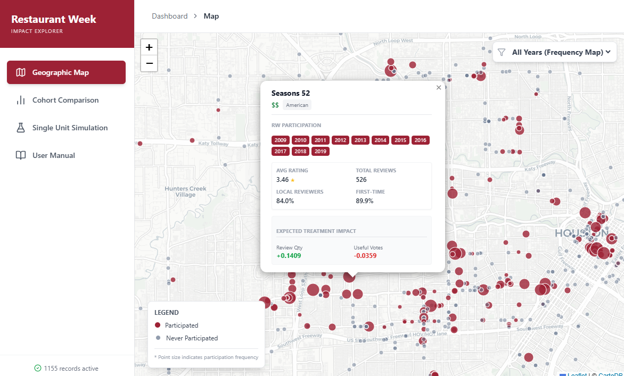
Tool link: https://uflyy.github.io/restaurant-week/
Academic Reference:
Yang, Y., Yin, Q., Hwang, G. K., Liang, S., & Yang, D. (forthcoming). Restaurant week paradox: Asymmetric effects of event-based marketing on online engagement. International Journal of Contemporary Hospitality Management.
1. Geographic Map View
- Year Filtering: Use the dropdown in the top right corner to filter participation status by a specific year.
- Frequency Mapping: If “All Years” is selected, the size (radius) of the cherry-red markers expands dynamically based on the total number of years a restaurant has participated.
- Interaction: Click on any marker to open an information popup with historical baseline data and predictive metrics.
2. Cohort Comparison
- Purpose: Compares the structural and baseline performance differences between restaurants that participated in RW versus those that did not.
- Visual Variables: Recharts-based grouped bar charts are used to visualize the mean values of quantitative variables (Rating, Review Volume, Local/First-time mix) and the proportional makeup of categorical variables (Price Level, Fine Dining status).
- Frequency Histogram: When filtering by “All Years”, a unique frequency distribution chart activates, revealing the historical retention and loyalty of participating restaurants.
3. Single Unit Simulation
- Purpose: A sandbox environment detached from the map data. It allows you to model hypothetical scenarios based on econometric estimation formulas.
- Controls: Adjust the baseline consumer mix (Local Reviewers and First-Time Reviewers) and toggle the Fine Dining status to see real-time marginal treatment effects.
- Tool
Rating Adjustment Tool
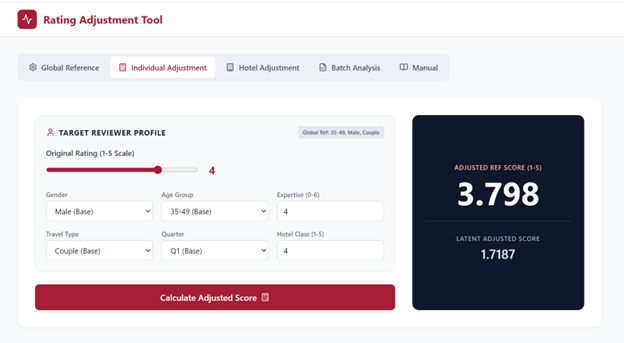
Tool link: https://uflyy.github.io/rating-adjustment/
The Rating Adjustment Tool is an advanced analytical web application designed to standardize hotel online reviews by correcting for “scaling heterogeneity”—the phenomenon where different types of reviewers interpret and use rating scales differently. Powered by a Hierarchical Ordered Probit (HOPIT) model grounded in peer-reviewed academic research , the tool mathematically controls for systematic response biases tied to traveler demographics (such as age and gender) and trip characteristics (such as travel type and reviewer expertise). By offering individual review adjustments, hotel-level aggregate score calculations, and batch CSV processing, the tool effectively translates subjective, raw user ratings into objective, comparable latent scores and standardized 1–5 metrics, ensuring fairer and more accurate hotel evaluations.
This rating adjustment tool is built on the theoretical framework and empirical results from the following paper:
Leung, X. Y., & Yang, Y. (2020). Are all five points equal? Scaling heterogeneity in hotel online ratings. International Journal of Hospitality Management, 88, 102539.