JOURNAL OF SUSTAINABLE TOURISM
Hotel performance under extreme weather: A contingency perspective on organizational resilience
- 2026
- JOURNAL OF SUSTAINABLE TOURISM
- 10.1080/09669582.2026.2614549
Nam, Yoonyoung; Yang, Yang
Abstract
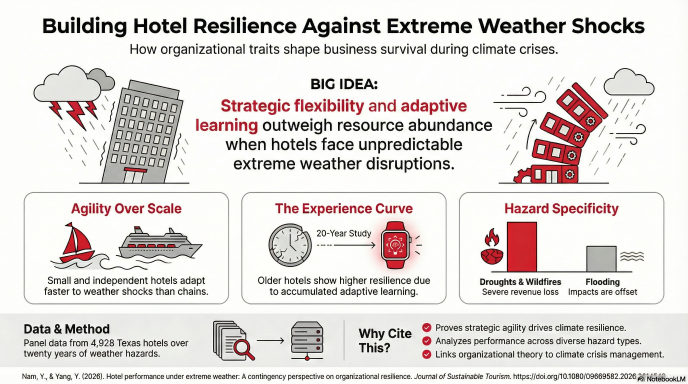
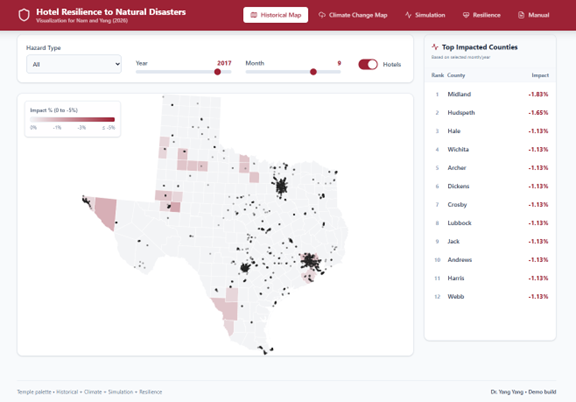
Unpredictable climate patterns and extreme weather events are reshaping the hotel business environment and call for adaptive strategies. Grounded in contingency theory, this study examines how such weather events affect hotel performance, including how organizational characteristics shape resilience. Using panel data from 4,928 hotels in Texas over two decades, combined with locally relevant hazard records, the results demonstrate that extreme weather events significantly reduced hotel performance. The effects are heterogeneous: smaller hotels and independent hotels with greater operational flexibility were better equipped to swiftly react to crises, thus mitigating adverse consequences. Hotels with longer operational histories also exhibited greater resilience, likely reflecting adaptive learning from repeated hazard exposure. Among hazard types, droughts, wildfires, hail, and severe wind posed significant threats to performance, whereas flooding had an insignificant impact. By offering firm-level evidence, these findings underscore the importance of organization adaption and flexibility in shaping resilience and offer insights for stakeholders aiming to develop disaster mitigation strategies amid escalating climate challenges.
Keywords
Extreme weather events; climate crisis; hotel performance; organizational resilience; risk management; contingency theory
Research topic
Tourist Flows and Location, Sustainability and Resilience
Research method
Econometrics
Geographic area
US
AI Audio Overview
AI Infographic