TOURISM ECONOMICS
Elevating excellence: Examining the effects of spatial competition on hotel quality
- 2026
- TOURISM ECONOMICS
- 10.1177/13548166261473765
Yoonyoung Nam, Zhenxing Mao, Yang Yang
Abstract
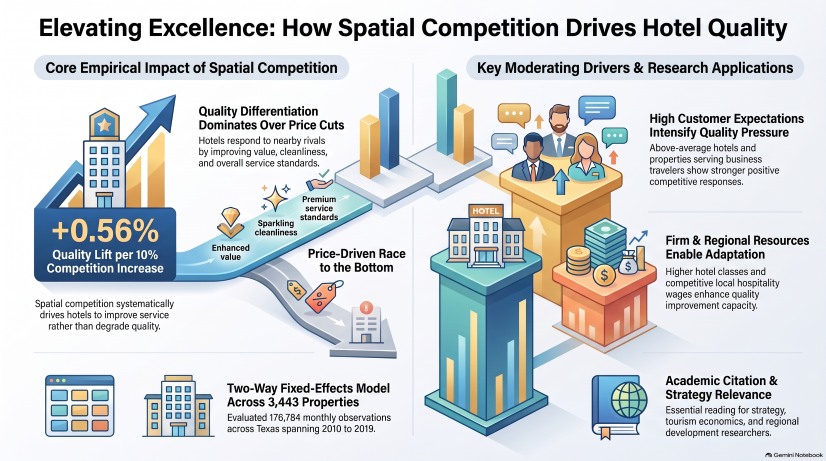
This study investigates how spatial competition influences the quality of hotel properties in the lodging market. We collected hotel characteristics and online rating data for 3,443 properties in Texas, USA, spanning from 2010 to 2019. A two-way fixed-effects panel data model indicated that spatial competition improved hotel quality in the vicinity. Specifically, a 10% increase in spatial competition led to a 0.56% increase in hotel quality, as reflected in a 5-point online rating scale. Drawing from institutional theory and resource dependence theory, we further explored how hotel characteristics related to customer expectations and available resources moderated this relationship. Higher customer expectations, as evidenced by hotels’ relative quality and guest portfolios, intensified competitive pressure; hotel resources, such as class and employee wage levels, enhanced the positive impact of competition. Our findings’ practical and theoretical implications are summarized in the closing section.
Keywords
hotel quality, spatial competition, institutional theory, resource dependence theory
Research topic
Tourist Flows and Location
Research method
Econometrics, Spatial Modeling
Geographic area
US
AI Audio Overview
AI Infographic