TOURISM GEOGRAPHIES
Feast or famine: asymmetric links between events and restaurant revenue
- 2026
- TOURISM GEOGRAPHIES
- 10.1080/14616688.2026.2733832
Gyusang (Kevin) Hwang; Yang Yang
Abstract
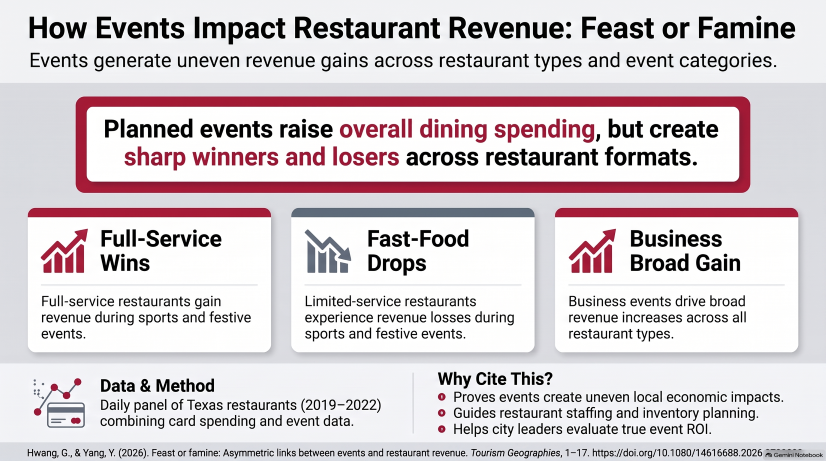
Planned events are often expected to coincide with higher hospitality consumption, yet aggregate evaluations can obscure how event-related revenue is distributed across businesses and space. This study examines associations between planned events and observed restaurant revenue across event types, restaurant formats, and spatial contexts. We integrate SafeGraph restaurant revenue, PredictHQ event records, and PRISM weather data to construct a daily establishment-level panel of Texas restaurants from 2019 to 2022. High-dimensional fixed-effects models show a positive average association between planned events and restaurant revenue, although the estimate attenuates substantially under more demanding restaurant-specific temporal fixed effects. The results reveal substantial heterogeneity across event and restaurant types. Business events are associated with broad positive revenue patterns across restaurant categories. In contrast, sports and festive events exhibit a feast-or-famine pattern, with positive associations for full-service restaurants but negative associations for limited-service restaurants. Supplementary analyses further indicate that event-related revenue associations can extend beyond the focal zip code, although spatial inference remains limited. By conceptualizing planned events as event bubbles associated with uneven revenue geographies, the study advances event-impact research beyond aggregate economic evaluation toward spatially and sectorally differentiated hospitality outcomes.
Keywords
Event bubble; event impact; restaurant revenue; big data analytics; geospatial analytics; Texas
Research topic
AI and Big Data, Tourist Flows and Location
Research method
Econometrics, Spatial Modeling, Big Data
Geographic area
US
AI Audio Overview
AI Infographic