TOURISM MANAGEMENT
When crowds converge: Link between events and crime
- 2027
- TOURISM MANAGEMENT
- 10.1016/j.tourman.2026.105525
Gyusang (Kevin) Hwang; Yang Yang
Abstract
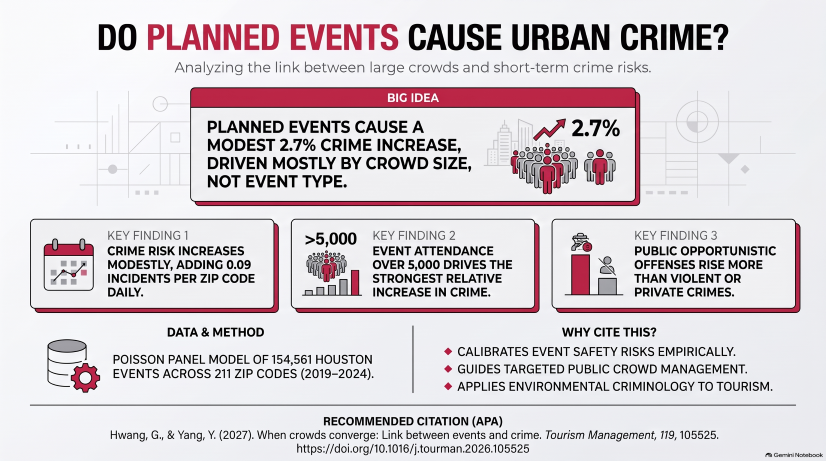
This study draws on environmental criminology to conceptualize planned events as bounded opportunity contexts that temporarily reshape urban activity. Using high-dimensional fixed-effects Poisson models and a panel of 154,561 events in Houston, Texas, we estimate reduced-form associations across event attributes and offense types. The event-crime association is statistically detectable but economically modest. Formal comparisons reveal selective offense heterogeneity, with the Crimes Against Society coefficient exceeding the Violent Crime coefficient. Public opportunistic crime also shows stronger associations than private opportunistic and non-opportunistic crime, but not Other Crime. Event size exhibits significant heterogeneity, with the largest events showing stronger associations than those in all lower-attendance categories. Event type, day-type context, duration, and recurrence are not statistically distinguishable. Adjustment for contemporaneous foot traffic attenuates the event coefficient. The findings suggest proportionate, targeted situational prevention rather than generalized security escalation in urban destination safety planning.
Keywords
Planned events; Routine activity theory; Rational choice theory; Risk assessment; Destination management
Research topic
AI and Big Data, Tourist Flows and Location
Research method
Econometrics, Spatial Modeling, Big Data
Geographic area
US
AI Audio Overview
AI Infographic