TOURISM MANAGEMENT
Clouds and crowds: A meta-analysis of air pollution and tourism demand-experience dynamics
- 2027
- TOURISM MANAGEMENT
- 10.1016/j.tourman.2026.105504
Huo, Tingting; Yang, Yang; Zhang, Linjia
Abstract
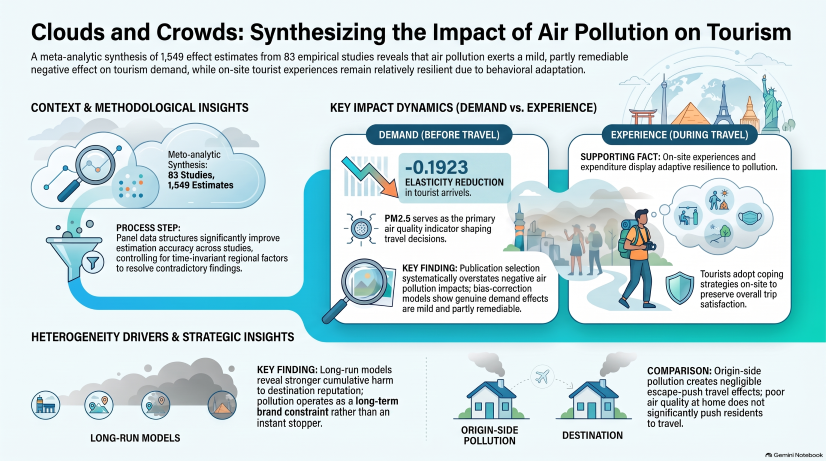
Empirical evidence on how air quality shapes tourist responses remains inconsistent. Drawing on a meta-analytical framework and cognitive-relational theory, this study synthesizes the effects of air pollution on demand- and experience-related outcomes across the travel process. The analysis pools 974 estimates from 58 demand studies and 92 estimates from 8 experience studies on destination-side pollution, as well as 483 estimates from 17 demand studies on origin-side pollution. After correcting for publication bias, air pollution has a mild, partly remediable adverse effect on tourism demand, while evidence for tourist experience is less consistent. The demand effect remains robust across destination-only and origin-destination settings, whereas origin-side air pollution has a negligible, statistically insignificant positive effect. Meta-regression results indicate that between-study heterogeneity is mainly driven by international tourism contexts, online word-of-mouth measures, PM2.5 or air quality index measures, and long-run effects. This meta-analysis provides actionable implications for scenario-based planning, forecasting and econometric practice.
Keywords
Air pollution; Tourism demand; Tourist experience; Meta-regression; Publication bias
Research topic
Tourist Experience, Sustainability and Resilience
Research method
Econometrics, Meta-analysis
Geographic area
Global
AI Audio Overview
AI Infographic