
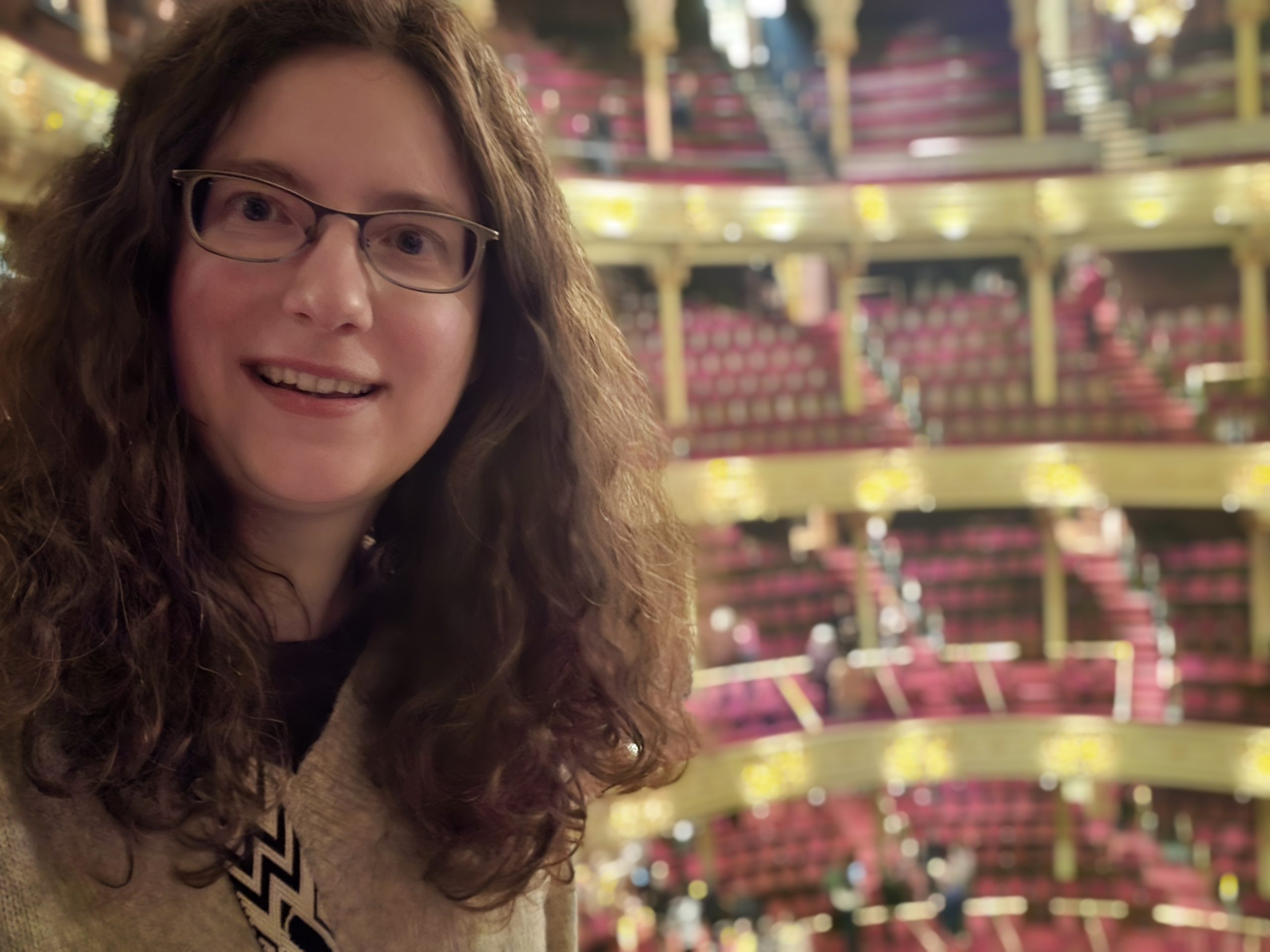
In 1968, The New York Times posed the question, “Is the concerto dead?” Almost 60 years later, Malwina Marciniak, a Fulbright Visiting Scholar at Temple University for Spring 2026, came to Temple to approach this question from a fresh perspective.
Marciniak, a pianist and researcher who holds a PhD in music theory, travelled here to work with Temple Music Theory Professor Michael Klein. She is expanding her research on American composers and concertos among others, the three concertos of American composer, Phillip Glass.
Currently, she is an assistant professor at the Nowowiejski Academy of Music in Bydgoszcz, Poland, where she teaches music theory and piano performance.
“A concerto is a type of musical piece, a musical genre. It’s very specific because it’s designed for a special instrumental setting. There’s a soloist, the instrument that takes the center place, and there’s an accompanying group of instruments.”
– Malwina Marciniak
Michael Klein, who is currently working closely with Malwina, praises her work and sums it up, “Malwina is a brilliant scholar whose work at Temple this semester is focusing on two areas. First, she is researching piano concertos written by American composers. Second, she is thinking through the enormously complex problem of meaning in instrumental music.”
“How does music without lyrics convey meaning to listeners? How wide or narrow are the meanings that we can consider to be legitimate? By what means can we say that the music supports our interpretations of music?” he explained.
Read below about Marciniak’s research and why she came to Temple.
___________________________________________________________________________
Why did you choose Temple for your work as a Fulbright Visiting Scholar?
It’s always been my dream to spend time on a big American campus. I chose Temple’s Boyer College of Music and Dance to work with Professor Michael Klein. He’s my mentor for the Fulbright. This kind of personal relation is one of the things required by Fulbright–having a mentor to guide and supervise one’s research project. Before working on my PhD, I contacted him and used his theories, which were very helpful in my narrative analyses of contemporary Polish piano concertos.
How would you explain a concerto to someone who is not a musician?
A concerto is a type of musical piece, a musical genre. It’s very specific because it’s designed for a special instrumental setting. There’s a soloist, the instrument that takes the center place, and there’s an accompanying group of instruments. The key idea is the relationship between the one and the many, the single instrument and the multitude. Shaping this relation is either in a conversation, a conflict or a dialogue-like mode.
This musical genre has been extremely popular for over 400 years and has existed in musical culture with changes in styles, forms and compositional techniques. That’s the reason for the popularity of the concerto–various types of relationships that have changed over the years, showing interchangeable relations between the human and the society, between the one and the opposing world.
Why is asking, “Is the concerto dead” still relevant?
When this question was raised in The New York Times in 1968, respondents replied yes or no, and most answers were yes. Critics, composers and reviewers argued that the concerto is dead. It is in line with what happened in music maybe more than 50 years ago, in the 1950s and ’60s, a second avant-garde after World War II when many revolutionary experimental ideas somehow decreased the importance of traditional musical genres.
But now the time has changed. We observe a comeback to traditional ideas and musical genres, with significant changes because we don’t write as Mozart or Beethoven or Chopin now, but with modern language and techniques.
What are some examples showing that the concerto is well and alive?
As I said before, the concerto features a solo instrument and orchestra, for example, piano and orchestra. Nowadays composers replace the orchestra with an electronic layer–a concerto for piano and computer, a huge difference.
There is no orchestra on the stage. There is a set of speakers. But there is still the relationship between the one and some kind of opposition which may represent not the relationship between the individual and society like in Mozart’s times but now concentrating on the relationship between humans and technology. How do we cope with AI, computers, technology and electronic devices? Can humanity survive this clash with technology?
Why do you think the concerto is still here?
Well, the idea of a relationship is universal. That’s why it still attracts composers and listeners. Conflict is basic for humanity, as is communication.
Who are some modern Polish composers you are studying?
Among my recent research there is a work that provides a direct link with American culture, Krzysztof Penderecki’s Piano Concerto “Resurrection,” written as a special tribute to the tragic events of 9-11. Penderecki is one of the top Polish composers of the past decades. His concerto has been quite controversial, especially in Poland, so it was a challenge to uncover certain significant meanings beneath the piece through my analytical approach.
Another Polish composer is Wojciech Kilar, the composer who wrote the soundtrack for Francis Ford Coppola’s movie, “Dracula.” He worked on both films and classical music. And his piano concertos are written in a kind of post-minimal style.
What composers are you researching at Temple?
At Temple my research is dedicated to American composers and concertos. I am thinking of Philip Glass and his three concertos. I am very interested in Glass’ special ideas of minimal music versus the concerto, a very narrative form and how these two aspects clash.
What is the difference between American and Polish concertos?
Polish music is generally more open towards commissioning new avant-garde pieces. American music tends to be more traditional.
What are some differences between U.S. universities and Polish universities?
For higher education in music, we have smaller-size institutions that are centered only around music studies, especially the performance studies – Music Academies. Here, there is a music college within a big university, a general university. The teaching programs are a little different, and analytical methods are different, too. It is really inspiring to follow the differences and expand my horizons while in the United States.
Interviewed by Journalism Major, Iona Clark (KLN ’26)
Photo courtesy of Malwina Marciniak