
I grew up in what can be considered one of the most conservative towns in Spain: Santander. Early in life, I learned that boys wear blue and play with toy cars; that girls wear pink and play with dolls. Words like “gay” or “lesbian”—let alone “trans”—were never part of my vocabulary. When I heard them, they were used as insults by my parents or by the priests who taught at the Catholic school I attended. When my best friend Pedro and I started to receive these insults, I realized that something needed to change. However, Santander wasn’t the right place for that to happen.
Everything changed when I came to the United States to start college. From my very first day in the country, I noticed how different things in Philadelphia were compared to my hometown. For the first few days, out of curiosity, I felt like an anthropologist conducting ethnographic research, closely observing the people around me. What I found surprised me in the best possible way.
The first thing I noticed on Temple’s campus was how free students seemed: free to act as they wanted, to dress as they wanted, to say what they wanted, to kiss whom they wanted. They didn’t seem to be bound by the unspoken, yet unbreakable, rules I had grown up with. They were themselves. And I loved that.
Now, almost three years later, I see things in a wildly different light. I can proudly say that I have officially become part of Temple’s diverse, open-minded, and inclusive community, especially for nonnormative and LGBTQIA+ students. This queer-friendly environment has empowered me to question my previous biases about sexual orientation and to start exploring my own identity. While this is still a work in progress—and probably one that will take time, I have taken the first step. And that matters. A lot.
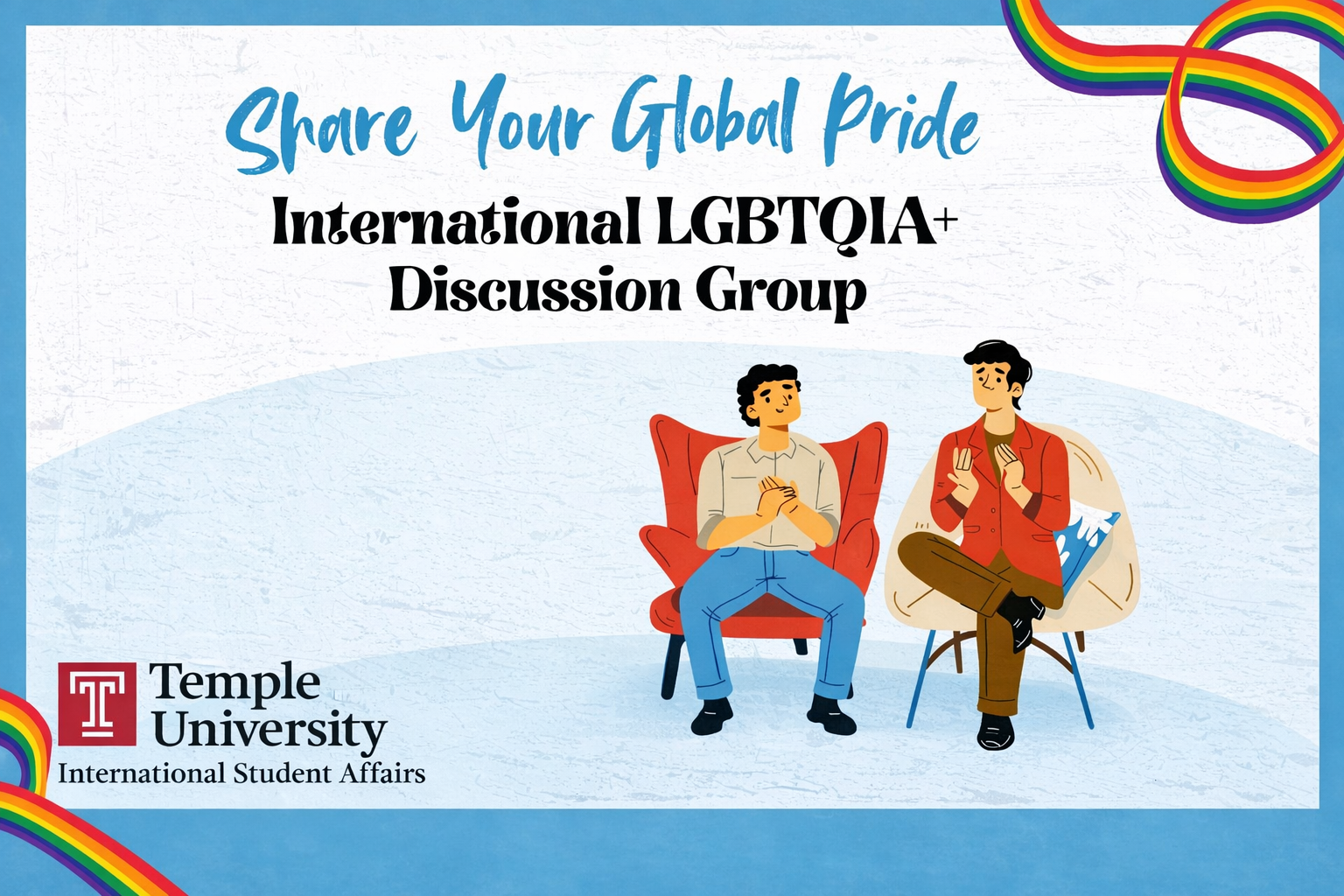
I am, and will always be, incredibly grateful for coming to Temple and having the opportunity to discover the thriving LGBTQIA+ community both on campus and in Philadelphia at large. To give back, I created an event to help other international students like me learn about non-normative sexual orientations and gender identities. I titled it “Share Your Global Pride: LGBTQIA+ Discussion Group.” At our first meeting, we discussed topics such as coming out and how the queer community is perceived around the world. We also read excerpts from British queer lawyer Mohsin Zaidi’s memoir A Dutiful Boy. I will host this event again before the end of the semester, this time focusing on how perceptions of masculinity and femininity vary across cultures.
“The first thing I noticed on Temple’s campus was how free students seemed; free to act as they wanted, to dress as they wanted, to say what they wanted, to kiss whom they wanted. They didn’t seem to be bound by the unspoken, yet unbreakable, rules I had grown up with. They were themselves. And I loved that.”
– Mateo Perez Presmanes (CLA ’27)
Every Friday from January to April, I assiduously sit on my couch at exactly 8:00 PM to watch a new episode of RuPaul’s Drag Race. Looking back, I wonder what 18-year-old Mateo would think of seeing not one, but several drag queens on TV. Before coming to the U.S. I can picture myself sitting on my parents’ couch, confused, uncomfortable, and most likely hearing them repeat the hurtful words Pedro and I were called for years. This version of myself feels so distant now; not because I have forgotten where I come from, but because I’ve learned to see the world, and myself, radically differently.
If you are an international student struggling with your sexual orientation or gender identity, don’t despair. Know that there are places where you can be yourself and where, like I did, you can discover the rainbow.
Note: LGBTQIA+ discussion groups sponsored by ISA – April 9th & April 24th, 2026
By Mateo Perez Presmanes (from Spain) CLA ’27
Presmanes is a recent winner of the 2026 Diamond Award.