JOURNAL OF TRAVEL RESEARCH
The world is flatter? Examining the relationship between cultural distance and international tourist flows
- 2019
- JOURNAL OF TRAVEL RESEARCH
- 10.1177/0047287517748780
Yang, Yang; Liu, Hongbo; Li, Xiang (Robert)
Abstract
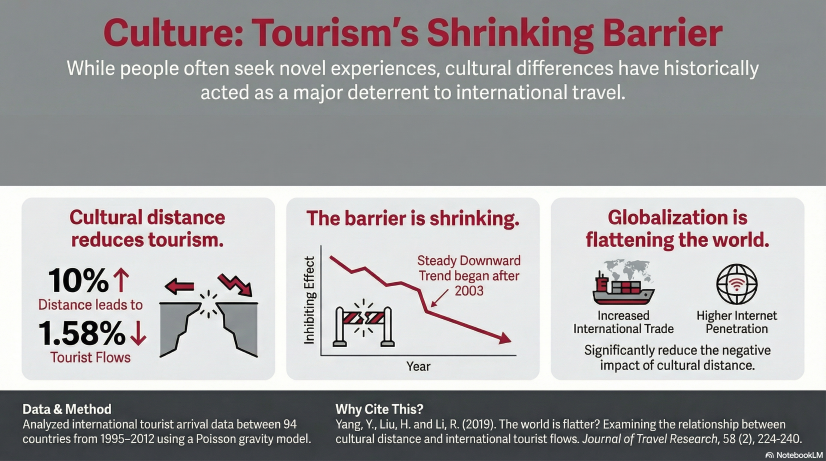
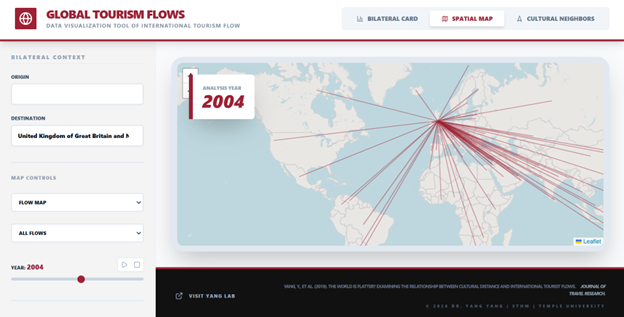
Geographic distance has been studied extensively as an obstructer of tourism flows, whereas another distance measure, cultural distance (CD), receives less attention in tourism demand research. Using international tourist arrival data between 94 countries for the period 1995-2012, we estimate several Poisson gravity models incorporating a CD measure based on national cultural scores from the World Values Survey (WVS). Our estimation results show a negative and significant effect of CD on international tourist flows, the elasticity of which is -0.158, and the effect appears significantly smaller between countries with historical colonial linkage. Most notably, the tourism-inhibiting effect of CD began a downward trend in 2003. In particular, we find that economic globalization and technology advancement can be used to explain the declining effect of CD. Major conclusions are substantiated in a robustness check using two alternative CD measures.
Keywords
cultural distance; international tourist flows; Poisson gravity model; economic globalization; technology advancement
Research topic
Tourist Flows and Location
Research method
Econometrics, Spatial Modeling
Geographic area
Global
AI Audio Overview
AI Infographic