Categories
Act on Climate

Civilian Climate Corps

Historic heat waves are sweeping the Northwest with roads buckling under heat stress and hundreds already pronounced dead. Climate-related crises like these are becoming commonplace for younger generations and will require creative action to confront. But one thing’s for sure: tackling the climate crisis will take a lot of work.
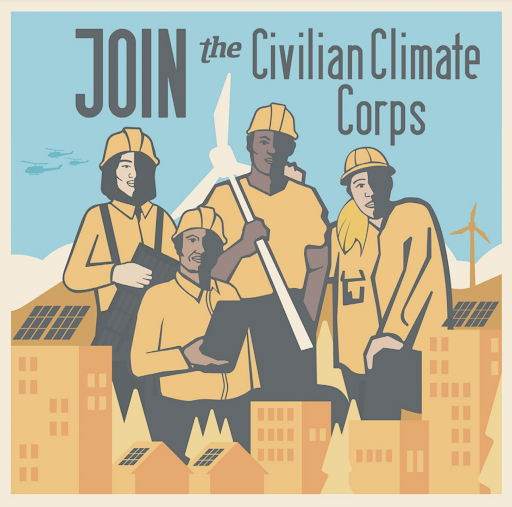
Four workers stand together with the caption “Join the Civilian Climate Corps”

We need to modernize our electricity grid, revamp our agricultural systems, establish rapid disaster-response networks, and more. Meanwhile millions of Americans are unemployed or underemployed. So why not put them to work fighting climate change? This is the logic of the Civilian Climate Corps.

The Civilian Climate Corps

The Civilian Climate Corps (CCC) is a proposed government jobs program that would employ Americans to fight the climate crisis. According to the White House, the program would aim to “conserve and restore public lands and waters, bolster community resilience, increase reforestation, increase carbon sequestration in the agricultural sector, protect biodiversity, improve access to recreation, and address the changing climate.” 

Illustration by Terry LaBan

The Civilian Climate Corps draws inspiration from a similar New Deal job program, the Civilian Conservation Corps, a national public works program that employed over 3 million people over a decade building, repairing, and conserving forests, parks, and natural resources across the country. Like much of the New Deal, however, the CCC largely excluded nonwhite, nonmale people. The Civilian Climate Corps charts a different path.

There are a handful of CCC proposals floating around Washington DC. The most ambitious proposal goes to Ed Markey who seeks to employ an equitable and diverse group of 1.5 million Americans over 5 years. Even this amount is insufficient to meet the scale of the crisis, but it’s a start. It’s also much more comprehensive than other proposals. In his American Jobs Infrastructure bill, President Biden asked for about $10 billion over a decade to fund his CCC, equating to about 10-20,000 jobs a year. Even that figure was whittled down in recent compromises.

Sunrise Movement and the Civilian Climate Corps
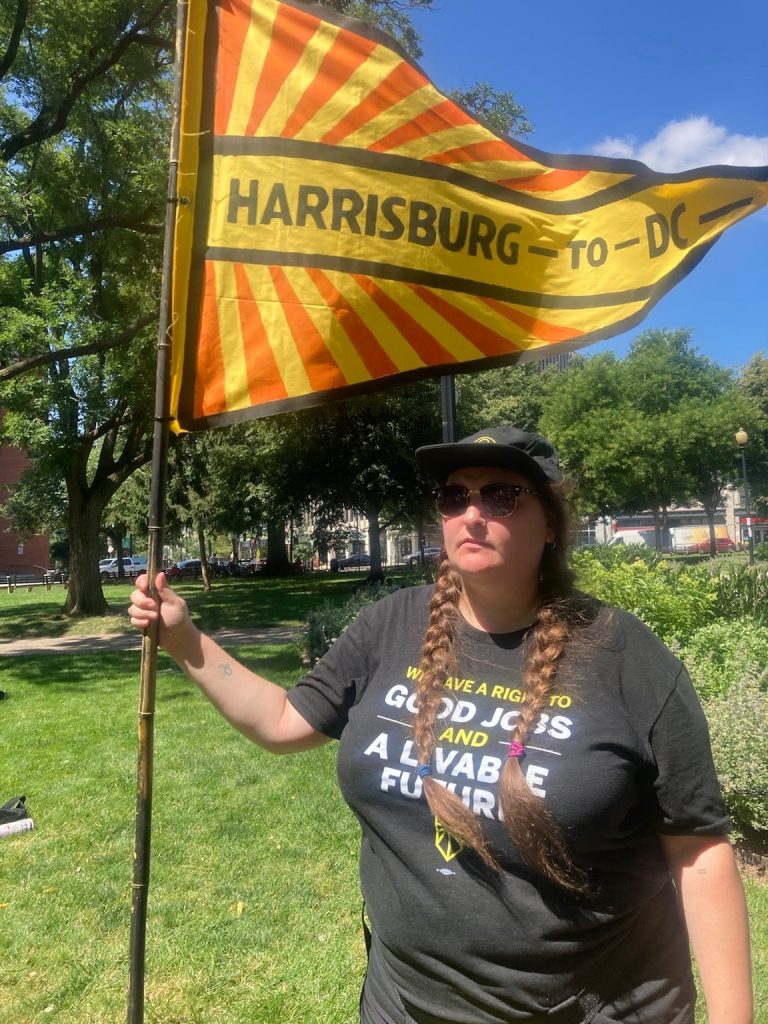
Sunrise Lewisburg hub coordinator, Mary Collier holds a “HARRISBURG – TO – DC –” flag


In response to Biden’s decision to mortgage my generation’s future on an insufficient CCC, I joined a dozen Pennsylvanians in the Sunrise Movement who were trekking from Harrisburg to Washington, DC to demand a bold Civilian Climate Corps. We trekked over 100 miles through the woodlands of Pennsylvania and along the highway shoulders of Maryland. The days were long and hot, the types of days that my generation will endure for decades. So we took care of each other and kept on walking.

We arrived in DC on Sunday, June 27th, and joined hundreds of young people from across the country, including a Gulf Coast Trek and a California Trek. It is important to protect our lives from being compromised away. It is us that can not settle for anything less. So members of the Sunrise Movement rallied outside the White House with young people from across the country and representatives Jamaal Bowman (NY-16), Cori Bush (MA-07), and Alexandria Ocasio-Cortez (NY-14). But we knew that wouldn’t be enough. We needed more.

We used our bodies to nonviolently blockade every entrance of the White House for hours in the scorching sun. Eventually, the Secret Service had to arrest dozens of us. By then we had made our point, so the protest wrapped up soon after.

The experience, from the trek to the protest, grounded my stake in climate action. At 22 years old, what does my future hold when each summer brings another heat wave worse than the last? How long does my family have until disaster strikes? My life and the lives of my loved ones are at stake. We need bold climate action now.

From our author and EcoLead, Sean Welch.
Categories
Act on Climate

Philosophy and the Climate Crisis

In order to tackle the climate crisis, we will need thousands of people organizing their friends, family, neighbors, and co-workers to take bold, collective action that creates power. That much is true for people from all walks of life… including philosophers!

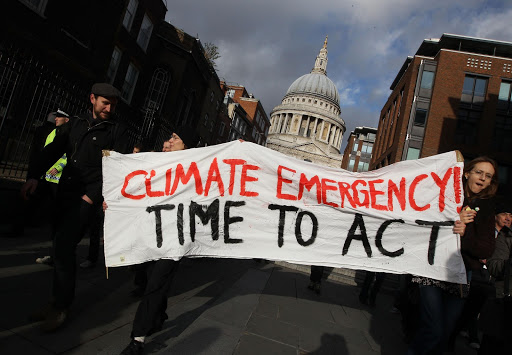
Two people carry a banner reading “CLIMATE EMERGENCY! TIME TO ACT”

Fortunately, an international group of philosophers are getting organized to do just that, encouraging their profession to take leadership on climate change and sustainability. They call themselves Philosophers for Sustainability.

Philosophers for Sustainability.

The group was co-founded by Temple’s own Eugene Chislenko, a professor in the Philosophy Department and local eco-champion. In the Office of Sustainability’s new and student-run podcast, Climate Conversations, we interviewed Eugene earlier this month on his work with the group. While they are still a relatively new group, they have already successfully persuaded the American Philosophical Association (APA) to include more sustainable practices in their professional guidelines. 

A wave crashes into a rocky seashore.

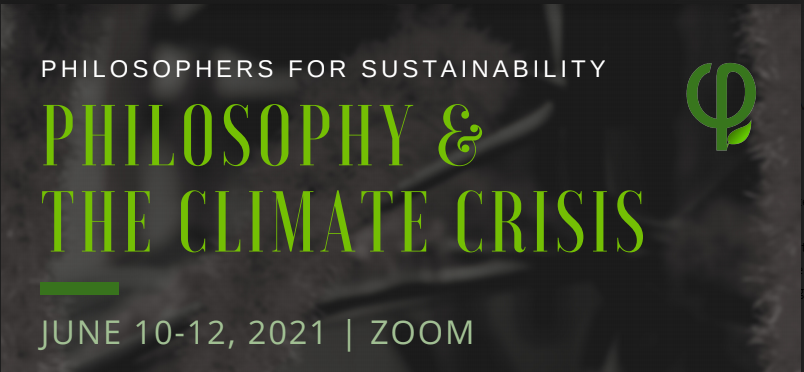
Philosophers for Sustainability has several ongoing projects. They are hosting local Sustainable Practices in Philosophy Workshops across the country through their members, integrating environmental sustainability into their teaching, advocating for greater course offerings on climate change to their departments, sharing best practices with each other, and so much more. In fact, they just held their 2021 conference: Philosophy & the Climate Crisis this past weekend through Temple University.

Conference 2021: Philosophy & the Climate Crisis.

The 3-day conference covered a range of topics. Panel organizers facilitated conversations on minorities in Philosophy, philosophical cases for climate action, teaching the climate crisis, and more. 

I attended the symposium on Teaching the Climate Crisis and was impressed by the panelists’ commitment to creating educational experiences that prepared students for a world in flux.

The panelists were professors across the country who made up Engaged Philosophy, a group of philosophy professors using their courses to teach civic engagement. Professors in the group, like Ramona Ilea in Pacific University, provide hands-on activist projects for their students, building classroom content from their students’ experiences and not the other way around. I left wishing that I had taken more classes like theirs, with my imagination stimulated on education’s role in climate action.

Listen to our Climate Conversations podcast to hear from Euguene himself.

Getting involved.

Learn more about Engaged Philosophy by checking out their website and the resources they provide. You can get involved with Philosophers for Sustainability, consider joining them as a member, although there are several other ways to get involved. If you have any questions, contact the group at philosophersforsustainability@gmail.com.

Finally, Eugene is teaching a pilot Gen-Ed class at Temple this Fall on Climate Change and Climate Justice. If you are interested, send him an email at chislenko@temple.edu! 

Categories
Act on Climate

Climate Action and Global Citizenship

Environmental issues do not distinguish between borders, so it is only natural that an international perspective is brought into the discussion. That is exactly what the Temple Office of Sustainability and International Student Advisory Board (ISAB) hosted; a dialogue about Climate Action and Global Citizenship. In which four international students from around the world were able to share their views that, while as diverse as the students themselves, were united by the common theme of environmental concern.

Environmental Education & Mainstream Media.

The event began with a discussion about environmental education and the role these issues had in mainstream media around the world. It was soon evident that different countries could have drastically different attitudes on the environment which were reflected in their educational policy and the presence of these topics held in the media.

In China, one student relates, he was made aware of environmental issues from a very young age, and that the country experiences a great deal of action when it comes to addressing environmental issues.

On the other hand, a student recounts that Mexico holds no such emphasis on the environment and instead focuses on other domestic issues.

Extreme Weather & Climate Change.

The discussion then shifted to how extreme weather events are dealt with around the world, and how they are connected to climate change. And, since greenhouse gases from transportation emissions are heavily linked to the warming climate, this was also a point of discussion. In a country like Brazil, which has been in the spotlight in connection to the wildfires in the Amazon forest, it is difficult not to take into account extreme weather events, especially after having experienced a devastating drought. Similarly, cities like New Dehli in India, which experience oppressive amounts of pollution, have had to resort to policies that attempt to grapple with the environment, such as restrictions on driving depending on the day and license plate number.

Global Gala.

Global Impact.

Another extremely important environmental aspect to discuss was the impact the U.S has on other countries, whether it be through travel or the consumption of goods. For example, Mexico takes many queues from its northern neighbor, so it is not misleading to say that U.S tourists hold a lot of sways when it comes to where they spend their money.

Furthermore, one student from India began to question the status quo of plastic use that is so prevalent around the world, but especially in the U.S. “I love to travel,” said Moumita, from India, but the way my consumption pattern, or that of the people around me, is based on using a lot of plastic every day, then how can I say I am able to visit places that are beautiful? Because I am spoiling the natural resources, I am spoiling everything.”

When it comes to discussing issues in the U.S, whether it be environmental or otherwise, hearing an international perspective has the effect of jolting Americans out of the perspective they find normal. When it comes to human-induced climate change, this is very much the desired effect– we must realize that this is not normal, and it cannot remain so.

Categories
Act on Climate Stories of Sustainability

Students & Local Climate Action Planning in Pennsylvania

How can college students take climate action in local government? This question is at the core of the Local Climate Action Program (LCAP) under the Pennsylvania Department of Environmental Protection  (DEP). The program matches college students with local governments across the state, then trains both of them through a DEP contractor, ICLEI USA, on how to develop a Greenhouse Gas (GHG) inventory and climate action plan for that government. 

The program’s most recent cohort included three Temple students, so our Office of Sustainability sat them down to discuss their experiences on Earth Day in Stories of Sustainability: ICLEI & Local Climate Action Planning in the Commonwealth.

Creating a GHG Inventory.

After being accepted into the program, the three students, Mark Costanzo, Nicole Somers, and Jada Ackley, received training from ICLEI on creating a GHG inventory tool in Fall 2020. These GHG inventories, as explained by Mark, are lists of emissions sources in the municipality (like homes, energy plants, transit systems, etc.) along with how many CO2 equivalents they emit. These inventories provide crucial information on setting goals of emissions reductions in the later climate action plans.

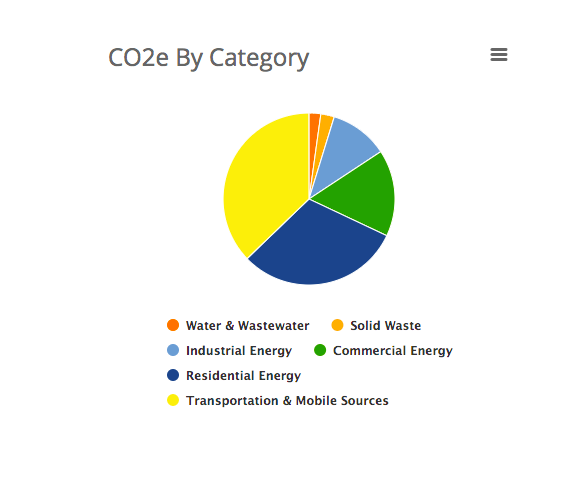
Pie chart of carbon-dioxide equivalents emissions by category for Warwick Township

Students compiled data from local utility companies, transit sources, waste facilities, and more to build these inventories, and soon found that GHG inventories looked different in different places. For example, transportation and residential activities were the major contributors in Warwick Township, PA, the government with which Mark Costanzo collaborated on LCAP.

Local Climate Action Planning.

Students and local governments received additional training in Spring 2021 to create their climate action plan (CAP). These plans, as explained by fellow student Nicole Somers, were meant to reduce GHG emissions while preparing for the impacts of climate change. Accordingly, CAPs include GHG mitigation targets, objectives, and actions, like changing town ordinances to require energy efficiency standards on new buildings, alongside adaptation actions, like expanding green spaces and incorporating climate change vulnerability assessments into future construction plans. Lastly, they developed a monitoring plan to keep track of reductions going forward.

 Image of ICLEI Local Governments For Sustainability.
 Image of ICLEI Local Governments For Sustainability

The third student, Jada Ackley,  discussed the importance of community engagement in any CAP. On one hand, they explained, it helps governments gather information from residents for the plan, but also fosters community support for it. For some examples, Jada used surveys and community workshops to engage residents on what a CAP for Haverford Township needed to include.

Getting Involved.

In her closing remarks, Heidi Kunka, Energy Programs Specialist at DEP and overseer of LCAP, discussed the importance of getting a diversity of perspectives in climate action planning and invited students to fill out an interest form if they may want to apply next year. If you’re interested, check it out!

Everyone has something to gain from fighting climate change, and something to lose from letting it run unchecked.

Categories
Activism Climate Action Plan Uncategorized

The Sustainability Annual Report Is Here

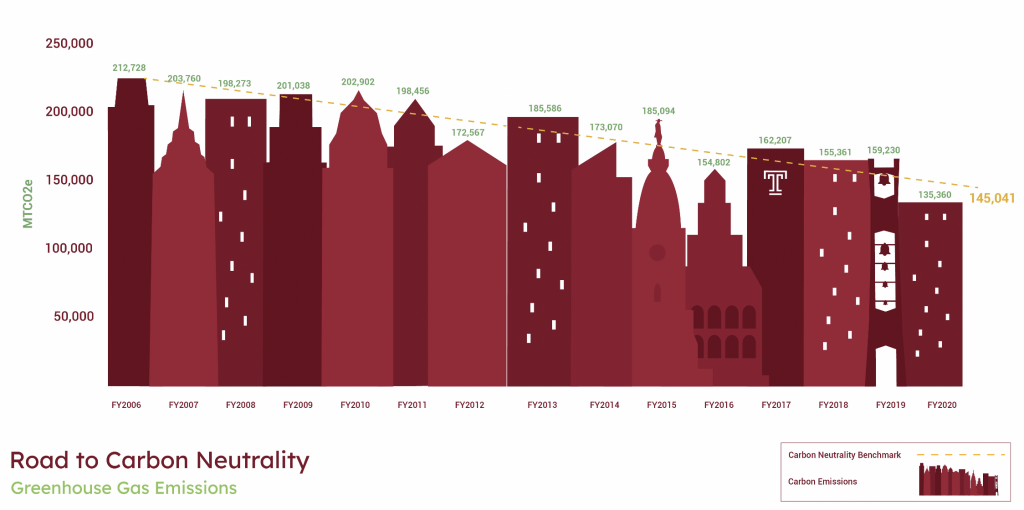
The 2019-2020 academic year started with a renewed strategic vision for climate activism at Temple University. Goals included in the 2019-2020 Sustainability Annual Report were established in the 2019 Climate Action Plan.

The Climate Action Plan, released in April 2019, provided a roadmap for continued progress towards carbon neutrality by 2050. Over 300 members of the Temple community collaborated to articulate goals in 5 different focus areas. These are Academics and Research, Culture, Design, Energy, and Operations. The plan reflects a true commitment from Temple students, faculty and staff to work together to shape a more sustainable and just climate future on campus, in Philadelphia and beyond.

Although the COVID-19 outbreak pushed our report’s release, our students, faculty and staff remained committed to climate action. This Sustainability Annual Report details significant progress towards a more environmentally, socially, and economically sustainable future. Highlights include memorable accomplishments and progress toward goals in all focus areas.

Greenhouse gas emissions progress as seen in the Sustainability Annual Report.
Greenhouse gas emissions progress as seen in the Sustainability Annual Report

Check out the Temple University Sustainability Annual Report. Learn about our commitment to sustainability and our progress to the climate action goals we have in place.

Thank you for being a part of history in the making.