Research Resource Repository
- Tool
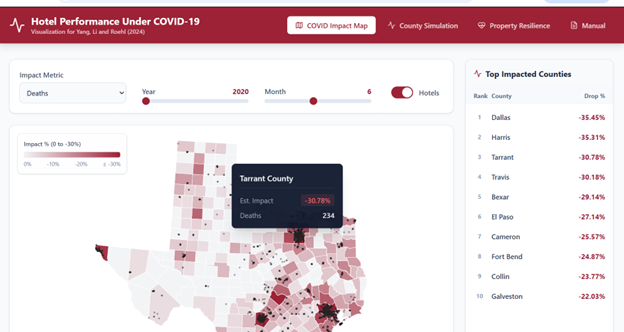
Hotel Performance Under COVID
Tool link: https://uflyy.github.io/covid-impact
This interactive dashboard serves as the companion tool for the research paper in the reference. This tool bridges the gap between theoretical econometric models and practical hotel management, allowing stakeholders to visualize the historical impacts of COVID-19 deaths and cases on hotel revenue across various scenarios.
- Tool
Tourist Experience Simulation Tool
Tourist Experience Simulation Tool is a Web-GIS system designed to help tourism practitioners monitor and simulate tourist experiences under varying environmental conditions. This tool allows users to input specific scenarios defined by air pollution levels (specifically PM2.5), weather conditions (temperature, sun, wind, and precipitation), and date types (e.g., weekends or holidays). Utilizing a predictive algorithm derived from the sentiment analysis of geotagged social media posts, the system calculates “experience scores” to visualize the spatial distribution of tourist satisfaction across the city. This platform enables stakeholders to conduct scenario analyses, such as predicting experience fluctuations during heavy pollution events, and offers features for benchmarking specific locations and recommending itineraries that mitigate the negative impacts of poor air quality
- Dataset
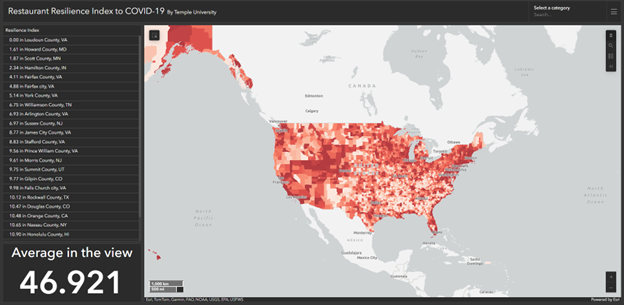
Restaurant Resilience Index
The Restaurant Resilience Index was developed to characterize the regional restaurant industry’s resilience to the COVID-19 pandemic across U.S. counties. Estimated from econometric results regarding daily restaurant demand, this index incorporates key moderating variables—specifically ethnicity, political ideology, dining habits (eat-in vs. off-premise), and restaurant diversity—that were found to influence the magnitude of demand decline caused by the pandemic and stay-at-home orders. By visualizing these data, potentially through tools like an ArcGIS dashboard, the index enables government entities and stakeholders to pinpoint geographically vulnerable areas and effectively allocate support resources, such as consumer voucher programs, to the hardest-hit local businesses.
Link to the Restaurant Resilience Index dashboard.
- Tool
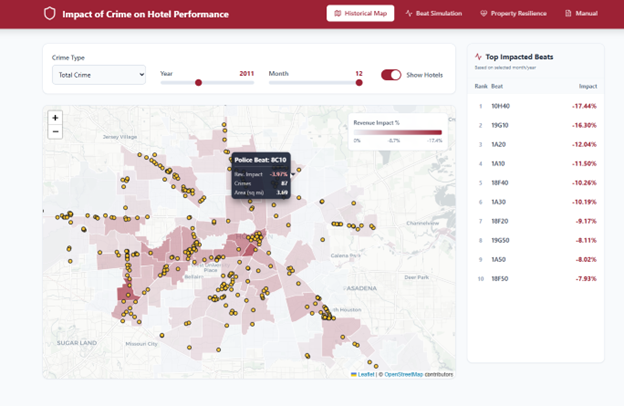
Crime and Hotel Performance Tool
Tool link: https://uflyy.github.io/crime-effect/
This interactive dashboard visualizes the findings from recent literature regarding the intersection of urban crime and hospitality economics. It acts as a companion tool for two principal papers exploring vulnerability and resilience across hotel segments:
Hua, N., & Yang, Y. (2017). Systematic effects of crime on hotel operating performance. Tourism Management.
Yang, Y., & Hua, N. (2020). Does hotel class moderate the impact of crime on operating performance? Tourism Economics.
Historical Map Module
The Historical Map projects Houston Police Beats alongside hotel establishments to monitor absolute crime counts and estimate percentage impacts on monthly hotel revenue. Built on interactive OpenStreetMap tiles, the module applies a dynamic choropleth rendering. Visual mapping allows stakeholders to hover over regions and examine geographical clustering of property crimes versus violent crimes across the 2009–2014 timeframe.
Beat Simulation
The Beat Simulation assists developers and asset managers in understanding systemic risk. By selecting a localized police beat, the tool automatically preloads the local hotel class composition and average room counts. Crucially, users can manually override these portfolio metrics—adjusting the total number of hotels, room capacity, and class distribution (Economy, Midscale, Upscale, Luxury)—to create custom “What-If” development scenarios. This enables rapid estimation of theoretical monthly dollar losses applied to aggregate capacity against hypothetical spikes in criminal incidents.
Property Resilience
Guided by the Routine Activities Theory framework addressed in Yang and Hua (2020), this module recognizes that higher-end hotels exhibit significantly higher threshold resistance against crime externalities due to intensive site hardening. The Resilience Module computes an indicative score comparing specific asset profiles (Class segment & Scale) against market benchmarks.
- Tool
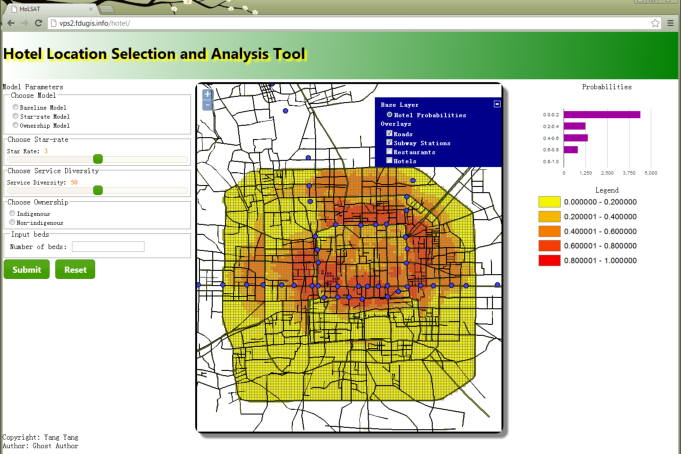
Hotel Location Selection and Analysis Tool (HoLSAT)
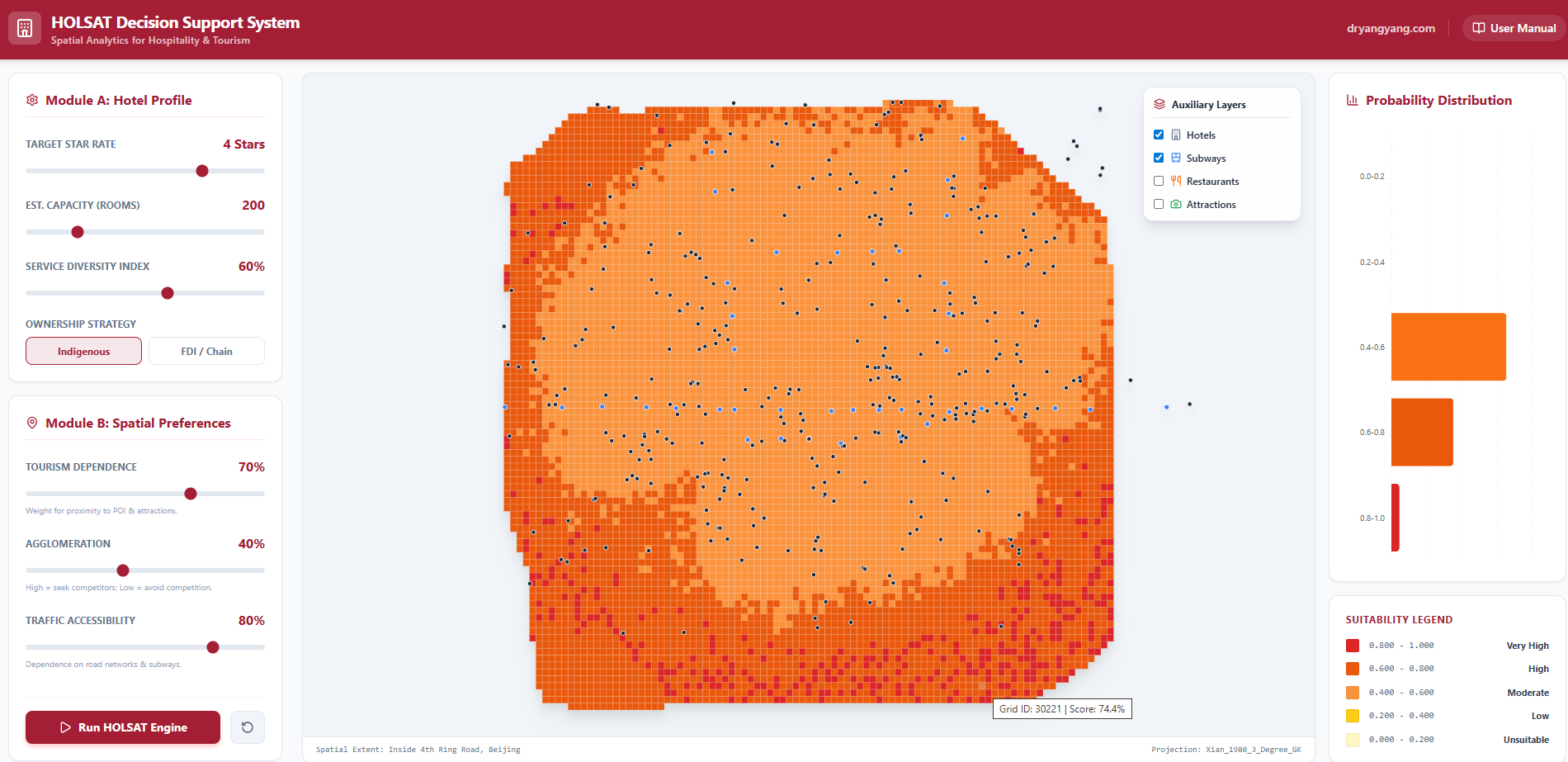
Hotel Location Selection and Analysis Tool (HoLSAT) is a WebGIS-based spatial decision support system and simulation toolkit designed for hotel location assessment. In your study of Beijing hotels, we programmed a simulation toolkit that allows hotel investors to assess various determinants and calculate the probability of a hotel locating in a specific potential site based on estimated model coefficients. Furthermore, in our research on Los Angeles, you developed a location evaluation tool that utilizes a “fishnet” grid system to predict and simulate location preference scores for any site within the research area. This tool allows stakeholders to conduct scenario analyses, evaluating how different traveler portfolios or changes in location factors (such as new metro lines) would influence guest satisfaction with a hotel’s location. Additionally, our work on Hong Kong hotel preferences advocates for a Web-GIS platform that uses willingness-to-pay (WTP) estimates to demonstrate promising location sites for new market entrants
We updated the program with a Vite + React framework Web APP in March 2026. Now it is online via: https://uflyy.github.io/hotel-gis-app/
Here is the new tool snapshot:

You must be logged in to post a comment.