JOURNAL OF TRAVEL RESEARCH
Understanding guest satisfaction with urban hotel location
- 2018
- JOURNAL OF TRAVEL RESEARCH
- 10.1177/0047287517691153
Yang, Yang; Mao, Zhenxing; Tang, Jingyin
Abstract
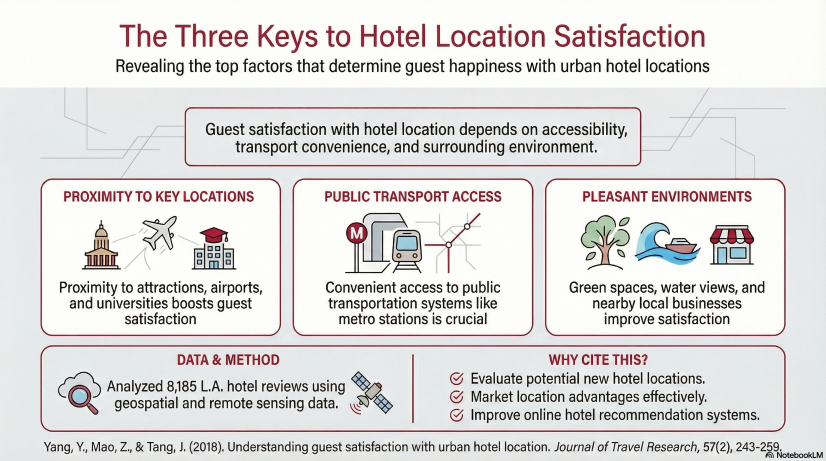
In this article, we unveil determinants of guest satisfaction with urban hotel locations and disclose what types of locations are preferred by guests. Using data from 8,185 online reviews of 220 Los Angeles hotels checked in during a 1-year period, we apply a mixed-effect ordered logit model to investigate factors determining location evaluation scores. We classify all location-related factors into three categories: accessibility to points of interest, transport convenience, and surrounding environment. Our results suggest that a property’s accessibility to attractions, airports, universities and public transportation, as well as green spaces, bodies of water, and local businesses are significant determinants. Free parking and airport shuttle bus service could mitigate disadvantages related to inferior airport accessibility. Moreover, we underscore different hotel location satisfaction effects across travelers’ experiences and types of travel described in the online reviews. Lastly, different types of travelers demonstrate heterogeneous location preferences related to different tourist attractions.
Keywords
hotel location; accessibility; transport convenience; mixed-effect ordered logit model; NDVI
Research topic
AI and Big Data, Digital Platform and Pricing
Research method
Econometrics, Big Data
Geographic area
US
AI Audio Overview
AI Infographic