TOURISM MANAGEMENT
Balancing the clock: How predictive scheduling laws influence employee satisfaction in the U.S. tourism and hospitality industry
- 2026
- TOURISM MANAGEMENT
- 10.1016/j.tourman.2026.105419
Yang, Yang; Tan, Karen Pei-Sze; Liu, Yi Vanessa
Abstract
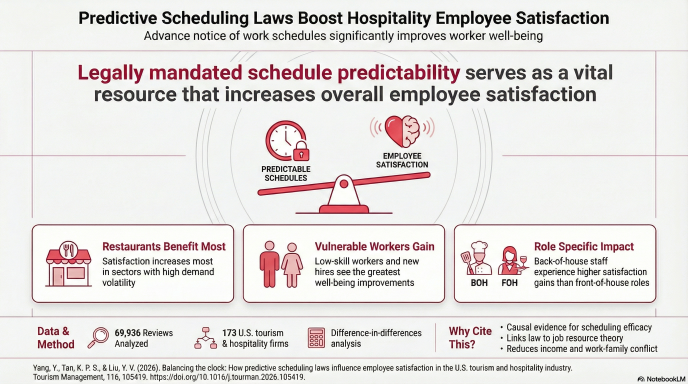
As more U.S. jurisdictions implement predictive scheduling (PS) laws for selected industries, more employers are required to provide employees with advance notice of work schedules. We evaluate the impact of these laws on employee satisfaction in tourism and hospitality by building on the job demands-resources theory. Using U.S. Glassdoor reviews from current employees at 173 tourism and hospitality firms, we exploit the staggered adoption of PS laws and implement a difference-in-differences research design with high-dimensional fixed effects. Results indicate that exposure to PS laws is associated with a statistically significant increase in employee satisfaction. This is most pronounced among employees with less than 3 years at the company, particularly those in the restaurant (vs. hotel vs. foodservice contract companies vs. others) sector working in low to mid-level skills positions and engaging in back-of-house (vs. front-of-house vs. mixed) roles. Findings are robust across various checks, confirming PS laws as a job resource.
Keywords
Predictive scheduling; Tourism and hospitality employees; Employee satisfaction; Business types; Customer orientation; Job tenure; Skill level
Research topic
AI and Big Data, Digital Platform and Pricing
Research method
Econometrics, Big Data
Geographic area
US
AI Audio Overview
AI Infographic
Extra Information
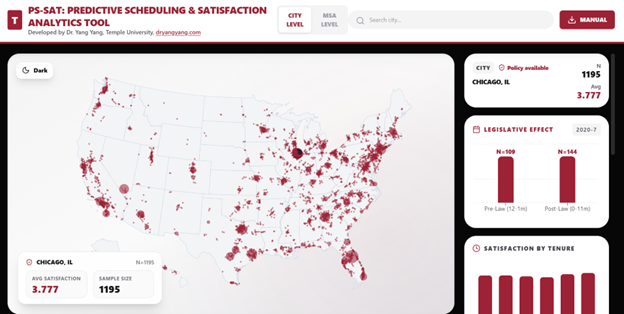
Data Tool on Predictive Scheduling and Employee Satisfaction [link]