Digital Platform and Pricing
Recommendation
- Article
- US
- Econometrics, Big Data
Yang, Yang; Tan, Karen Pei-Sze; Liu, Yi Vanessa
- Article
- US
- Econometrics, Big Data
Zhang, Ziqiong; Yang, Yang; Wang, Xueyan; Wang, Chuxin; Zhang, Zili
- Article
- US
- Econometrics, Big Data
Tian, Fengjun; Wang, Zhonglie; Yang, Yang; Mao, Zhenxing
Related Presentations
Related Resources
- Tool
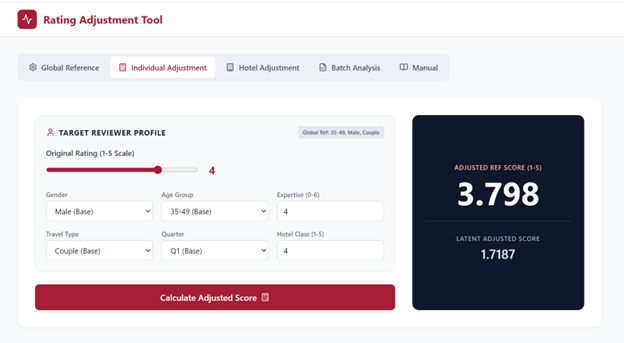
Rating Adjustment Tool
Tool link: https://uflyy.github.io/rating-adjustment/
The Rating Adjustment Tool is an advanced analytical web application designed to standardize hotel online reviews by correcting for “scaling heterogeneity”—the phenomenon where different types of reviewers interpret and use rating scales differently. Powered by a Hierarchical Ordered Probit (HOPIT) model grounded in peer-reviewed academic research , the tool mathematically controls for systematic response biases tied to traveler demographics (such as age and gender) and trip characteristics (such as travel type and reviewer expertise). By offering individual review adjustments, hotel-level aggregate score calculations, and batch CSV processing, the tool effectively translates subjective, raw user ratings into objective, comparable latent scores and standardized 1–5 metrics, ensuring fairer and more accurate hotel evaluations.
This rating adjustment tool is built on the theoretical framework and empirical results from the following paper:
Leung, X. Y., & Yang, Y. (2020). Are all five points equal? Scaling heterogeneity in hotel online ratings. International Journal of Hospitality Management, 88, 102539.
- Tool
PS-SAT: Predictive Scheduling & Satisfaction Analytics Tool
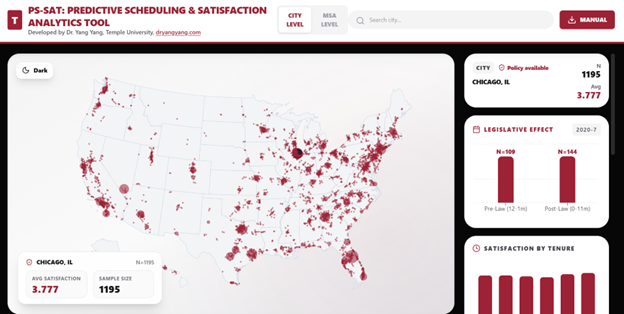
This web-based dashboard is designed to visualize tourism and hospitality employee satisfaction data across U.S. geographic units at both the City and Metropolitan Statistical Area (MSA) levels. The application provides interactive mapping, subgroup breakdowns, and (where applicable) legislative pre– and post–comparisons.
Key Features:
- Dual-Level Geographic View: Users can switch between City-Level (point markers) and MSA-Level (polygon map) visualization.
- Interactive Search & Selection: Users can search locations dynamically and select them either via the map or the dropdown search interface.
- Subgroup Breakdown Analysis: Satisfaction scores are displayed by:
-
- Job tenure
- Business model
- Skill level
- Front-of-house vs. back-of-house
- Legislative Effect Comparison: For locations with valid policy-period data, the dashboard displays Pre-Law vs. Post-Law satisfaction comparisons.
- Visual Encoding of Sample Size: City marker size scales with sample size (N), allowing immediate identification of data-rich locations.

You must be logged in to post a comment.