INTERNATIONAL JOURNAL OF CONTEMPORARY HOSPITALITY MANAGEMENT
Restaurant week paradox: from relation to transaction in online reviews
- 2026
- INTERNATIONAL JOURNAL OF CONTEMPORARY HOSPITALITY MANAGEMENT
- 10.1108/IJCHM-07-2025-1124
Yang Yang, Qianwen Yin, Gyusang Hwang, Sai Liang, Dejin Yang
Abstract
Purpose
This study aims to investigate the impact of Restaurant Week participation on online engagement, exploring the tension between relational and transactional review behaviors.
Design/methodology/approach
Grounded in the social exchange theory-equity theory (SET-ET) framework, this study analyzes a longitudinal Yelp data set from Houston (2007–2019) using a difference-in-differences approach to identify the causal offline to online effects.
Findings
Participation in Restaurant Week drives a surge in review volume but a concurrent decline in review helpfulness. The SET-ET framework explains the “Restaurant Week Paradox”: promotional scarcity triggers the reciprocity norm, while the discount frame simultaneously activates a transactional, effort-minimization heuristic. Further analysis reveals that first-time reviewers and locals drive this engagement trade-off, whereas returning patrons and tourists maintain cognitive depth. Fine-dining establishments incur a more severe utility penalty than casual-dining establishments.
Practical implications
This study offers strategic pathways to preserve digital review utility. At the micro-level, managers should adopt product-based framing and dynamic inventory allocation to maintain service standards. At the macro-level, destination marketing organizations should implement tiered participation guidelines to protect brand equity.
Originality/value
This study advances relationship marketing by establishing event-based promotional scarcity as a theoretical boundary condition within the SET-ET framework, demonstrating that digital reciprocation is contingent upon a consumer’s relational proximity rather than solely on the economic deal.
Keywords
Restaurant week, Online engagement, Event-based marketing, Social exchange theory, Equity theory, Online reviews
Research topic
Digital Platform and Pricing
Research method
Econometrics, Big Data
Geographic area
US
Extra Information
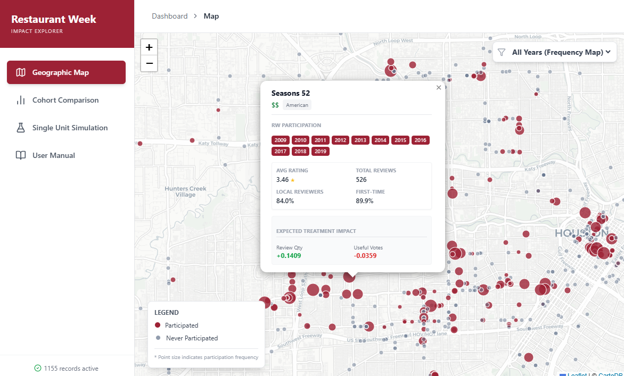
Data Tool on Restaurant Week Impact Explorer [link]