In a two-game rout, the Eigenspikers made short work of the Volleytines, earning them their second victory in so many weeks. Congrats to the whole team for a memorable victory!


Computational biophysical modeling and simulation group in the Department of Chemistry at Temple University
In a two-game rout, the Eigenspikers made short work of the Volleytines, earning them their second victory in so many weeks. Congrats to the whole team for a memorable victory!
From June 3-14, Temple’s College of Science and Technology (CST) is hosting a two-week (~4 hours a day, 5 days a week) workshop on computing and statistics, designed to orient graduate students (and advanced undergraduates) on professional scientific computing and statistical reasoning. Organizers of the workshop are Prof. Matthew Newby (Physics), Prof. Vincent Voelz (Chemistry), and Prof. Adrienn Ruzsinszky (Physics).
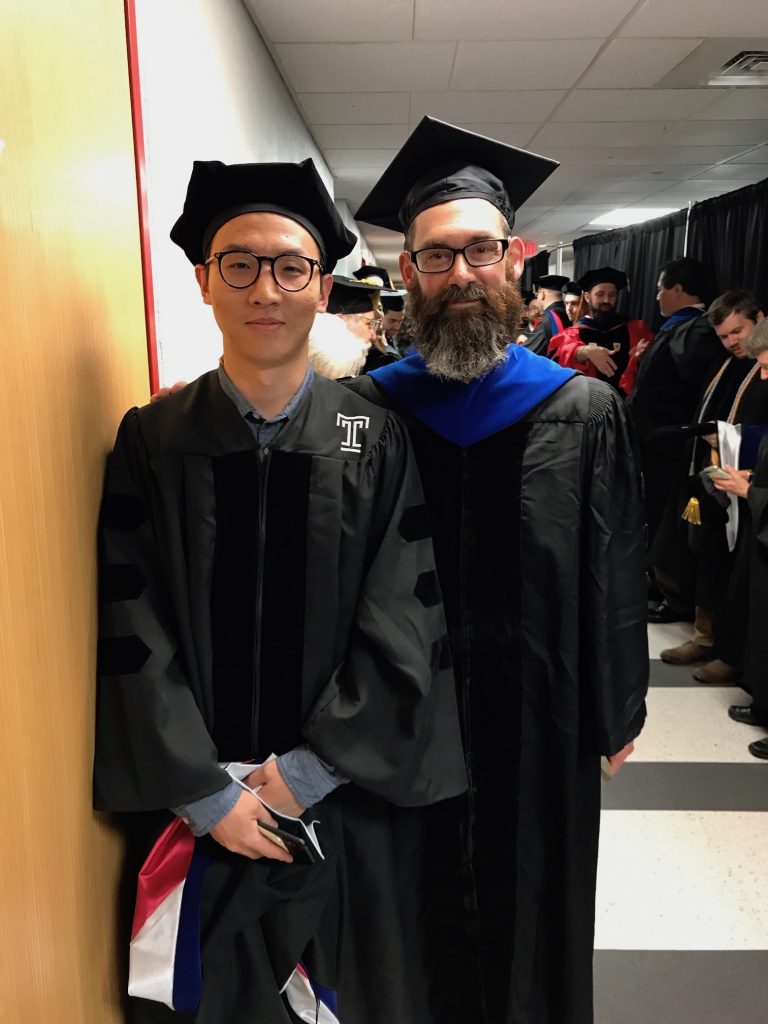
Hongbin Wan successfully defended his thesis, “Efficient Sampling of Protein Conformational Dynamics and Prediction of Mutation Effects”, on April 23. Congrats Hongbin!
| In new collaborative work with the Andrade, Leimkuhler Grimes, Dunman and Valentine groups, we have brought our cutting-edge computational methods to bear on the problem of understanding the effects of the macrolide antibiotic albocycline on Staphylococcus aureus, bacteria attributed as a major source of antibiotic resistance. Based on initial characterizations of albocycline, which suggested a mechanism in which the molecule targets inhibits of peptidoglycan biosynthesis of the bacterial cell wall, our manuscript explores the inhibition of an enzyme called MurA by albocycline. Experimental studies from the Grimes group showed that albocycline inhibits MurA. To model the interaction between albocycline MurA, we used our BICePs algorithm to combine QM/REMD modeling and NMR restraints to determine the likely structure of albocycline in solution. We then performed distributed simulations of the MurA enzyme on Folding@home, generating a large collection of receptor conformations that we could use to homology-model related enzymes and perform computational docking. Intriguingly, the ensemble-docking studies correctly predicted the relative affinities of albocycline to S. aureus MurA, S. aureus MurZ and E. coli MurA. However, we also find the albocycline is a more potent antibiotic than can be explained by its affinity for MurA alone, suggesting another target, which may be discovered by future screening of resistance mutants. To learn more, check out our full paper in Bioorganic & Medicinal Chemistry:Elucidating the inhibition of peptidoglycan biosynthesis in Staphylococcus aureus by albocycline, a macrolactone isolated from Streptomyces maizeus. Liang, Hai; Zhou, Guangfeng; Ge, Yunhui; D’Ambrosio, Elizabeth; Eidem, Tess; Blanchard, Catlyn; Louka, Cindy; Chatare, Vijay; Dunman, Paul; Valentine, Ann; Voelz, Vincent; Grimes, Catherine; Andrade, Rodrigo, Accepted, Bioorganic & Medicinal Chemistry (2018). doi:10.1016/j.bmc.2018.05.017 |
Comments