Temple University’s Office of Sustainability is thrilled to present our February events and this year’s Campus Race to Zero Waste campaign. Join us in sowing the seeds of change and nurturing a more eco-friendly campus.
Campus Race to Zero Waste is a sustainability competition in which Temple University goes head-to-head against schools across the country to see who can divert the most waste from landfills.
Want to get started? Check out the calendar below to discover the array of events happening on and off campus this February. Click the links to RSVP and become a part of the movement toward a circular economy!
Kickoff: Feb 2 – March 29, 2025
Theme
Event
Where & When
RSVP
Sustainable Fashion
Temple Thrift Pop-Up
Tuesday, February 11, Morgan Hall North D301, 10AM – 3PM
Reflections from Climate Café student facilitators Kai Yuen & Maggie Roseto
In the face of anthropogenic climate change, people are scared and struggling to find ways to deal with feelings of activist burnout, and impending doom. The term “eco-grief” or “climate-anxiety” was coined by the Climate Psychology Alliance to describe the feelings relating to the chronic fear surrounding environmental disaster.
“College students are experiencing all-time high rates of depression, anxiety and suicidality, according to the latest Healthy Minds survey. In the annual survey, which received responses from 96,000 U.S. students across 133 campuses during the 2021–22 academic year, 44 percent reported symptoms of depression, 37 percent said they experienced anxiety and 15 percent said they have seriously considered suicide—the highest rates in the survey’s 15-year history.”
As Environmental Studies Majors, we are constantly learning about the inescapability of climate issues. It is difficult to attend classes everyday learning about the sometimes seemingly unreachable solutions to slowing the rapid destruction of the planet. Even outside the classroom, overwhelming amount of media and bad news coverage of extreme weather effects, glacial melting and more natural lands being ceded to big oil overwhelms and it is difficult to not get bogged down and feel hopeless in the face of such an insurmountable crisis.
Addressing student wellness
The Climate Psychology Alliance has started a program called “climate-café” modeled from a death-café model. This semester, we have adopted the program for Temple University through the Office of Sustainability in order to provide EcoReps and the Temple Community a place to share their feelings about and personal responses to climate change.
hyper object – an object or event whose dimensions in space and time are massive in relation to a human life, eg a black hole, an oil spill, all plastic ever manufactured, capitalism, and especially climate change
There is a large lack of space for people, and especially students to reflect, digest, and work through their thoughts about climate change, since it really is a hyper object, whose dimensions in space and time are massive in relation to a human life and therefore extreme difficult to make sense of.
Climate Cafés at Temple
In spring of 2023, the Office of Sustainability began our own version of Climate Café, hosted and facilitated by EcoLeads who participated in training run by the North American Climate Psychology Alliance.
Focused specifically on addressing climate and environment-related anxiety for students and young people, Climate Cafés at Temple were implemented to provide a haven from the business and activity of the world.
To address this, we sought to create an interdisciplinary and holistic experience where peers learn from each other, sharing their diverse perspectives and approaches to interacting with climate and the environment, coming together to work through and process shared climate grief intellectually, cognitively and emotionally,
What happens during a Climate Café
The climate café is essentially a guided reflection through dialogue with like-minded peers. We try to create a comfortable, peaceful space filled with tea and refreshments, and natural objects. The climate café consists of four parts;
Principles and Ground Rules
Personal Statement
Climate Café,
Wrap=up and Processing
We begin by explaining the purpose of the climate café with some background and laying out some ground rules. Basic ground rules include being respectful and open to other people’s views, active listening, and leaving space for silence.
The personal statements take up a generous amount of time. Participants are encouraged to choose from a series of natural objects on the table and share why they chose the object, something about climate change, and something about themselves. Everyone is encouraged to share but there is no requirement, participants are told to share whatever they feel comfortable with.
After this round, the floor is open for discussion for anyone to bring up something that jumped out at them during the personal statements, or anything else they wish to talk about more, wish to share, or need to get off their chest. To conclude the café, we always provide a brief reflection and then ask participants to provide feedback on how to improve the program and what things would make it a more comfortable experience.
Evaluating Measuring Impact
There were many similarities in themes and topics discussed in our eight climate cafes this semester. We spent a lot of time discussing current events as it was a tumultuous semester. We discussed the Willow Project, train-derailments and extreme weather like flooding in South Florida and California. Many participants talked about desensitization and feeling numb to many of the ideas in the media. We also talked about individual and corporate responsibility and autonomy of action. We also shared the importance of looking at cute animal videos and other things that bring us joy.
I think the biggest takeaway we have found is that people are just looking for community.
Climate Café has provided a space for students to find fellowship and meet like-minded peers. It seems our peer-led climate café program has allowed people to realize that they are not alone in their feelings and can relate to other peers through common values.
Throughout the semester we have given each participant a pre and post evaluation form assessing anxiety levels overall, and about climate change. We hosted eight climate cafes and reached 60 participants. 51% of respondents felt that their anxiety in general lessened, while 45% felt it stayed the same and 6% felt it worsened. 56% of respondents felt that their climate change-related anxiety lessened, while 43% felt that it stayed the same and 11% felt that it worsened. Because the vast majority of participants felt that their anxiety remained the same or improved, we are hopeful that this program will positively impact students and other members of the Temple Community in semesters to come.
51% of student participant respondents felt that their anxiety in general lessened and 56% of student participant respondents felt that their climate change-related anxiety lessened.
Because the vast majority of participants felt that their anxiety remained the same or improved, we are hopeful that this program will positively impact students and other members of the Temple Community in semesters to come. Huge thank you to everyone who shared the space with us this semester. We look forward to growing the program throughout the fall semester and reaching even more students.
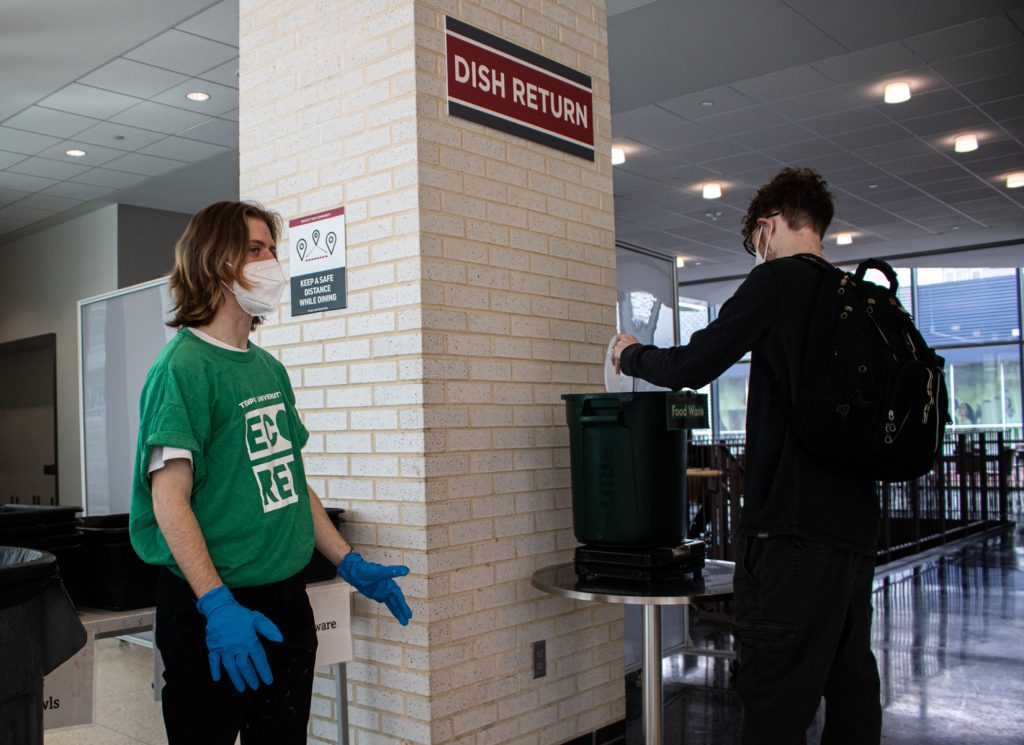
Over the course of two weeks, students volunteered during lunch from 11am – 2pm at the dish return station in Morgan Dining Hall. From buffalo cauliflower wings to unfinished pizza slices, students were able to get a glimpse at the process of diverting food waste from landfills.
Goal: Teach students about food waste and get metrics on how much food ends up in the dining hall’s bio digester. The two weeks inspired a multitude of learning opportunities and insights around waste literacy on Temple’s campus.
Here are some of the key takeaways from the Weigh the Waste event:
Even though the food waste bucket is at the dish return spot in the dining hall all the time, this event highlighted the lack of student familiarity with separating food waste.
Most of the students eating at the dining hall were unaware that there was a food waste bucket at the dish return table in Morgan.
A majority of the students however, were willing to listen to instructions on where to put their waste when directed by the dining hall staff and EcoReps.
Thanks to students’ willingness to learn, we saw individuals become more familiar with the process of separating their food waste.
EcoLead Mason Dofflemyer instructs student diner on how to properly dispose food waste
Food Waste and Future Opportunities
From this event, there is a lot of momentum around the scope of food waste. We are so excited to continue to partner with Aramark to address the issue of food waste on Temple’s campus. These two weeks of Weigh the Waste have identified how we can improve our food waste mitigations strategies as students and as an institution.
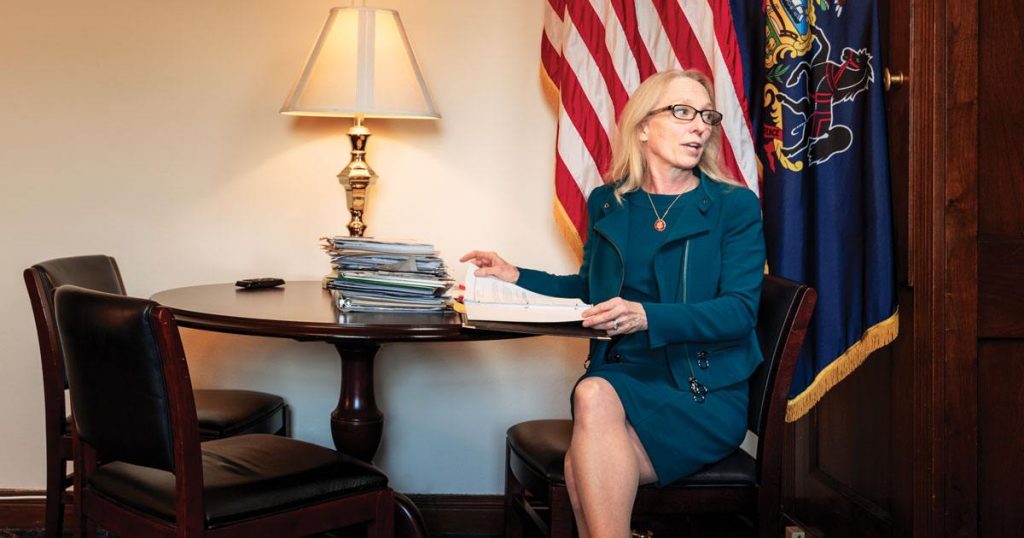
In September of 2020, the Temple College of Public Health hosted several political leaders to discuss Social Justice, Public Health, and the 2020 Election. Most questions posed to the panelists centered around electoral participation. Nevertheless, one question in particular caught our attention.
After acknowledging the PES refinery explosion and the trash-burning plant in her district, both being textbook examples of environmental racism, Scanlon provided an overview of some of regulatory confines under which climate action policies operate:
“When I was on the local school board, we had to do some rebuilding. Of course, you want to do it in a sustainable way. But the laws and regulations you operate under require certain things with respect to funding and you can’t raise taxes more than a certain amount in our school districts so… the budget was always a concern.
“People wanted to put solar panels on and would say, ‘well right across the river in New Jersey all those schools are doing solar panels.’ Well, New Jersey had implemented state funding to incentivize the use of solar energy. We didn’t have that in Pennsylvania so that became economically not possible.”
Scanlon then stressed the federal government’s role in funding state and local climate action. The Representative’s story illustrates a tension between climate action policies and the divisions of power between our governments.
Local governments are reliant on state and federal funding, revenue streams which have withered over the past half-century due to predominance of neoliberal governance — leaving cities, and communities of color in particular, out to dry. This problem is pronounced in Philadelphia, where the state government’s flat tax rate inhibits Philadelphia’s ability to raise revenue. Assuredly, there are other revenue-raising tools the city can employ which have gone underutilized. Still the issue remains: much of the funding for a Just Transition will need to come from the federal government.
Temple is Philadelphia. As the only four-year public college in Philadelphia and as an urban institution that is deeply engaged in the community, Temple University’s commitment to sustainability can have a profound impact on the health and quality of life of a large and diverse population within Temple and its surrounding environment. The university is positioned to be an important educational resource for teaching sustainability, with its three pillars of environment, economics and social justice.
We are committed to demonstrating the value of environmental justice principles through our own example and through the activities we sponsor in the community. Temple aims to serve as a model for similar urban institutions and to burnish its national reputation for excellence and commitment to principled policy and action.
Our staff is continually encouraged and inspired by our students’ demands for justice and equity. We commit to challenge ourselves to incorporate the daily work of anti-racism and the unlearning and dismantling of white supremacy into our sustainability programming and in the fulfillment of our Climate Action Plan.
We know our work is just beginning and built on a large body of scholarship and activism from many dedicated and brilliant people, celebrated and lesser known. We look forward to working for a just climate future together in community with Temple students, staff and faculty and our North Philly neighbors. We’re starting by learning and listening.
Here are some action steps and reading lists from our own Temple Sustainability staff:
Teach-In: Environmental Justice
Just this past April we celebrated the 50th anniversary of Earth Day with a student-led teach-in on a brief history of environmental justice and conversation about inclusive climate leadership at Temple. You can see the slides here. For more even more background, the NAACP has great resources here on their site.
Get Involved: Support #BlackBirders
Beloved Temple alum and Philly community member, Tykee James, currently serves as an Audubon Society’s Government Affairs Coordinator and co-founded #BlackBirdersWeek to show that diversity in outdoor recreation exists, and to reinforce that nature is meant to be enjoyed by everyone. See Tykee in action here.
Temple Sustainability is proud to support #BlackBirdersWeek and join all Audubon’s efforts to ensure the outdoors – and the joy of birds – is safe and welcoming for all people. If you would like to learn more about this initiative and join the student-led environmental justice working group within our new Audubon campus chapter, you can sign up via this form.
Staff Picks
Caroline Burkholder, Sustainability Manager, is a student of Urban Bioethics at the Lewis Katz School of Medicine and thinking hard about the embodied experience of structural inequality and environmental insecurity as it relates to climate change, clinical care and community accountability. She is reading and re-reading “Police Power and Particulate Matters: Environmental Justice and the Spatialities of In/Securities in U.S. Cities” by Julie Sze and Lindsay Dillon. Check it out here.
Rebecca Collins, Director of Sustainability, recommends this essential perspective from Black climate expert, Ayana Elizabeth Johnson, and this call to action from a grandfather of the climate movement, Bill McGibbon, for the New Yorker.
If you would like to unpack these readings with us or join us in active dialogue about how to better incorporate principles of environmental justice into sustainability work on campus, please reach out via email to sustainability@temple.edu.