Omidreza is presenting at IMECE’23

Omidreza presented at the IMECE 2023, International Mechanical Engineering Congress & Exposition, ASME.

Title: Interpretable Machine Learning Modeling of Li-ion Batteries

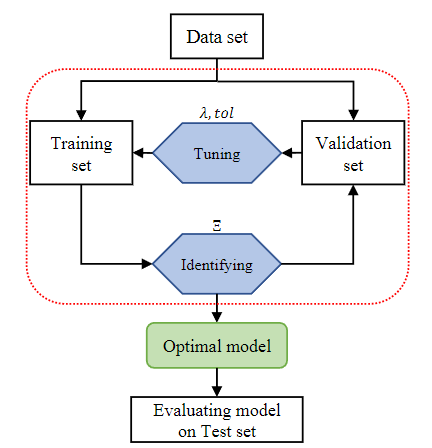
Abstract: Lithium-ion batteries (LIBs) are present in many modern applications due to several desirable properties such as high energy and power densities. Accurate real-time modeling of LIBs improves their operation and safety. Traditionally, equivalent circuit models (ECM) have been used to model LIBs due to their simplicity. These models utilize passive electrical components such as resistors and capacitors to model the battery’s responses. However, their lack of connection to physics results in poor extrapolation performance, and they require limiting the operating range and life of LIBs. These drawbacks have led to an increase in the popularity of physics-based models of LIBs in real-time applications over the past few years. However, developing these models is very cumbersome and requires several measurements and information that often are unavailable and change with the operational conditions and life of the batteries. We propose a novel solution for battery management systems through interpretable machine learning (ML) modeling. We identify the governing equations of LIBs without requiring the in-situ measurements and proprietary information needed by physics-based models. To address the common issue of overfitting and finding a wrong fit with many ML techniques, which results in poor performance in unseen scenarios, we propose a novel physics-informed reduced-order nonlinear model of LIBs. The model’s input is the electrical current and the measurable output is the voltage. We seek an input/output based formulation that predict the dynamics of LiBs., and SOC as the output of the ML model. We used Sequentially Thresholded Ridge regression (STRidge) to promote the model’s sparsity. The technique includes physics-based functions and employs sparse regression to balance the accuracy and complexity of the model using measured data. These terms were associated with the solution of the Doyle-Fuller-Newman (DFN) model, which is a mechanistic model. The added observables (functions of the input/output data) are solid and electrolyte concentration, the Butler-Volmer equation, and solid and electrolyte electric potentials. Furthermore, we improve our ML models by i) augmenting the method to determine the battery’s governing equations with noisy measurements accurately, and ii) restructuring the optimization problem and introducing the sparsifying parameters as hyperparameters and tuning them using a training and a validation dataset, hence resulting in a more generalizable model. Sparsifying parameters are thresholds and regularization parameters that nullify the less important terms and adjust the coefficient values, respectively to balance model accuracy and complexity. We use training data with known input/output to find sparse models for different ranges of hyperparameters. The identified sparse model for each hyperparameter is assessed with the validation data set whose input is only known. The hyperparameters that provide the lowest cost function for the validation data are selected. In addition, we present a robust modeling technique for noisy measurements. This model uses a Kalman filter approach, where the sparse terms are updated based on the Kalman filter to remove the noise from the voltage data and enhance the state of charge (SOC) prediction. We have tested the method using data from advanced chemistry that is used to develop new electric vehicle applications (21700 cylindrical cells, NMC811). We used uniformly distributed electrical current signals up to 2C/4C charge/discharge rates for training the model and the US highway profile (US06) for the validation set. We showed the model’s accuracy using the Urban Dynamometer Driving Schedule (UDDS) as the unseen test data. The model predicted the response with less than 8.3×10^−5 normalized root mean square error (NRMSE) for SOC and Voltage predictions.

Related Publications:

  1. O. Ahmadzadeh, R. Rodriguez, Y. Wang, D. Soudbakhsh, A physics-inspired machine learning nonlinear model of li-ion batteries, in: 2023 American Control Conference (ACC), IEEE, 2023, pp. 3087–3092. 10.23919/ACC55779.2023.10156368
  2. O. Ahmadzadeh, Y. Wang, D. Soudbakhsh, Sparse modeling of energy storage systems in presence of noise, IFAC-PapersOnLine 56 (2) (2023) 3764–3769. https://doi.org/10.1016/j.ifacol.2023.10.1546
Mohsen is presenting at CCTA’23

Title: Effect of Temperature and SOC on Frequency-Response Modeling of Li-ion Batteries

Abstract: This paper investigates the choice of equivalent circuit models (ECMs) for modeling Li-ion batteries (LiBs). ECMs with distributed elements (dECMs) are the most common tools to analyze LiB impedance spectra. However, the choice of the model is ambiguous. In this work, we investigate the validity of 14 typical models to accurately represent the impedance spectra of the cells under various operating conditions such as cycling, various State-of-Charge, and temperatures. These models represent a more extensive set as such ECMs are degenerate, and several models are equivalent.
The model parameters were fit to the experimental data using a complex nonlinear least squares (CNLS) approach.
We used 7 Li-ion cylindrical cells with graphite/LiFePO_4 material in our studies and measured electrochemical impedance spectroscopy (EIS) under several scenarios: i) new cells, ii) after cycling, iii) resting at different temperatures, and iv) indented cells.
The models with the worst fit were excluded from the study after each fitting set. Our study showed that two of the 14 original models are general enough to represent the tested scenarios without overfitting; therefore, these models can be used to analyze the effect of temperature, SOC, and mechanical loading.

DOI: 10.1109/CCTA54093.2023.10253177

Derakhshan, M., Shankin, H. M., Lohan, L. A., & Soudbakhsh, D. (2023, August). Effect of Temperature and SOC on Frequency-Response Modeling of Li-ion Batteries. In 2023 IEEE Conference on Control Technology and Applications (CCTA) (pp. 388-393). IEEE.

Omidreza is presenting at IFAC’23

This paper presents a reduced-order modeling technique for energy storage systems (ESS) such as Lithium-ion batteries (LIBs). Data-driven models (DDMs) accurately represent the system dynamics without requiring the in situ measurements and proprietary information needed by physics-based models. However, the DDM sometimes result in poor performance in unseen scenarios as they tend to overfit the available data. Here, we present a novel data-driven modeling technique to discover the governing equations of individual cells using only the excitation inputs and measured outputs. Instead of adding generic terms to discover the model, we seek physics-informed reduced order nonlinear models. Our technique is based on Sparse Identification of Nonlinear Dynamics with Control (SINDYc) and was solved using Sequentially Thresholded Ridge regression (STRidge) optimization. The method accounts for the noisy data using Kalman filters, which update the terms for an enhanced state of charge (SOC) estimation. We propose using two scenarios as training and validation sets to tune the hyperparameters (threshold and regularization parameters) and a third scenario to validate the model (test set). The data for the system identification was generated using a high-fidelity model of a Li-ion cell. The model was trained on uniformly distributed electrical current signals with maximum amplitudes of 2C charge and 4C discharge rates. We used the US-highway profile (US06) as the validation set. The generalizability of the model was assessed with Urban Dynamometer Driving Schedule (UDDS) data where the identified model achieved the normalized root mean square error (NRMSE) of $8.3\times10^{-5}$ for SOC and Voltage predictions.

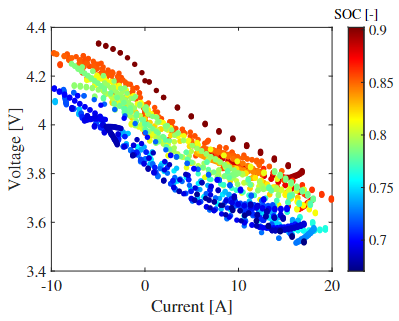
Stochastic training data with noise

O. Ahmadzadeh, Y. Wang, and D. Soudbakhsh, “Sparse modeling of energy storage systems in presence of noise,” IFAC-PapersOnLine 56.2 (2023): 3764-3769

doi: https://doi.org/10.1016/j.ifacol.2023.10.1546
SCImago Journal & Country Rank

Omidreza is peresenting at ACC’23

Accurate modeling of Lithium-ion batteries (LiBs) allows for more efficient utilization of their potential without compromising their safety or useful life. Accurate physics-based models require in-situ measurements and proprietary information unavailable for each cell. Data driven models offer a solution to identify governing equations of individual cells using only the excitation inputs and measured outputs. However, the main drawback of such models is their performance in unseen scenarios, as they tend to overfit the training data and perform poorly in other scenarios. We seek physics-informed reduced-order nonlinear models of LiBs from measured data. The model was trained using a high-fidelity model of a Li-ion cell. We used Sequentially Thresholded Ridge regression (STRidge) optimization to determine the optimal reduced-order model. Using a validation set, we proposed an algorithm to tune hyperparameters (threshold and regularization parameters). A stochastic electrical current signal up to 2C/4C-rates charge/discharge was used in the training set, and the US highway profile (US06 drive cycle) was used for the validation. The model was validated with EPA Urban Dynamometer Driving Schedule (UDDS) as the test set. The test errors (normalized root mean square error (NRMSE)) were 6.3e-3 for SOC and Voltage predictions.

Proposed Methodology for optimizing the non-linear data-driven model

O. Ahmadzadeh, R. Rodriguez, Y. Wang and D. Soudbakhsh, “A Physics-Inspired Machine Learning Nonlinear Model of Li-ion Batteries,” 2023 American Control Conference (ACC), San Diego, CA, USA, 2023, pp. 3087-3092,

doi: 10.23919/ACC55779.2023.10156368

SCImago Journal & Country Rank

Publication Alert: Renato’s paper to appear in the Journal of Dynamic Systems, Measurements, and Control

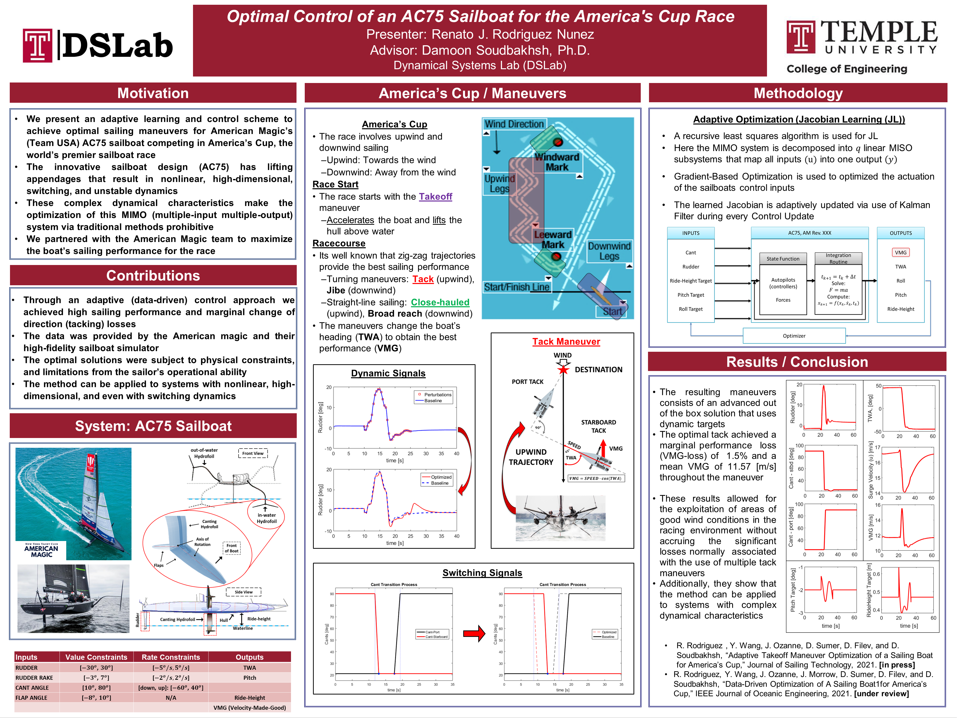
Renato’s paper on an adaptive control strategy to optimize the sailing maneuvers of an AC75 foiling sailboat competing in America’s Cup, was accepted for publication at the Journal of Dynamic Systems, Measurements, and Control, 11/2022.

Rodriguez, R., Wang, Y., Ozanne, J., Morrow, J., Sumer, D., Filev, D., Soudbakhsh, D., “Adaptive Learning and Optimization of High-speed Sailing Maneuvers for America’s Cup”, Journal of Dynamic Systems, Measurements, and Control 2022.

Abstract: This paper presents an adaptive control strategy to optimize the sailing maneuvers of an AC75 foiling sailboat competing in America’s Cup. Foiling yachts have nonlinear, high-dimensional, and unstable dynamics due to several articulations for fast motions and maneuverability. Achieving aggressive and optimal maneuvers requires taking these complex dynamics into account instead of analytical optimizations using reduced-order models.
We compared extremum-seeking and Jacobian learning (JL) control approaches on a full-order model to achieve optimal maneuvers and used JL to optimize articulations. The controllers were integrated with a high-fidelity sailboat simulator for safe and efficient maneuver optimization.
The optimal solutions were subject to physical/actuator constraints and those enforced to ensure the feasibility of the maneuvers by humans (sailors). The close-hauled and tacking maneuvers were optimized to achieve maximum Velocity Made Good (VMG) and minimum loss of VMG, respectively. The optimal maneuvers boast a marginal VMG loss of less than 1.5%, which enables exploiting areas of good wind conditions in the racing environment.

https://doi.org/10.1115/1.4056107

Publication Alert: Renato’s paper to appear in the Journal of Dynamic Systems, Measurements, and Control (JDSMC)

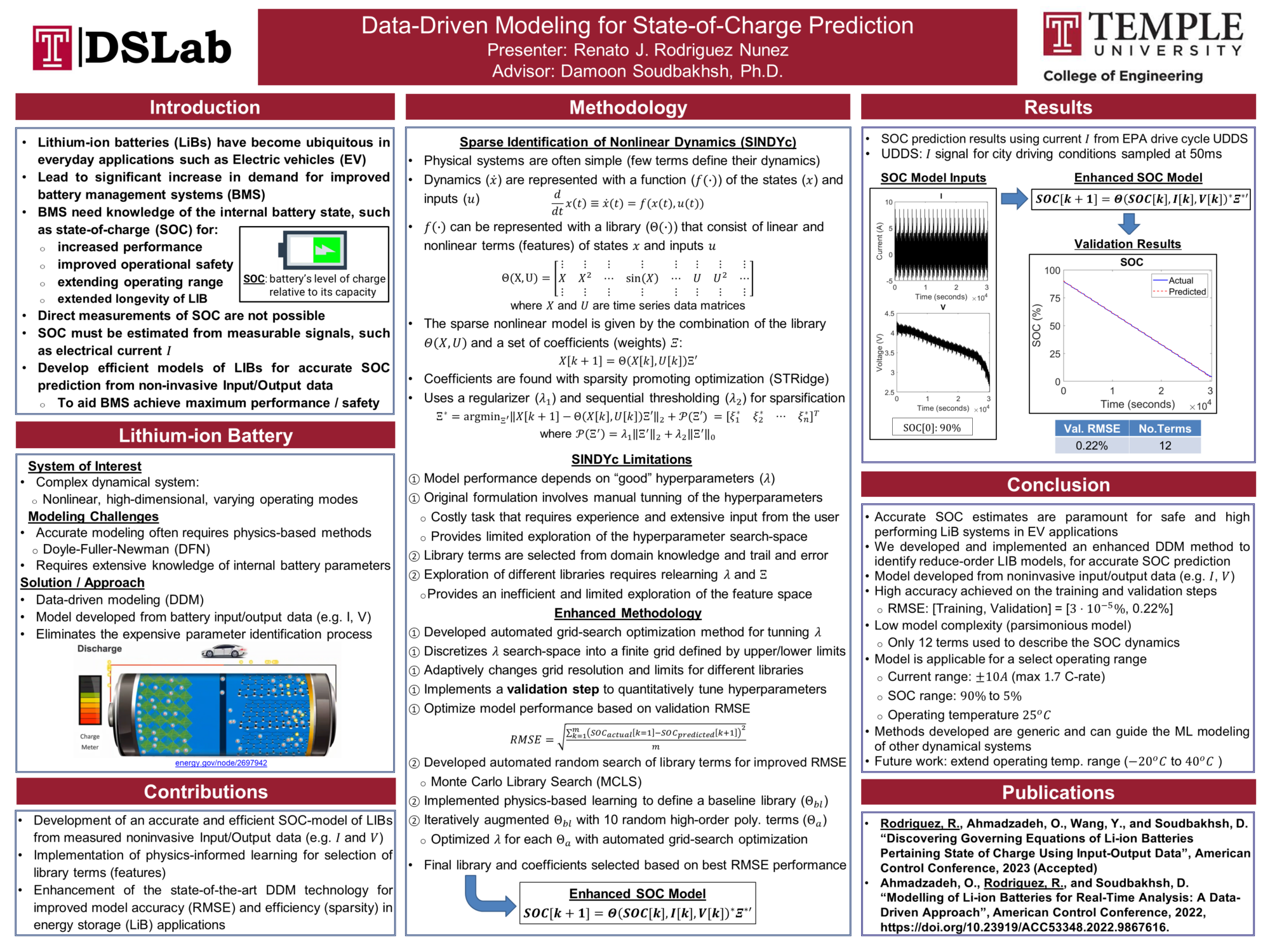
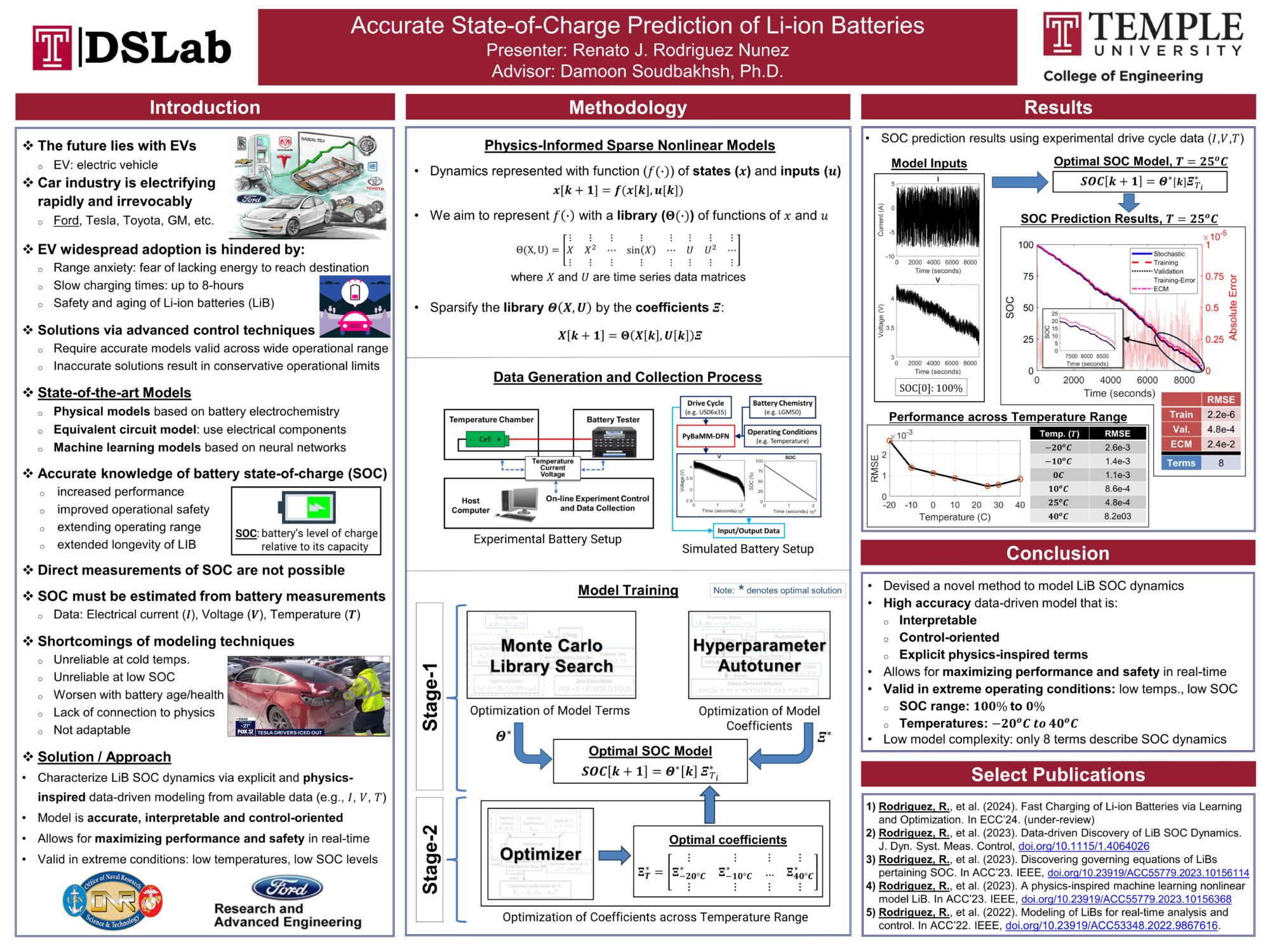
Title: Data-driven Discovery of Lithium-Ion Battery State of Charge Dynamics

Abstract: We present a physics-inspired input/output predictor of lithium-ion batteries (LiBs) for online state-of-charge (SOC) prediction. The complex electrochemical behavior of batteries results in nonlinear and high-dimensional dynamics. Accurate SOC prediction is paramount for increased performance, improved operational safety, and extended longevity of LiBs. The battery’s internal parameters are cell-dependent and change with operating conditions and battery health variations. We present a data-driven solution to discover governing equations pertaining to SOC dynamics from battery operando measurements. Our approach relaxes the need for detailed knowledge of the battery’s composition while maintaining prediction fidelity. The predictor consists of a library of candidate terms and a set of coefficients found via a sparsity-promoting algorithm. The library was enhanced with explicit physics-inspired terms to improve the predictor’s interpretability and generalizability. Further, we developed a Monte Carlo search of additional nonlinear terms to efficiently explore the high-dimensional search space and improved the characterization of highly nonlinear behaviors. Additionally, we developed a hyperparameter autotuning approach for identifying optimal coefficients that balance accuracy and complexity. The resulting SOC predictor achieved high predictive performance scores (RMSE) of 2.2 × 10⁻⁶ and 4.8 × 10⁻⁴, respectively, for training and validation on experimental results corresponding to a stochastic drive cycle. Furthermore, the predictor achieved an RMSE of 8.5 × 10⁻⁴ on unseen battery measurements corresponding to the standard US06 drive cycle, further showcasing the adaptability of the predictor and the enhanced modeling approach to new conditions.

  • Rodriguez, R., Ahmadzadeh, O., Wang, Y., & Soudbakhsh, D. (2023). Data-driven Discovery of Lithium-Ion Battery State of Charge Dynamics. Journal of Dynamic Systems, Measurement, and Control, 1-13, https://doi.org/10.1115/1.4064026.
SCImago Journal & Country Rank

Renato J. Rodriguez Nunez

PROFESSIONAL SUMMARY

❖ Ph.D. candidate in Mechanical Engineering working on Modeling and Control of Li-ion batteries for Electric Vehicles (EVs) and Fast-Charging

• 4 years of academic research in modeling Li-ion batteries for accurate state-of-charge and voltage prediction (papers 5)

• 4 industry internships modeling and controlling racing yachts, complex engines, and energy storage systems (papers 3)

• Experience with Machine Learning / Deep Learning for signal and image processing in biomedical applications (paper 1)

• Modeling and control of unmanned aerial and underwater vehicles (UAV, UUV) with experience in data acquisition and data processing (paper 1)

Resume: bit.ly/Resume_Renato_Rodriguez

PERSONAL SUMMARY

 Renato is currently pursuing his Ph.D. in the field of Mechanical Engineering at Temple University, Philadelphia PA. He completed his B.Sc. and M.Sc. in Mechanical Engineering at George Mason University and Temple University respectively. Renato’s research interests include control of linear and nonlinear dynamical systems, model-based and model-free optimization, data-driven modeling, and model-reduction of complex high-dimensional systems with unknown dynamics. He completed four separate internships at Ford Motor Company’s Research and Advanced Engineering (R&AE) division, where he led the research efforts on an ongoing project involving optimal control of a complex nonlinear MIMO system (AC75 sailboat) via model-free optimization and implemented data-driven modeling (DDM) techniques to develop proxy models of the complex internal combustion engine (ICE) and lithium-ion battery (LIB) systems. He is a Research and Teaching Assistant for the Dynamical Systems Laboratory (DSLab), at Temple University. Renato’s Ph.D. aims to introduce more powerful data-driven modeling techniques that can outperform and exceed the limitations of current methods.

Publications (ResearchGateGoogle Scholar)

    1. Rodriguez, R., Ahmadzadeh, O., Wang, Y., & Soudbakhsh, D. (2023). Data-driven Discovery of Lithium-Ion Battery State of Charge Dynamics. Journal of Dynamic Systems, Measurement, and Control, 1-13, https://doi.org/10.1115/1.4064026.
    2. Rodriguez, R., Ahmadzadeh, O., Wang, Y., & Soudbakhsh, D. (2023, May). Discovering governing equations of li-ion batteries pertaining state of charge using input-output data. In 2023 American Control Conference (ACC) (pp. 3081-3086). IEEE, https://doi.org/10.23919/ACC55779.2023.10156114.
    3. Ahmadzadeh, O., Rodriguez, R., Wang, Y., & Soudbakhsh, D. (2023, May). A physics-inspired machine learning nonlinear model of li-ion batteries. In 2023 American Control Conference (ACC) (pp. 3087-3092). IEEE, https://doi.org/10.23919/ACC55779.2023.10156368.
    4. Rodriguez, R., Wang, Y., Ozanne, J., Morrow, J., Sumer, D., & Filev, D. (2022). Adaptive Learning and Optimization of High-speed Sailing Maneuvers for America’s Cup. Journal of Dynamic Systems, Measurement, and Control, 1-12, https://doi.org/10.1115/1.4056107.
    5. Rodriguez, R., Wang, Y., Ozanne, J., Sumer, D., Filev, D., & Soudbakhsh, D. (2022). Adaptive Takeoff Maneuver Optimization of a Sailing Boat for America’s Cup. Journal of Sailing Technology, 7(01), 88-103, https://doi.org/10.5957/jst/2022.7.4.88.
    6. Rodriguez, R., Wang, Y., Ozanne, J., Sumer, D., Filev, D., & Soudbakhsh, D. (2022). Adaptive Learning for Maximum Takeoff Efficiency of High-Speed Sailboats. IFAC-PapersOnLine, 55(12), 402-407, https://doi.org/10.1016/j.ifacol.2022.07.345.
    7. Ahmadzadeh, O., Rodriguez, R., and Soudbakhsh, D. “Modelling of Li-ion Batteries for Real-Time Analysis: A Data-Driven Approach”, American Control Conference, 2022, https://doi.org/10.23919/ACC53348.2022.9867616.
    8. Rodriguez, R. (2021). OPTIMAL CONTROL OF THE AC75 SAILBOAT FOR THE AMERICA’S CUP RACE (Master’s Thesis, Temple University. Libraries), http://dx.doi.org/10.34944/dspace/7177.
    9. Shawki, N., Rodriguez R., Obeid, I., & Picone, J. (2021, December). On Automating Hyperparameter Optimization for Deep Learning Applications. In 2021 IEEE Signal Processing in Medicine and Biology Symposium (SPMB) (pp. 1-7). IEEE, https://doi.org/10.1109/SPMB52430.2021.9672266.
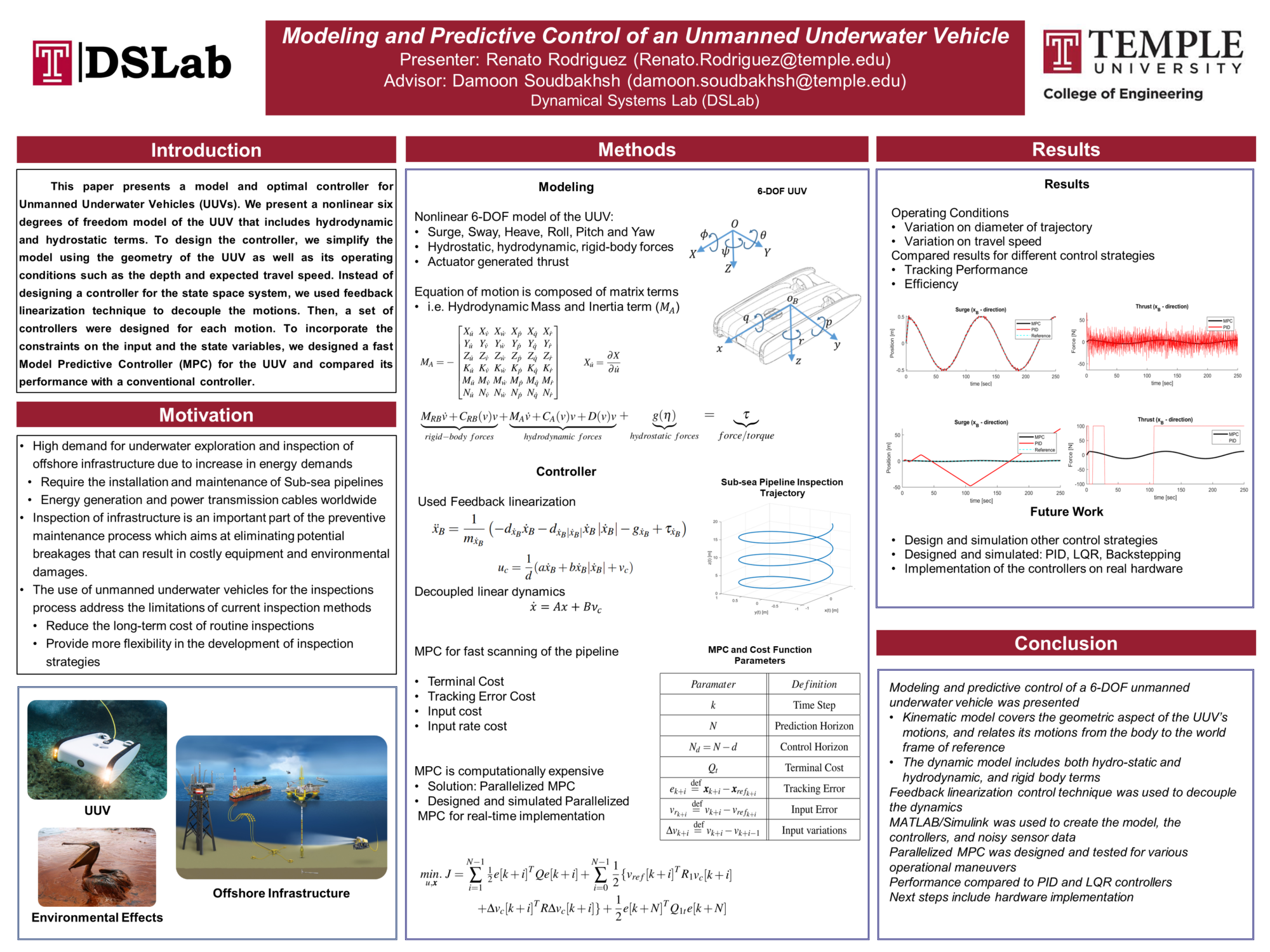
    10. Rodriguez, R., & Soudbakhsh, D. (2019, October). Modeling and predictive control of an unmanned underwater vehicle. In Dynamic Systems and Control Conference (Vol. 59162, p. V003T21A009). American Society of Mechanical Engineers, https://doi.org/10.1115/DSCC2019-9154.

     
    SCImago Journal & Country Rank


    SCImago Journal & Country Rank


    SCImago Journal & Country Rank

    Presentations

    • ACC 2023, “Discovering governing equations of li-ion batteries pertaining state of charge using input-output data”
    • IMECE 2023, “Data-Driven Modeling for Accurate State-of-Charge Prediction of Li-Ion Batteries”
    • ALCOS 2022, “Adaptive Learning for Maximum Takeoff Efficiency of High-Speed Sailboats”
    • Ford Motor Co.’s 3rd Artificial Intelligence & Machine Learning Conference 2022, “Data-driven Modeling of Li-Ion Batteries”
    • ECC 2022, “Adaptive Learning Optimization of A High-Speed Sailboat for the America’s Cup”
    • Ford Motor Co.’s 6th Global Control Conference 2021, “Optimal Control of the AC75 Sailboat for the America’s Cup Race”
    • DSCC 2019, “Modeling and predictive control of an unmanned underwater vehicle”

    Research

    Data-driven Discovery of Governing Equations of Li-ion Batteries Pertaining State of Charge

    Optimal Control of an AC75 Sailboat for the America’s Cup Race

     
    Health Monitoring of Offshore Field Infrastructure