Sustainability and Resilience
Recommendation
- Article
- China
- Spatial Modeling
Liu, Fajian; Guo, Zongkun; Xie, Zhenzhen; Chen, Dongdong; Yang, Yang
- Article
- US
- Econometrics
Nam, Yoonyoung; Yang, Yang
- Article
- US
- Econometrics
Nam, Yoonyoung; Yang, Yang
Related Presentations
- Invited Talk
- 03/04/2024
COVID19tourism Index and its application in tourism management
University of Perpignan
Perpignan, France
Related Resources
- Tool
Green Hospitality Dashboard
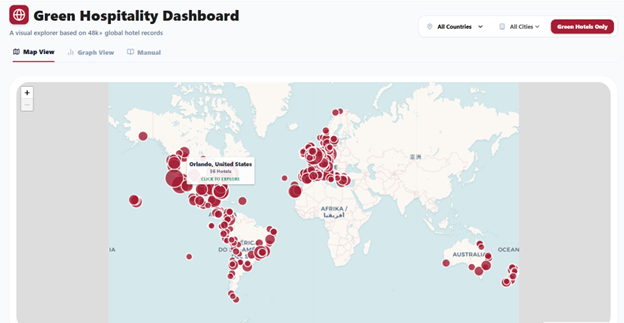
Tool Address: https://uflyy.github.io/green-hotels/
How to Use This Dashboard
- Global Map Aggregation: At the global or country level, cities are represented by aggregated markers scaled by hotel volume. Click a city marker to seamlessly zoom in and load individual hotel properties without clutter.
- Dynamic Popups: Popups intelligently pan into the view to ensure long lists of Green Features or Hotel Styles are never clipped by the screen edges.
- Deep-Dive Graphing: Navigate to the Graph View to instantly evaluate structural differences across subgroups using Native Boxplots (min, Q1, median, Q3, max), Standardized Radar Profiling, and 100% Stacked Bar Charts.
- Top 10 Feature Slicing: When grouping by specific environmental practices (Green Features), the system automatically filters for the top 10 most adopted measures to preserve visual clarity.
- Tool
Hotel Resilience to Natural Disasters Tool
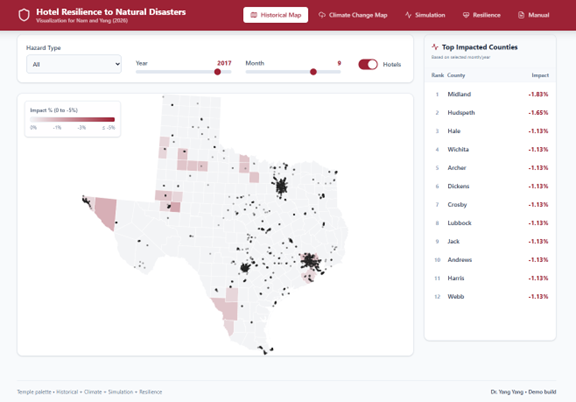
Tool link: https://uflyy.github.io/natural-disaster/
This interactive dashboard serves as the companion tool for the research paper Nam and Yang (2026): Hotel performance under extreme weather: a contingency perspective on organizational resilience, published in the Journal of Sustainable Tourism (Link). This tool bridges the gap between theoretical econometric models and practical hotel management, allowing stakeholders to visualize the historical and future impacts of natural disasters on hotel revenue across various scenarios.
The Historical Map provides a geospatial visualization of actual hazard impacts across Texas counties. By selecting specific hazard types (e.g., flooding, hurricane, hail) and historical timeframes (2002-2019), users can observe the distribution of past events and the estimated percentage impact on local hotel performance. The top 10 most severely impacted counties for the selected month are dynamically highlighted.
The Climate Change Map allows stakeholders to conduct forward-looking macro stress tests. By anchoring on the 18-year annual average of specific historical hazards, this module enables users to project future spatial risks by adjusting the frequency deterioration slider (e.g., +20% flood frequency). It maps how a shifting climate trajectory will aggravate expected annual hotel revenue damages across different counties over the long term.
The Simulation Module equips hotel portfolio managers to estimate financial losses under hypothetical disaster severities. Users can configure an aggregate portfolio’s characteristics—including ownership mix (independent vs. chain vs. franchise), hotel class structure, and baseline revenue—to analyze how these organizational boundaries mitigate or exacerbate absolute revenue loss during a hazard shock.
The Resilience Module translates the study’s empirical findings into a scoring system for individual properties. By inputting key hotel determinants such as room count, operational age, and chain affiliation, the tool computes a normalized ‘Resilience Score’ (0-100). This score is benchmarked against predefined industry percentiles, empowering owners to understand their property’s inherent capacity to withstand extreme weather disruptions.
- Dataset
COVID19tourism Index
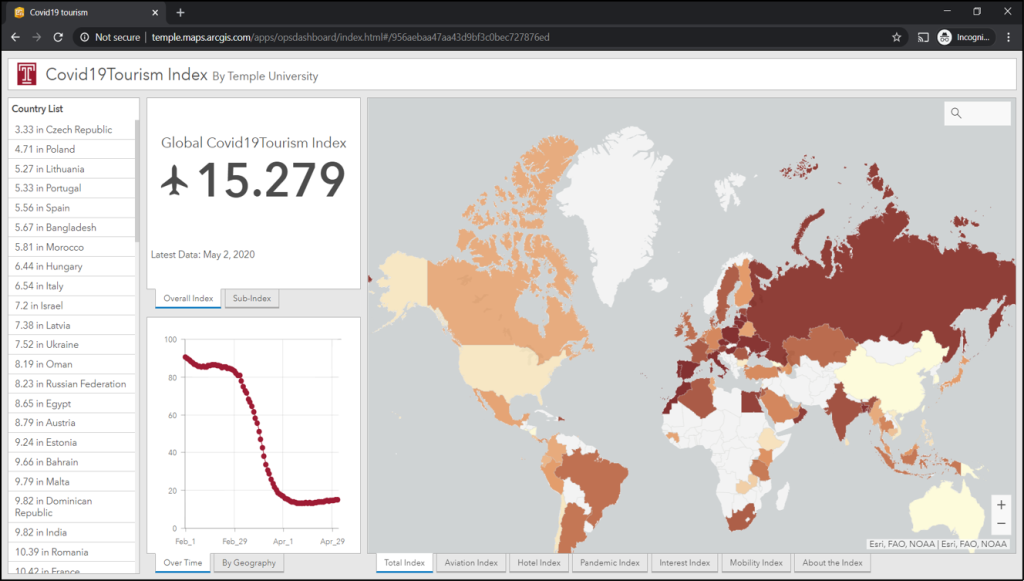
The COVID19tourism index was developed to monitor the pandemic’s multifaceted impact on the global tourism industry. This index comprises five distinct sub-indices designed to track the specific effects of COVID-19 across various aspects of tourism activities. By utilizing this tool, destinations are enabled to assess their recovery status, generate rigorous forecasts, and benchmark their performance against potential competitors. Sub-indices The COVID19tourism index is comprised of five distinct sub-indices. These sub-indices were designed to track the specific effects of the pandemic across different aspects of tourism activities.
Dashboard Utility The index functions as a tool that enables destinations to perform three primary functions:
• Evaluate Recovery: Destinations can use the tool to assess their current recovery status.
• Forecast: The tool allows users to produce rigorous forecasts regarding tourism trends.
• Benchmark: Destinations can use the index to benchmark their performance against potential competitors
Link to the COVID19tourism Index Dashboard
Link to download the data

You must be logged in to post a comment.