Research Resource Repository
- Dataset
Government Attention to Tourism Data
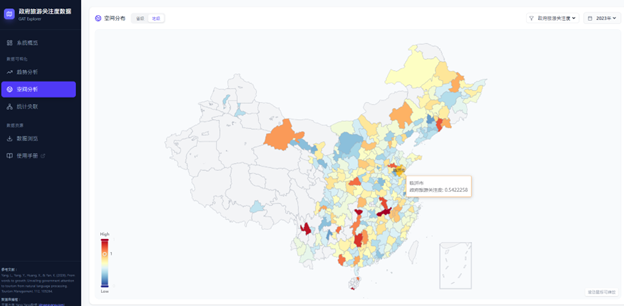
This web-based application is designed to provide researchers and policymakers with an interactive platform for querying and analyzing data regarding Government Attention to Tourism (GAT) in China.
Based on the research findings of Yang, Yang, Huang & Yan (2026), this tool visually demonstrates the spatiotemporal relationships and statistical correlations between the GAT index and various tourism economic indicators. This tool supports a bilingual interface in both Chinese and English. You can switch between the two language modes in real-time by clicking the language toggle button (中文/EN) located in the top-right corner of the page.
Key Features:
Multidimensional Data Coverage: Includes GAT indices and 11 key tourism economic indicators at both the provincial and prefectural (city) levels.
Interactive Visualization: Provides trend analysis, spatial distribution maps, and statistical correlation scatter plots.
Data Resources: Supports viewing summaries of raw data and downloading data.
Tool Link: https://uflyy.github.io/gat-database/
本网页应用旨在为研究人员和政策制定者提供关于中国政府旅游关注度 (Government Attention to Tourism, GAT) 的交互式数据查询与分析平台。
该工具基于 Yang, Yang, Huang & Yan (2026) 的研究成果,通过可视化手段展示了 GAT 指数与各类旅游经济指标之间的时空关系和统计关联。本工具支持中英文双语界面。点击页面右上角的语言切换按钮(中文/EN),即可在两种语言模式间实时切换。
核心功能:
- 多维数据覆盖: 包含省级和地级层面的 GAT 指数及 11 项关键旅游经济指标。
- 交互式可视化: 提供趋势分析、空间分布地图和统计关联散点图。
- 数据资源: 支持查看原始数据摘要及下载。
- Tool
Extended MASEM Analysis from SO, YANG AND LI (2025)
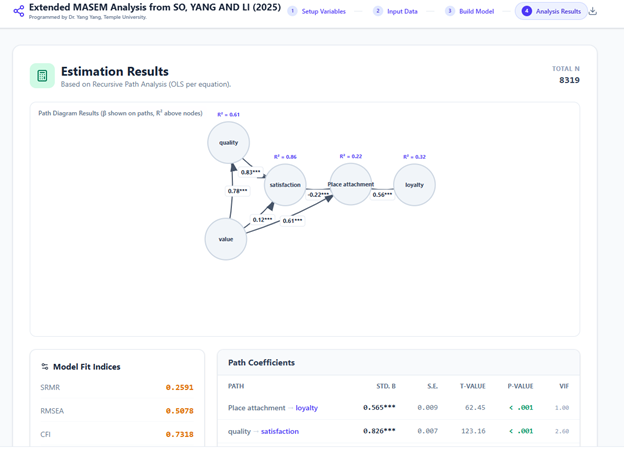
This web-based application is designed to conduct Meta-Analytic Structural Equation Modeling (MASEM). It is built upon the foundational research of So, Yang, and Li (2025), which synthesized 15 years of research to determine the interrelationships between Customer Loyalty, Customer Satisfaction, Perceived Value, and Perceived Service Quality.
Key Features:
- Replication: Users can replicate the findings of So, Yang, and Li (2025) using pre-loaded, industry-specific data.
- Extension: The tool allows researchers to expand the original model by adding new variables (e.g., Place Attachment, Trust, Brand Image) to test novel theoretical frameworks.
- Methodology: It utilizes the Harmonic Mean or Minimal N methods to aggregate sample sizes.
- Dataset
Pulse of American Domestic Tourism
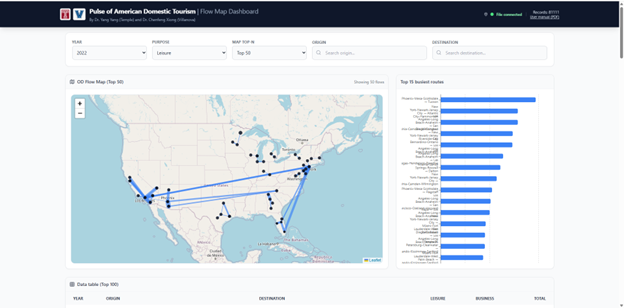
“The ‘Pulse of American Domestic Tourism’ project serves as a digital monitor for the nation’s internal mobility. By mining transportation-derived mobility data, we develop a comprehensive matrix of tourism flows connecting American MSAs. This data-driven approach unveils the rhythmic shifts in visitor demand and regional connectivity. Crucially, we ground these digital insights through extensive cross-validation with household survey data, creating a verified, high-resolution framework for understanding the evolving landscape of domestic travel.”
Key Vocabulary Used (Why it works):
- Inter-MSA travel flows: Specific and accurate to your methodology.
- Arterial circulation / Rhythmic shifts: Reinforces the “Pulse” metaphor without being cheesy.
- High-granularity / Spatiotemporal precision: Highlights the “Big Data” advantage.
- Rigorously cross-validated: Emphasizes the reliability of your model (crucial for academic trust).
- Ground-truth metrics: A professional way to refer to the survey data as the standard of truth.
- Dataset
COVID19tourism Index
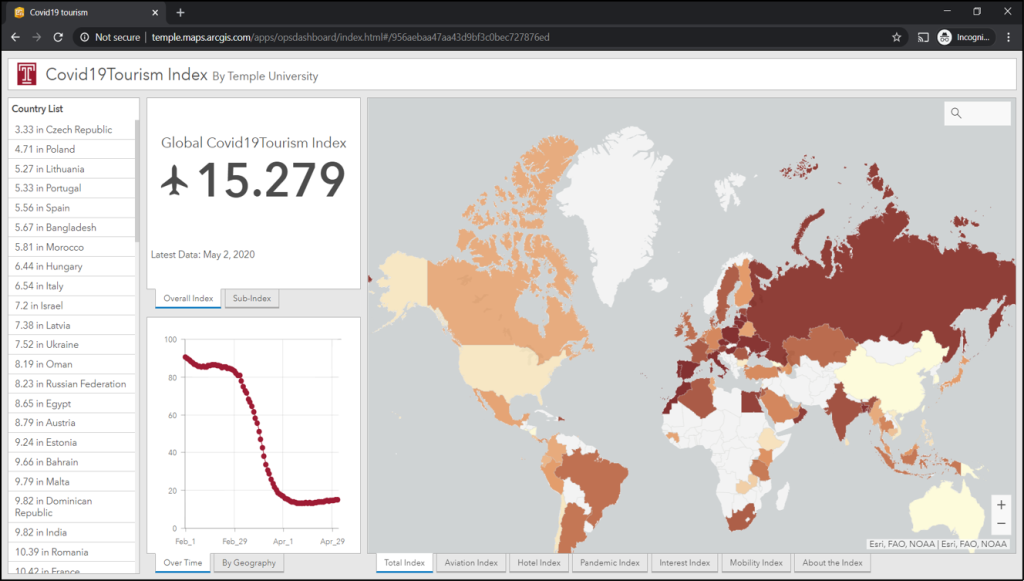
The COVID19tourism index was developed to monitor the pandemic’s multifaceted impact on the global tourism industry. This index comprises five distinct sub-indices designed to track the specific effects of COVID-19 across various aspects of tourism activities. By utilizing this tool, destinations are enabled to assess their recovery status, generate rigorous forecasts, and benchmark their performance against potential competitors. Sub-indices The COVID19tourism index is comprised of five distinct sub-indices. These sub-indices were designed to track the specific effects of the pandemic across different aspects of tourism activities.
Dashboard Utility The index functions as a tool that enables destinations to perform three primary functions:
• Evaluate Recovery: Destinations can use the tool to assess their current recovery status.
• Forecast: The tool allows users to produce rigorous forecasts regarding tourism trends.
• Benchmark: Destinations can use the index to benchmark their performance against potential competitors
Link to the COVID19tourism Index Dashboard
Link to download the data
- Dataset
Visualization on life happiness and tourism participation of U.S. counties
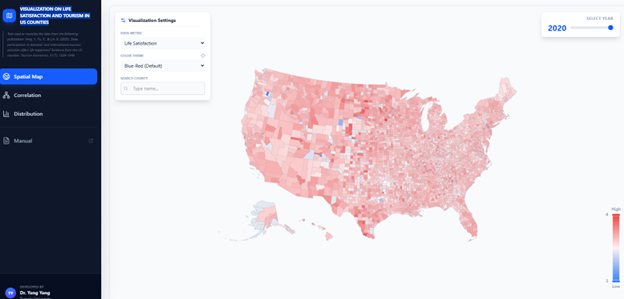
This web-based application is designed to visualize the longitudinal spatial-temporal relationship between resident life happiness and tourism participation across the United States. It is built upon the empirical research of Yang, Fu, and Lin (2025), which utilized a panel dataset covering over 3,000 U.S. counties to examine how domestic and international tourism activities influence subjective well-being.
Key Features:
- Spatial Visualization: Displays the geographical distribution of life satisfaction and tourism participation rates on an interactive map using the academic standard Albers USA projection.
- Correlation Analysis: Dynamically illustrates the statistical relationship between the change in tourism participation and life satisfaction.
- Distribution Analysis: Provides histograms for all variables to identify data characteristics, skewness, and outliers.
- Interactive Exploration: Allows users to customize the view by searching for specific counties, toggling years, and adjusting color schemes.
- Tool
MASEM of Risk Perception and Travel Behavior
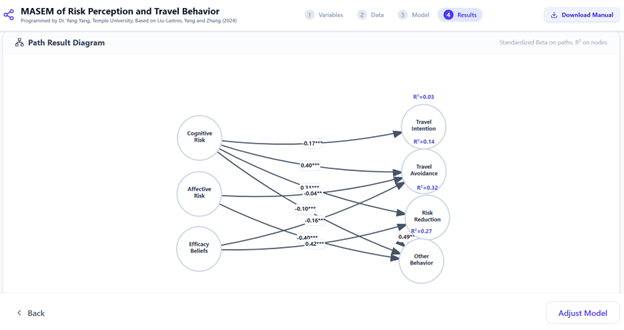
This web-based application is designed to conduct Meta-Analytic Structural Equation Modeling (MASEM) within the context of tourism risk perception. It is built upon the research of Liu-Lastres, Yang, and Zhang (2024), which synthesized findings from 108 articles to identify the optimal model explaining the relationships between tourists’ risk perceptions and behavioral outcomes during a pandemic.
Key Features:
- Replication: Users can replicate the testing of the 8 competing models (Model 1–8) proposed in the original paper (and beyond).
- Flexibility: The tool allows users to hide/restore specific variables to test simplified models or focus on specific relationships.
- Model Comparison: Users can save multiple model configurations and compare their Goodness-of-Fit indices (e.g., AIC, BIC, CFI) in a consolidated table to identify the best-fitting model.
- Visualization: Provides an interactive path diagram with auto-layout features (separating perception variables from outcome variables).

You must be logged in to post a comment.