ANNALS OF TOURISM RESEARCH
Tourism-enhancing effect of World Heritage Sites: Panacea or placebo? A meta-analysis
- 2019
- ANNALS OF TOURISM RESEARCH
- 10.1016/j.annals.2018.12.007
Yang, Yang; Xue, Lan; Jones, Thomas E.
Abstract
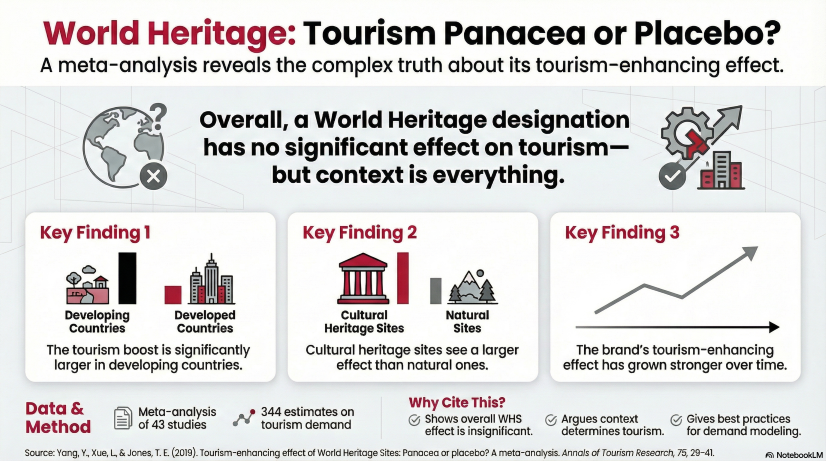
UNESCO’s World Heritage inscription is considered to positively influence tourism demand. However, relevant econometric research has yielded inconsistent results. In this study, we used a meta-analysis to synthesize the effects of World Heritage Site (WHS) status across 344 econometric estimates from 43 studies. Meta-regression results reveal several factors explaining the effect size of WHS status on tourism demand, such as the research period, level of development in the destination country, heritage type, dyadic data type, WHS endowment measure, and use of robust standard error. A sub-group analysis identifies different factors in developing vs. developed countries and cultural vs. natural WHS types. Lastly, implications are provided for destination/heritage management and tourism researchers based on meta-regression results.
Keywords
World Heritage Site; Tourism demand; Meta-regression
Research topic
Tourist Flows and Location
Research method
Meta-analysis
Geographic area
Global
AI Audio Overview
AI Infographic