TOURISM MANAGEMENT
From words to growth: Unveiling government attention to tourism from natural language processing
- 2026
- TOURISM MANAGEMENT
- 10.1016/j.tourman.2025.105264
Yang, Lisi; Yang, Yang; Huang, Xijia; Yan, Kai
Abstract
This paper theorizes and quantifies the government attention to tourism (GAT) using an AI-driven interdisciplinary approach to analyze government policy portfolios. By leveraging machine learning and natural language processing techniques, including textual analysis, word embeddings, and GPT-4o-based segmentation, the GAT indicator is derived from government annual reports. Within the framework of promotion tournament model and limited attention allocation theories, the study uses post-double-selection LASSO to identify key antecedents of GAT: the number of A-level scenic spots, male municipal party secretaries, and cities’ economic constraints. These factors collectively shape government resource allocation in tourism policy. Validation tests confirm a positive association between GAT and actual government inputs in tourism-related domains. When governments’ words align with actions, GAT can be a supplementary indicator for forecasting tourism growth. Robustness checks validate these findings, providing a reliable methodology. This study offers a comprehensive technology roadmap, guiding future tourism research with AI-driven approaches.
Keywords
Government attention to tourism; Natural language processing; Large language model; Machine learning; Tourism growth
Research topic
AI and Big Data, Tourist Flows and Location
Research method
Econometrics, Big Data
Geographic area
China
AI Audio Overview
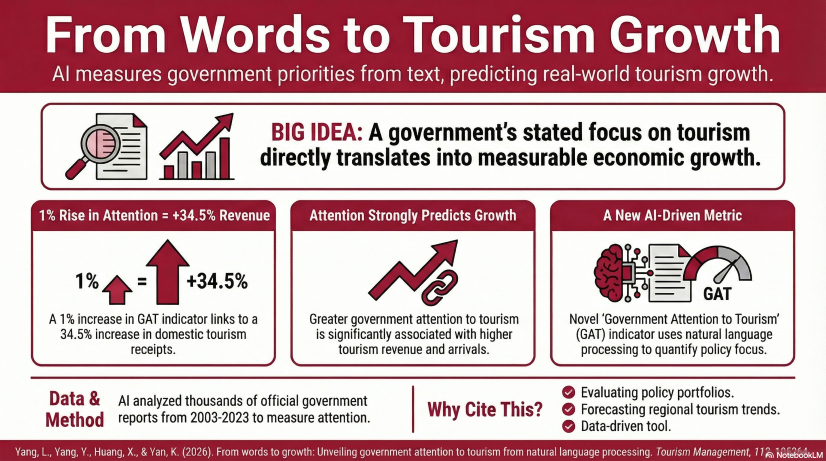
AI Infographic
Extra Information
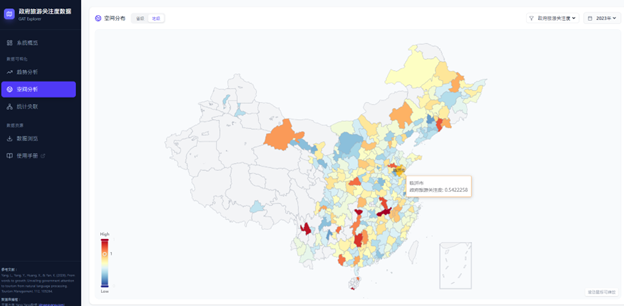
Data Tool on Government Attention to Tourism (GAT) [link]