INTERNATIONAL JOURNAL OF HOSPITALITY MANAGEMENT
Are all five points equal? Scaling heterogeneity in hotel online ratings
- 2020
- INTERNATIONAL JOURNAL OF HOSPITALITY MANAGEMENT
- 10.1016/j.ijhm.2020.102539
Leung, Xi Y.; Yang, Yang
Abstract
Online hotel ratings play a critical role in hotel online reputation building and greatly influence travelers’ decision making. However, self-reported online ratings are vulnerable to scaling heterogeneity due to reviewers’ unique response styles, leading to some incomparability issues. A research framework was developed based on latent state-trait theory and empirically tested using hotel online review data from TripAdvisor. A hierarchical ordered probit (HOPIT) model, which captured threshold differences in hotel online ratings, confirmed the presence of scaling heterogeneity and response styles in the online rating context. Results indicated that younger travelers, women, and travelers with less review expertise used lower thresholds when rating hotels online. Business travelers had the highest rating threshold compared to other types of travelers. Guests staying in high-class hotels tended to have more extreme response styles than those staying in low-class hotels. These findings offer valuable insights for hotel managers and online rating/review sites.
Keywords
Online rating; Response style; Rating threshold; Scaling heterogeneity; HOPIT model
Research topic
AI and Big Data, Digital Platform and Pricing
Research method
Econometrics, Big Data
Geographic area
US
Extra Information
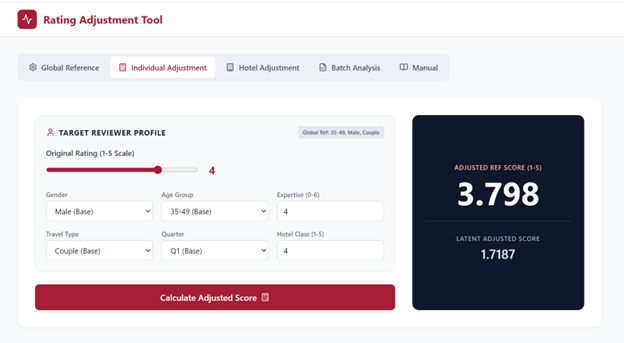
Rating Adjustment Tool: Link