The 2019-2020 academic year started with a renewed strategic vision for climate activism at Temple University. Goals included in the 2019-2020 Sustainability Annual Report were established in the 2019 Climate Action Plan.
The Climate Action Plan, released in April 2019, provided a roadmap for continued progress towards carbon neutrality by 2050. Over 300 members of the Temple community collaborated to articulate goals in 5 different focus areas. These are Academics and Research, Culture, Design, Energy, and Operations. The plan reflects a true commitment from Temple students, faculty and staff to work together to shape a more sustainable and just climate future on campus, in Philadelphia and beyond.
Although the COVID-19 outbreak pushed our report’s release, our students, faculty and staff remained committed to climate action. This Sustainability Annual Report details significant progress towards a more environmentally, socially, and economically sustainable future. Highlights include memorable accomplishments and progress toward goals in all focus areas.
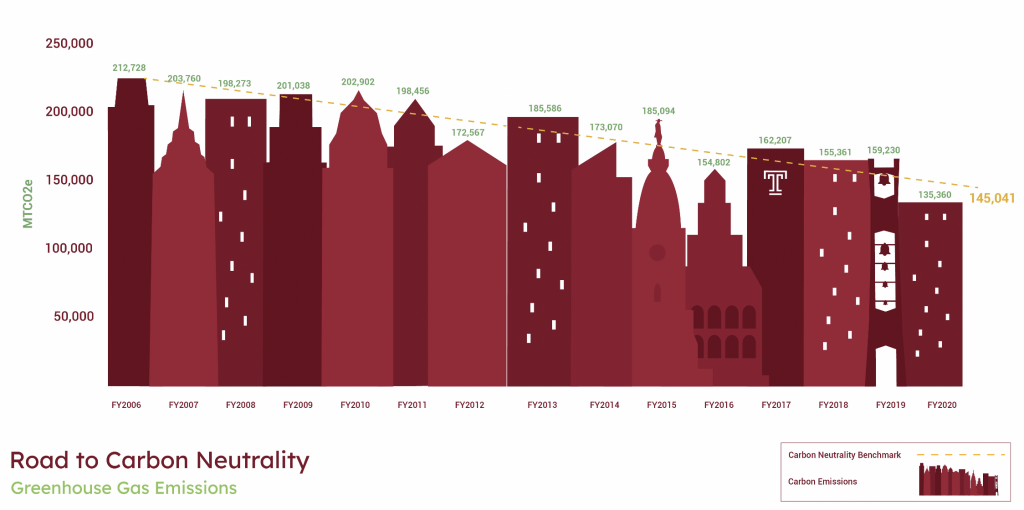
Greenhouse gas emissions progress as seen in the Sustainability Annual Report
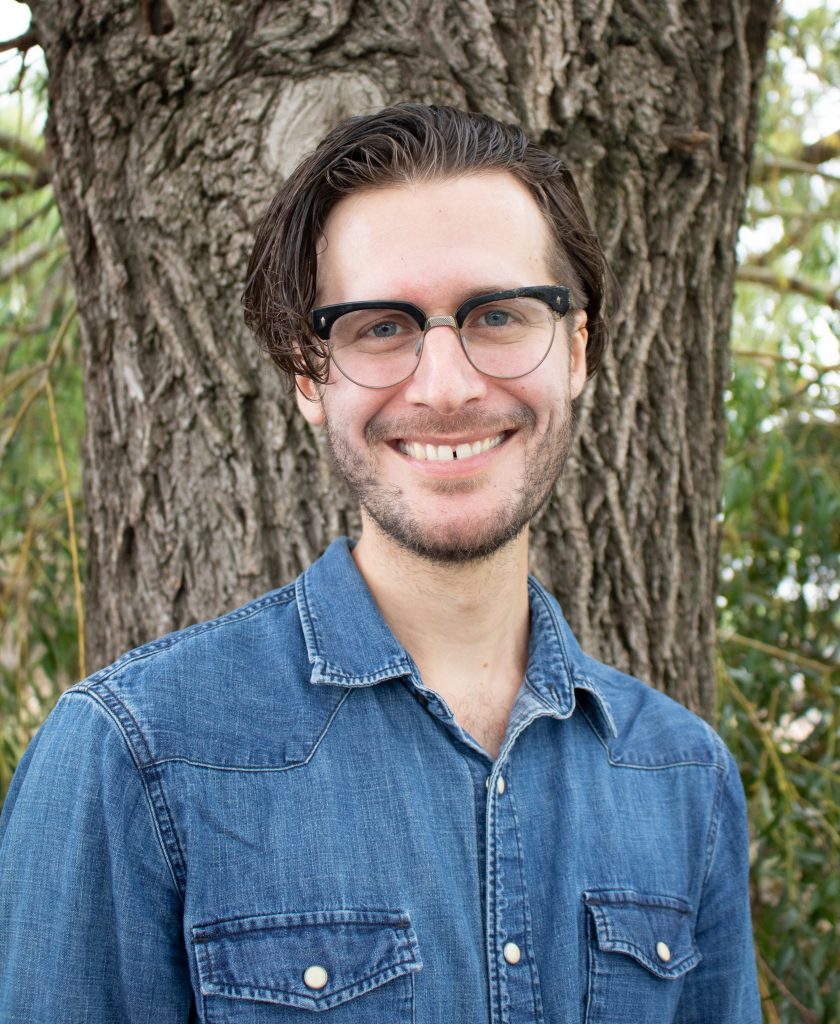
We concluded our Birds, Bees, & Trees series with Austin Martin, the 2020 Graduate Research Award Sustainability Program (GRASP) award winner and Ph.D. candidate in Geography and Urban Studies. Austin presented his findings on urban honey bees and pollinator forage as he examines how urban development and social control factor into urban pollinator systems.
Austin’s research seeks to better understand how capital flows through the urban built environment and what this means for urban ecosystems, specifically the health of native and non-native bees. His research considers the critical, social aspects of sustainability offering integrated and transformative climate solutions to urban communities and organizations.
Let’s dive deeper into Austin’s research.
https://youtu.be/iMt-qWjV9Lw
The gateway to larger ecological questions.
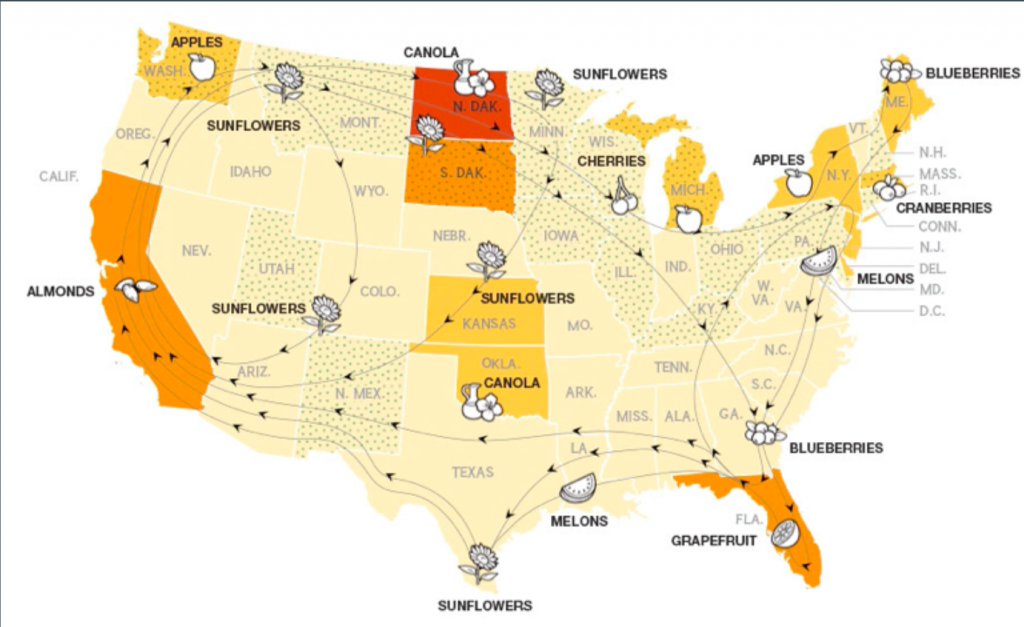
In the past decade, honey bees have rightfully garnered much public attention and concern. They sustain our multibillion dollar agricultural industry, which is heavily reliant on monocropping. Industrial scale beekeepers transport their hives across the United States to employ millions of honey bees as pollinators. As featured on the map, these crops include sunflowers, apples, canola, cherries, blueberries, cranberries, melons, and grapefruit, all across the US.
Industrial pollinators in the U.S.
Austin gained the first-hand experience during his time at the University of Michigan. He learned that honey bees are important not only for our food system but for human-nature connection. There are no other species that humans can cultivate and connect within the way that humans can with honeybees because of their colony scale.
Cities as a haven for bees.
Throughout his research, Austin found that honey bees in rural landscapes were not thriving nearly as well as honey bees in urban landscapes. He saw this same counterintuitive pattern with honey bees in the urban landscape of South Philadelphia rooftop.
The collapse of beehives begins with the poor biodiversity of flowers for bees to pollinate with. Beehives continue to decline through a series of self-reinforcing feedback loops including various toxins, weather conditions, parasites and poor nutrition.
Bees normally travel up to 3 miles to pollinate, but not in urban landscapes! In urban areas, the landscapes are rich enough with forage that the bees pollinate locally, increasing their lifespan. People plant new and diverse flowers in cities too. This brings new and unique pollination opportunities to bees.
Rethinking urban green spaces.
The data demonstrates a strong connection between wealth and bee richness. Low income areas had both higher bee abundance and higher richness. Low income communities and stewards of these urban green spaces also suffer from public disinvestment and a lack of capital. In neighborhoods and parks such as Cobbs Creek, we see this manifest in more woody vines, greater disarray in parks and sometimes higher occurrences of crime. This calls for a rethinking of how to manage our urban spaces.
Austin’s research better characterizes this uneven development across urban landscapes. He challenges our traditional notions of urban greening, asking if what is good for urban greening is truly good for urban ecology.
As a Temple community, we are in constant pursuit of a more ecologically, politically, and socially viable city. Leveraging this critical study of urban pollinators is an important step in centering community control of public spaces. We can strive for a more just and sustainable commons which equitably serves all Philadelphians, our flora, and our fauna.
Insight from Austin.
“As a beekeeper, I have learned that a good pesticide to use is called Oxalic acid which is relatively benign to the bees and kills the mites in the hive.”
“My favorite bee is the Blue Banded bee native to Australia and of course honey bees with my childhood connection.”
The Temple University Graduate Research Award Sustainability Program (GRASP) advances the university’s goal of expanding sustainability research by providing funding to a graduate student research project focused on sustainability.
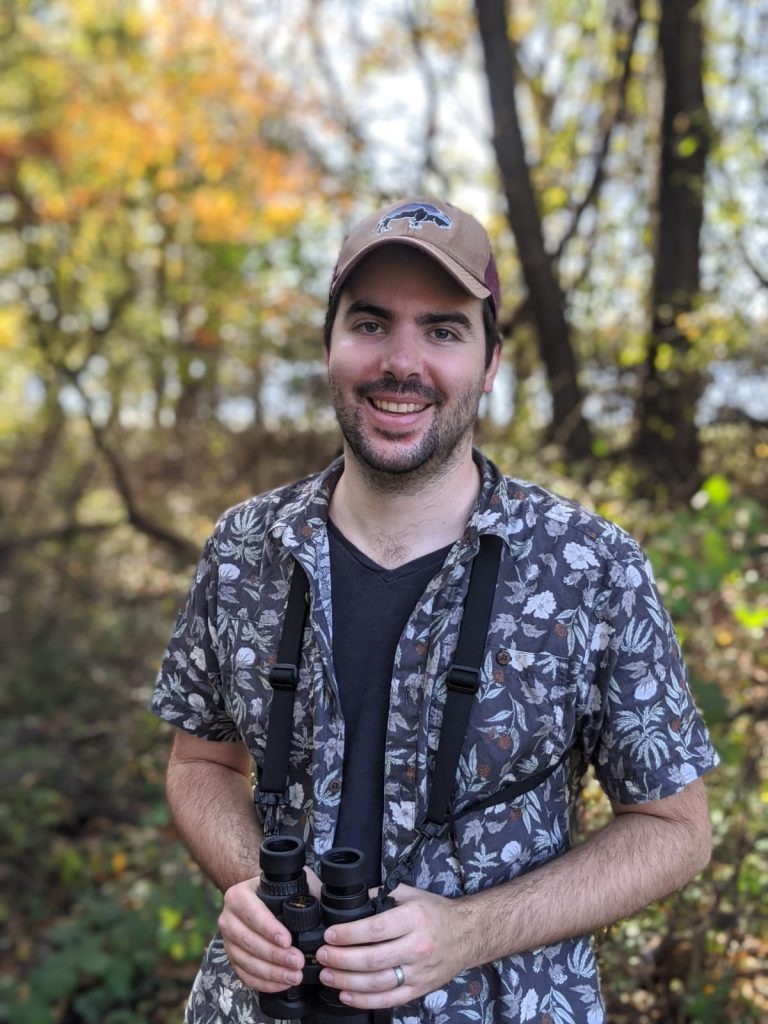
We welcomed Timothy Swartz, a current PhD student in the Integrative Ecology Lab at Temple University, to discuss the benefits of birds in urban environments. Timothy is an ecologist, conducting research on patterns of biodiversity and their relationship to the distribution and quality of habitat. He is particularly interested in studying the ecology of organisms in human-altered environments like urban landscapes.
Where it all started.
#EcoChampion: Timothy Swartz
Swartz started his academic career at Messiah College where he earned a BS in biology and the conservation of amphibian communities in vernal pools. In 2018, he earned a MS in Natural Resources and Environmental Sciences from the University of Illinois at Urbana-Champaign and worked in the Ecology and Conservation Biology Lab. Now he is a PhD student with Dr. Jocelyn Behm in the Integrative Ecology Lab at Temple University.
Life in the field.
As a field biologist, Timothy’s recent research investigates the role of birds in providing benefits to urban residents. Without being asked, birds fill our neighborhoods with song, hunt down pesky insects in our vegetable gardens, and gobble up littered food from our sidewalks. Timothy’s goal has been to investigate how people can return the favor by ensuring that our urban green spaces have the trees and other plants birds need to thrive. His findings could help fuel solutions to the growing problems of litter, tree canopy loss, and the widening gap between people and nature in Philly neighborhoods.
Here are some of our favorite facts from Timothy’s research, highlighted in our Stories of Sustainability webinar.
Positive impacts of birds in city landscapes.
With over 100 urban bird species in the city of Philadelphia and beyond, there are countless benefits that humans derive from nature. In Timothy’s research, he found that cities provide novel resources to people and ecosystems, including birds.
Species provide ecosystem services, which are services that include acoustic enrichment, pest control, seed dispersal, and visual enrichment. Birds provide songs to the spaces that people enjoy, control pests for our gardens and outdoor spaces, scatter seeds to help our urban areas, and add pops of color that are aesthetically pleasing. These factors all make birds vital to urban sustainability.
Timothy defines urban sustainability as finding the balance between habitat for animals and plants and the health and wellbeing of people…
“Creating cities where all people and nature can thrive”
https://youtu.be/jRE4PZFFjGo
Linking birds between habitat and ecosystem services.
By using these traits to link birds to ecosystem services, Timothy found that Philadelphia supports a diverse array of birds. Acoustic enrichment is supported by birds’ song syllables and the pleasure that strong and complex songs bring to humans. Birds with a majority diet of insects provide great pest control for our urban crops. Similarly, birds that eat a lot of fruits play a large role in seed dispersal. Birds with warm tones, like yellow, red, and orange, trigger a psychological response of enjoyment.
Differences in habitat influence which birds are present and what ecosystem services they provide. Philadelphia itself has a variety of urban green spaces. Varying from big open parks, overgrown and populated trails, and vacant lots. Timothy concluded in his research that the most important factor in these urban green spaces was local tree cover.
Timothy then led his research asking, how much of the park is covered by trees?
Areas with higher canopy cover had birds with a higher average syllable count, visual enrichment, pest control, yet a weak pattern for seed dispersal. Landscape tree cover saw even larger effects, especially with song complexity and a much greater increase in pest control and seed dispersal.
Timothy and undergraduate students conducting research.
Trees, wealth, and ecosystem services go hand-in-hand.
His research found that trees are really important to both green spaces and across the urban landscapes. Not only do they provide cooler areas in cities, but they also provide habitat for organisms that provide ecosystem services like birds.
Thinking in the context of urban canopy tree cover, areas of low wealth have far fewer trees and less canopy cover. Therefore, communities that suffer from racial injustice and redlining have lost more than what they have. Timothy found that there were higher enrichments, pest control, and seed dispersion, bringing much more positive effects to wealthier neighborhoods.
Bringing awareness of mass incarceration through sustainable fashion.
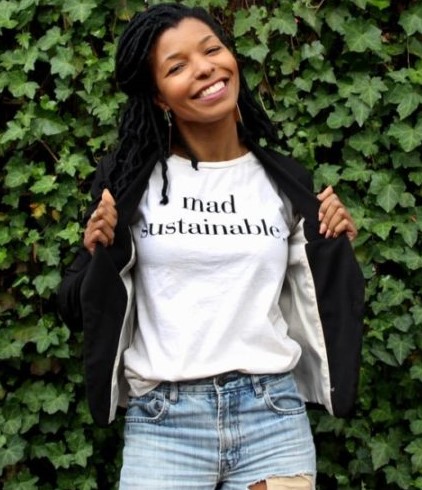
Wrapping up Stories of Sustainability: Fashion Series with Sustainable Fashion and Social Impact Q+A! We welcomed CEO and Founder of Grant Blvd, Kimberly McGlonn, in conversation with Temple Made sustainable student leaders. Using sustainable fashion, Grant BLVD designs inclusive pathways and creates employment opportunities. Grant BLVD proposes a solution to addressing the larger global crisis and social problems stemming from climate change and poverty.
Kimberly McGlonn
Meet our thought leader.
Kimberly is an activist, teacher, podcaster, and business owner tackling mass incarceration through sustainable fashion. She earned her Ph.D. from LSU and serves as a councilmember and school teacher in Montgomery County. Kimberly opened Grant BLVD’s storefront in August of 2020, tapping into West Philly using fashion as a “mechanism for creating opportunities”. As a creative director, she uses her platform to bring attention to the challenges of mass incarceration and the need for prison reform.
Meet our superstar student leaders.
Temple Made student leaders
We were joined by five superstar students. With varying majors and career goals, student leaders came together through their passion and desire to learn. They channeled their passion for the environment, fashion, and making a positive difference by leading an insightful and empowering conversation with Kimberly.
The power of acting with love and speaking out against inequity.
Hear directly from Kimberly on her journey and present efforts to make a change! Here we have highlighted our answers and insight from Kimberly.
We are guided through this conversation by superstar student leaders with three main topics in mind: People, Planet, and Profit.
Layers of permanent disruption are created once someone is convicted of a crime. Whether one can secure a job trickles into their housing, funding, and ability to reunite with their children. Kimberly’s legacy is just beginning as she founded Grant BLVD, knowing she could channel her passion for style by creating a sustainable fashion brand and eliminating barriers to provide employment opportunities.
https://youtu.be/c1vgTTFnaW4
Sustainable Fashion and Social Impact with Kimberly McGlonn
Q: What advice would you have for people beginning their journeys in sustainable fashion, and for sustainable entrepreneurs? A: Being sustainable starts with committing individually, to be able to defend the decisions that we make in terms of sustainability while educating others. The high standard of sustainability is reducing consumption, the second highest is repurposing items to avoid adding waste and the highest standard is that we don’t buy new products. Overall, circularity and reusing products are most important – and that is how we are bringing Grant BLVD to the next level. Our goal is to encourage our shoppers to bring their garments back to us, to extend their life and give them a new purpose.
https://youtu.be/xHt-FbNpRcY
Grant BLVD stands out against its competitors with its diverse and queer female staff, partnerships with communities in Philadelphia and their efforts of giving to non-profit organizations.
The larger challenge for humans is to overcome our current consumer behavior. With consistency and endurance, we must demand more from our consumers, regulating purchases, and recognizing purchasing power while acting on it. For a more in-depth conversation with Kimberly about consumers and consumption, head over to the Green Dreamer Podcast.
Q: Do you have any advice for someone who loves fashion but is feeling disillusioned with the fashion industry as a whole? A:Much of the disillusionment comes from brands claiming they are sustainable but not being ethical. It continues into the history of fashion in America and the cotton industry. These “sustainable” brands negatively affect Black and Brown communities through their manufacturing efforts and low-fair wages. It comes down to conducting research, and to stop shopping with brands that truly only benefit the top 5%. We must police ourselves and our consumption.
https://youtu.be/3W7WVS0xrro
It’s a tricky balance! Kimberly is constantly trying to figure out how to strike the balance between advocacy and sales. Determining how to strike the balance of being aware of the real things happening in our neighborhoods and country while still recognizing that Grant BLVD is telling a story about fashion.
Grant BLVD is using ethically and sustainably sourced fashion to tell a story about pleasure.
https://youtu.be/c8XeGhLyR8k
Q:Do you believe that one day sustainable fashion will be affordable for the average person? A: Well, we have gotten comfortable in this society where things cost more than we think they should and vice versa. I know that I am investing in my pieces, spending more because what I am wearing reflects my values which is not supporting slave labor or destroying the planet. Embracing our value as consumers, I believe, is the next step for the system to start recalibrating itself.
In the next 10 years, Kimberly hopes to see Grant BLVD break into new markets, build upon a talented team, and develop strategic partnerships with smaller brands. Overall, Kimberly is excited about educating people around various backgrounds about the intersections of sustainability and justice, sustainability and democracy, sustainability and equity and sustainability, and the survival of us as a whole.
https://youtu.be/NoP_n2Lx6zE
Q: What barriers did you face as you founded Grant BLVD and built upon the brand? A: As a woman, I was presented with those barriers. And a teacher for the last 15 years, I was constantly approached with the questions of: what do you know about fashion? For me, it was about countering narratives about what my talent was. I constantly remind myself that I am capable of. I was really careful about my tribe of people, and investing my time in people who encourage me and have faith in me.
https://youtu.be/gBJJuEUgZWQ
Q: We’re all in this fight and we are here for the gradual change of how people live their lives sustainability. What do you have to say to someone with the “I want to change now” mentality? A: As Americans, we are addicted to convenience and ease. It is challenging to overcome that mindset. But one word that I believe can help us is legacy. To remind ourselves of our legacy, what we leave behind, and the power that we have to influence others.
https://youtu.be/6NqlbzxHh9s
It is about “making sacrifices as a leader and businesswoman” to make change. It was truly beautiful to be in a space with like-minded people pushing for change. During this conversation, we empowered each other and learned from each other’s experiences.
Join our OwlConnect to remain informed and updated on all upcoming events with the Sustainability community at Temple. Check out our new EcoReps program while you’re there to gain hands on experience with greening our campus!
Take a look at our last Stories of Sustainability, Join the Waste Conscious Fashion Community. Learn about #EcoChampions and Founders of Thrift & Flop, Allison Altobelli and Miya Wager!
Follow along with us on our socials to stay engaged and learn more about our upcoming #EcoChampion!
Welcoming our first ever #EcoChampion, Will Fraser!
Our first #EcoChampion Will Fraser (CLA ‘15) with the Clean Air Council, spoke with Temple students, faculty and staff in an important conversation on Green Transportation as a climate solution!
Will graduated from Temple in 2015 with a degree in Environmental Studies. As the Transportation Outreach Coordinator, Will focuses his work on educating and organizing businesses to adopt sustainable commute benefits. Currently, Will chairs the City of Philadelphia’s Office of Transportation + Infrastructure, as well as Sustainability’s Vision Zero Education Sub-committee.
#EcoChampion: Will Fraser
Making the shift as a Temple Owl.
More than any other sector of greenhouse gas emissions, transportation generates the largest share. The emitted greenhouse gases come from our common use of burning fossil fuels for our use of cars, trucks, ships, and planes. A huge shift that Temple students, faculty and staff can make individually while changing the narrative together, is the shift towards Green Transportation!
In our Philadelphia community, we have the unique ability to make this shift. The most environmentally friendly modes of transportation are walking and biking, as they emit zero greenhouse emissions. Plus – it is a great form of exercise which benefits your health.
When walking and biking is not an option, public transportation is a great option that the City of Philadelphia offers. Utilizing the subway, bus, and trolley is a great alternative to utilizing a car. Also, carpooling and van-pooling is offered through many programs, where you can save money, and connect with your community.
Head over to our Temple’s on the Moveblog to learn more about getting around campus sustainably.
How can I make a sustainable and effective shift?
The City of Philadelphia and Temple University, both have plenty of safe green commute and transportation options. Our #EcoChampion, Will Fraser, shared several eco friendly resources featured below!
Philadelphia Commute Options
Options for transit passes, carpooling, and van pooling allowing employees to set aside pre-tax dollars to pay for expenses related to commuting to and from work! These are great resources to learn more and connect:
Global Bike Challenge:Sign up with CycleSeptember to earn points by riding while encouraging others to ride too. These points can lead to amazing prizes including an ebike!
Feet First Philly: Pedestrian advocacy group sponsored by the Clean Air Council! Promoting safer streets and advocating for pedestrian rights. Join their newsletter and follow them on Facebook and Twitter too!
Gain real-life experience diving deeper into Green Transportation!
Broad Street Looking North
Apply to receive your walk-audit certification with the Office of Sustainability and Clean Air Council! This semester-long training course is for anyone who is interested in learning more about sustainability, environmental justice and community development, and transportation advocacy.
Participating in this training will set you up for future student leadership opportunities with the Office of Sustainability and our partners, and teach you how to be a better neighbor and more engaged citizen of the city.
This training will take place over two 90 minute sessions, and together with data collection, will require about 5 hours of your time over the course of the semester. All students of every major are invited to apply.
Join our OwlConnect to remain informed and updated on all upcoming events with the Sustainability community at Temple. Check out our new EcoReps program while you’re there to gain hands on experience with greening our campus!
Follow along with us on social to stay engaged and find out who our next #EcoChampion will be!