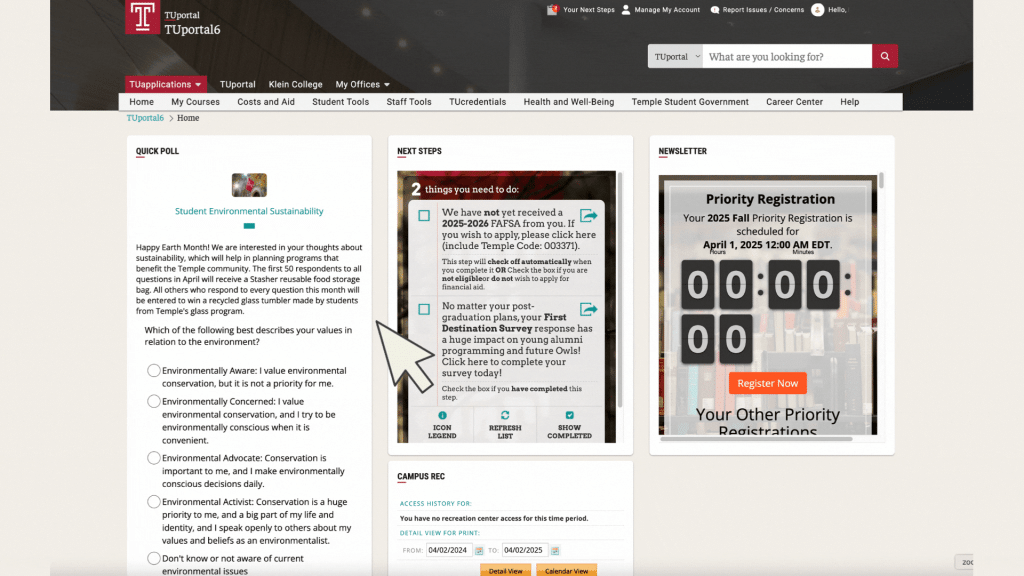
All Temple students, staff, and faculty will see new questions about sustainability in TUportal throughout the month of April from the 2nd through the 25th.
Every few days you’ll be asked about your personal values and actions when it comes to the environment, your thoughts and preferences on sustainability infrastructure and programs, and sustainability in your academic program or your professional role as a staff person.
Help us help you!
Your answers will help us plan programs that will benefit the Temple community for years to come.
The first 50 students and staff members to complete all the polls will receive a brand-new Stasher reusable storage bag.
February was Environmental Justice Month
In 2014, the Environmental Protection Agency (EPA) declared February to be Environmental Justice Month to commemorate the signing of historic 1994 executive order 12898: “Federal Actions to Address Environmental Justice in Minority Populations.”
This Campus Sustainability Month, the Office of Sustainability will create pathways for understanding how small, grassroots actions can have a longstanding impact.
A series of different workshops, events and service opportunities will focus on select United Nations Sustainable Development Goals and the Temple community will learn what they can do here in Philly and on campus to affect sustainable change globally.
Campus Sustainability Month is under way, and our #EcoChampions Allison and Miya are keeping the momentum going with Thrift and Flop. On October 14th, Allison and Miya hosted a valuable conversation with superstar students, and passionate faculty members. Read on to learn more about this Temple student-led waste conscious fashion forward community!
About our #EcoChampions
Allison Altobelli and Miya Wagner are students in the College of Liberal Arts at Temple University. Allison is a communications major with a minor in digital media engagement. Miya is also a communications major with a minor in psychology. As the recipients of the 2019-2020 Green Grant, they are entering their second year with Thrift and Flop. We are ecstatic to be featuring them both as our #EcoChampions, as they bring awareness to the negative effects of fast fashion and use their creative skills to channel a positive message through upcycling clothing!
Building a waste conscious and fashion forward community.
Miya founded Thrift and Flop in October of 2019 soon after realizing she wanted to be involved at Temple, but there was not a club that resonated with her passions. With Miya’s combined passion for upcycling clothes and craving a community of like-minded people, she collaborated with Allison and they founded Thrift and Flop.
Thrift and Flop began their community through an Instagram page, inviting students to create authentic pieces of clothing by channeling their creativity through fashion and sustainability. Now, as we are in the 2020 school year, Thrift and Flop has over 800 followers and 85 paying members. Thrift and Flop’s success is highlighted by the community of waste conscious fashion forward students. They continue to build upon this community of students by normally operating with weekly demonstrations, photoshoots, thrifting trips, clothing swaps, fashion shows and giveaways.
Thrift and Flop members posing
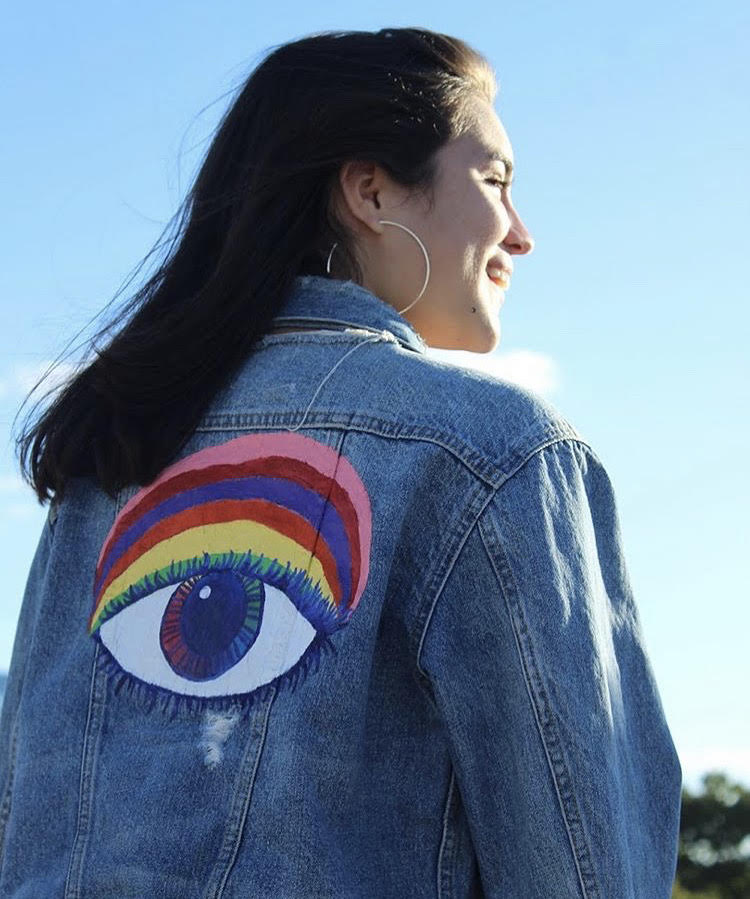
Upcycled denim jacket
Thrift and Flop organized photoshoot
Join the Thrift & Flop Community!
Follow Thrift & Flop on Instagram to learn how to join the fashion forward group for workshops, photoshoots & more.
Many people want to feel fashionable. The fast fashion community makes people feel that they have to do so with low prices and cheap non durable clothing. In America, we throw away about four billion pounds of clothing annually – making fast fashion the world’s second largest pollutant as 85% of the textiles slowly decay in landfills. Fast fashion is an ethical, environmental and economic issue. It pollutes the earth affecting our ecosystems, brings light to a major human rights issue, and makes people question: what happens to clothes before they are put in stores and after they are bought?
A waste conscious fashion solution.
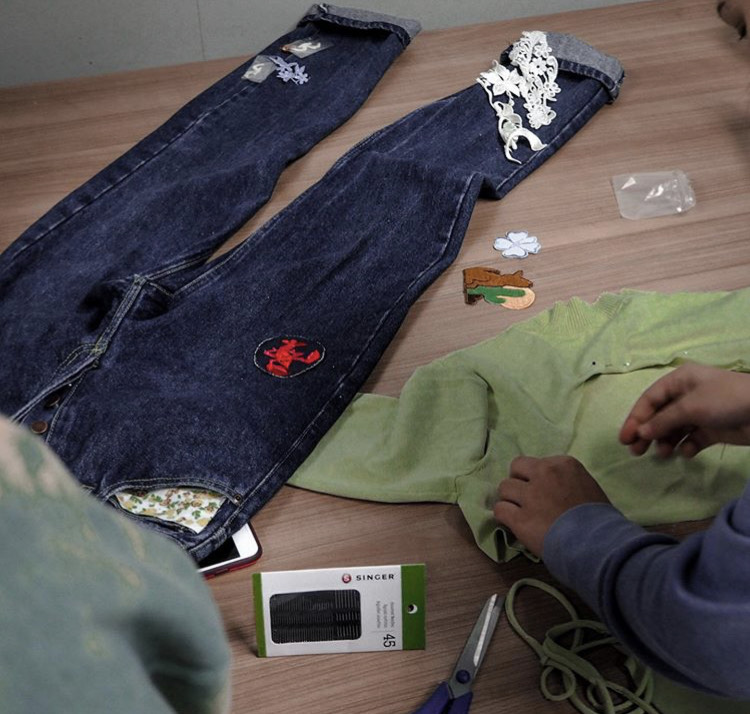
As people question their buying habits, we continue to move one step closer to slow fashion. Thrift and Flop offers a solution: upcycling clothing. Being zero waste, is not just recycling but it’s repairing, reusing and rethinking. The vision behind Thrift and Flop is brought to life through this solution. By taking garments that would rather be thrown away, one can take these garments and create a unique, beautiful piece of clothing. By altering their aesthetic or repairing them, the product life cycle is extended and fashionable pieces are created.
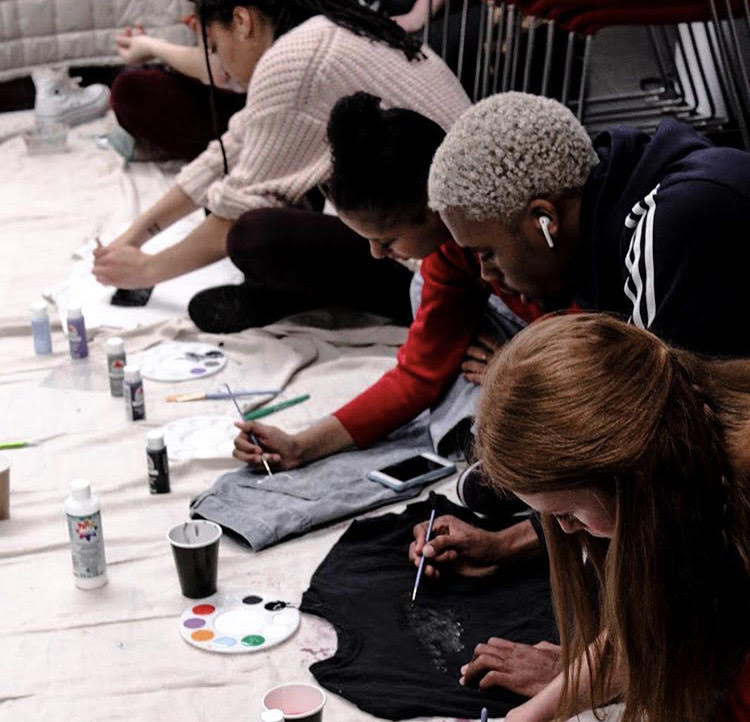
Thrift and Flop hosts several workshops for upcycling clothes – demonstrating how to distress denim, paint on fabric, sew, make jewelry, acid wash and so much more!
upcycled clothes made by Thrift and Flop members
Thrift and Flop Workshop
Be an Eco-Friendly consumer in Philadelphia.
As a part of the community in Philadelphia, we can make a positive impact and difference by being Eco-Friendly consumers. Before you buy that next clothing item, ask yourself: Do I have an item like this already in my closet? Is the price tag reasonable and worth it? What brand is this garment? Is it eco-friendly?
Visit our latest blog post to learn more about where to ethically and sustainably donate your clothes in Philadelphia.
Thrift and Flop’s Green Grant journey.
The Green Grant enabled Thrift and Flop to purchase needed supplies for their meetings and operations making this semester possible. The Office of Sustainability continues to guide Allison and Miya, bringing their vision of sustainability and zero waste to life.
Learn more and apply for the Green Grant!
Temple University’s Green Grant builds upon Temple University’s commitment to sustainability by funding projects led by students that focus on advancing the mission and have a positive impact on our local environment and community. The application deadline is November 30th, so head over to our website tolearn more about applying!
Join our OwlConnect to remain informed and updated on all upcoming events with the Sustainability community at Temple. Check out our new EcoReps program while you’re there to gain hands on experience with greening our campus!
Sustainable Innovation with CEO of Bucha Leather Inc: Zimri Hinshaw!
We are happy to kick off Temple Campus Sustainability Month with our #EcoChampion Zimri Hinshaw! As the Founder and CEO of Bucha Leather, Zimri hosted an important and interactive conversation on his solution to the leather industry. Read on to learn all about this incredible sustainable innovation!
Zimri is a Temple College of Liberal Arts Economic major with a minor in Business from the Fox School of Business. He is the Founder and CEO of Bucha Leather Inc., which he founded after growing kombucha in his dorm room at Temple. After submitting his entrepreneurial idea to various competitions he has worked to perfect Bucha’s triple bottom line business model. Bucha creates premium animal-free leather made out of bacterial nanocellulose. Bucha Leather is Zimri’s seventh entrepreneurial journey and as the recipient of the Green Grant, we are excited to feature him as our #EcoChampion!
Within every glass of kombucha is the solution to the leather industry.
Bucha Leather is not an alternative to leather, is it replacing traditional animal leather products. The problem behind the leather industry and its alternatives lie in their unsustainable production, energy and waste. The global leather industry pollutes the earth with over four million tons of solid waste every year. Its competitors, synthetic and faux leather, use unsustainable products that take up to 500 years to decompose littering our earth in landfills.
Bucha Leather provides the real solution to the leather industry. It is grown from strong bacterial nanocellulose and treated with all-natural waxes and dyes. It is animal-free with no plastic additives, has high strength and durability while boasting a premium leather texture. Bucha does not compromise on sustainability while meeting high-end industry and consumer standards. For their goal textile, Bucha implements five steps within their scientific and production process. This whole process takes 22 days, 15 days for growth, and 7 days for drying & treatment. Bucha has the fastest manufacturing time across the entire leather industry!
Bucha sells sheets of textiles directly to creators and designers and wholesale to manufacturers. They look for those trying to incorporate sustainable textiles into their final products.
Bucha Pillow: Animal-free with no plastic additives, high strength and durability, & a premium leather texture!
Building a sustainably-focused venture.
Zimri, along with his team, have built a sustainable production system. Goals within this production system are focused on a full cycle of sustainability, creating zero waste and low impact on the earth. After the growth period is complete and treatments are applied, the material dries and is ready for its finish touches. Bucha products come full circle. After they are applied and come to its end of use, the textiles can be composted and recycled back into earth!
When working to achieve a long-term vision and maximum profitability, Zimri highlights the importance of making compromises and knowing how to scale back in the future. With Bucha’s commitment to full cycle sustainability, highlighted as the triple bottom line, he touches on the importance of balancing people, planet and profit. As Zimri builds this model, he is constantly thinking about Bucha’s sustainable innovation. Asking himself, and his team: What is our end of life for our product? How can we be biodegradable and recyclable? How do we balance that with textiles that need to be durable and have a long life?
Brand new leadership development program that keeps you honest and on track with your goals.
Featured questions, answered by Zimri!
#EcoChampion Zimri during sustainable innovation Webinar
Q: What does sustainability mean to you, as the Founder and CEO of Bucha Leather?
A: I am always thinking about zero waste and what the end of life is for our product. Constantly thinking about making our production as clean as humanly possible while keeping it inspired and our values centered around circular production goals.
Q: Can you consume the product that is used to create Bucha Leather?
A: Yes! It is safe but it won’t be like kombucha and will probably taste like sweet bacterial tea.
Q: How many different types of products can Bucha imitate?
A: We will move into new products as we achieve new levels of technical strength and durability. But it is important to note that we are not imitating – we are replacing the traditional leather industry! We are the new and the next leather. Currently, we are working with partners to craft the possibility of shoes, pillows and clothing.
Q: How is Bucha Leather a climate solution?
A: We are replacing traditional animal leather products, eliminating one of the worlds largest pollutants. As a widely appealing product, Bucha appeals to all consumers. From meat lovers, to vegans, Bucha Leather is for everyone.
Follow Bucha Leather along their zero waste business journey!
Feel free to send a direct message to ask any questions and connect with the brains behind Bucha Leather Inc.
Temple University’s Green Grant builds upon Temple University’s commitment to sustainability by funding projects led by students that focus on advancing the mission and have a positive impact on our local environment and community. The application deadline is November 30th, so head over to our website tolearn more about applying!
Hey Eco Owl! Remain informed and stay connected:
Join our OwlConnect to remain informed and updated on all upcoming events with the Sustainability community at Temple. Check out our new EcoReps program while you’re there to gain hands on experience with greening our campus!