
Mechanisms of Speech Perception in Complex Listening Environments
Understanding speech in noise requires the interaction of multiple perceptual and cognitive processes. Our research investigates how acoustic cues, linguistic context, listening effort, and individual differences jointly contribute to successful speech understanding under adverse listening conditions.
Current topics include:
- Speech perception in background noise
- Listening effort and pupillometry
- Perceptual and cognitive interactions during speech processing
- Individual differences associated with hearing loss and aging

Discourse Comprehension and Continuous Speech Processing
Everyday communication involves understanding connected speech rather than isolated sentences. This line of research investigates how listeners integrate acoustic, semantic, and contextual information during continuous speech and conversation.
Using behavioral measures, pupillometry, and computational time-series analyses, we study how speech comprehension unfolds over time and identify the mechanisms that support successful communication in realistic listening environments.
 Face-to-Face Communication and Visual Attention
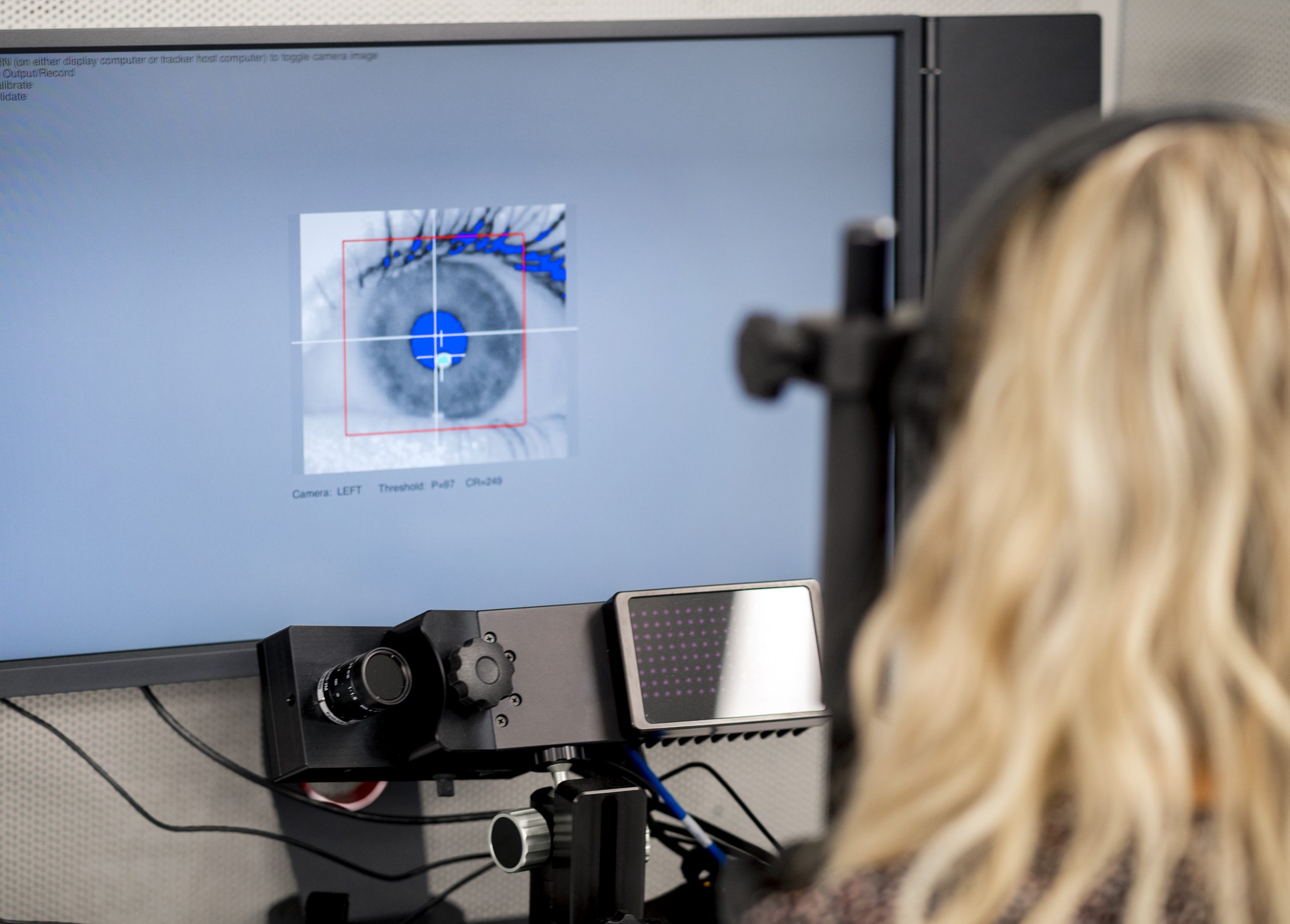
Face-to-face communication depends on the continuous integration of auditory and visual information. We use AI-generated conversational agents together with eye tracking and pupillometry to investigate how listeners allocate visual attention during communication under adverse listening conditions.
Rather than studying audiovisual speech perception in isolation, our goal is to understand how gaze behavior and physiological responses contribute to successful communication in realistic face-to-face interactions.
 Adaptive Communication Systems
Communication is a dynamic process that changes continuously as acoustic environments, conversational partners, and communication demands evolve. Our long-term research seeks to develop mechanistic models of adaptive communication by integrating behavioral, physiological, and computational approaches.
This work lays the foundation for future intelligent hearing technologies and AI-assisted communication systems capable of adapting to users’ moment-to-moment communication needs.