
The Speech Perception and Cognition (SPAC) Lab at Temple University investigates the perceptual, cognitive, and behavioral mechanisms that support successful communication in complex real-world listening environments. Our research combines hearing science, cognitive psychology, language science, and quantitative modeling to better understand how people communicate when speech is degraded by hearing loss, background noise, competing talkers, and other everyday challenges.
Our primary goal is to improve communication for older adults with hearing loss by identifying the mechanisms that underlie successful communication and translating these discoveries into future hearing technologies and communication interventions.
Our Research Philosophy
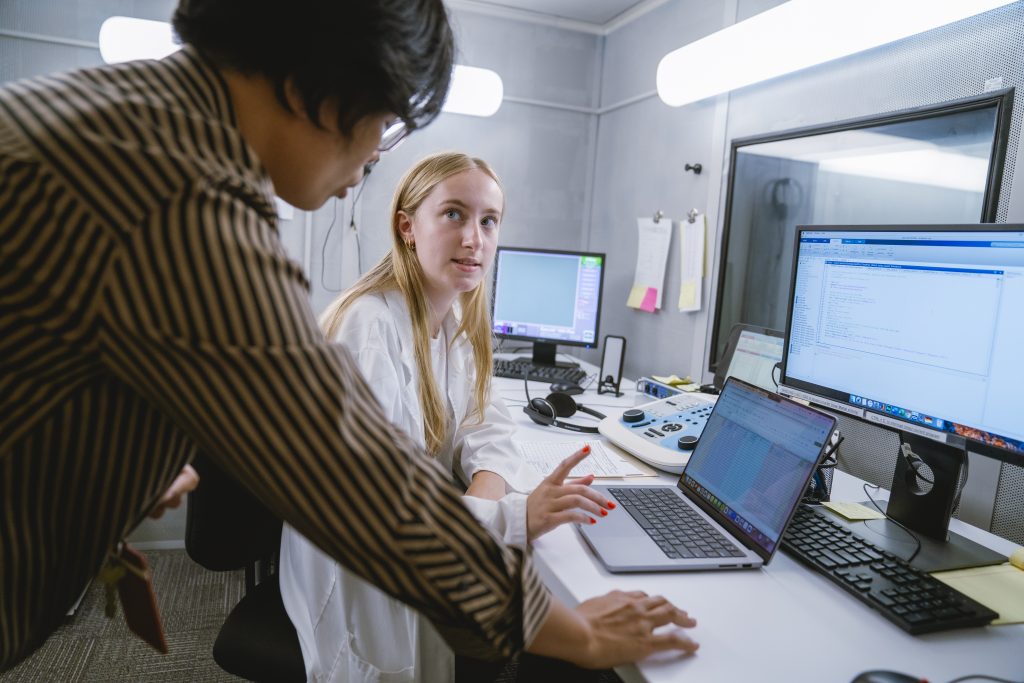
Communication in everyday life is considerably more complex than the speech perception tasks typically studied in laboratory experiments. A central goal of the SPAC Lab is to bridge this gap by developing experimentally controlled paradigms that progressively increase ecological validity while preserving the ability to identify the perceptual, cognitive, and behavioral mechanisms underlying successful communication.
Rather than viewing communication as a single speech recognition event, we study communication as a dynamic process that unfolds over time through interactions among acoustic environments, language, visual information, cognition, and listener behavior.
Current Research Themes
Our current research focuses on four complementary areas:
Speech perception in complex listening environments
We investigate how acoustic, perceptual, and cognitive factors jointly support speech understanding in noise and other challenging listening conditions.
Discourse comprehension during continuous speech
We study how listeners integrate acoustic, semantic, and contextual information while understanding connected speech, using behavioral measures, pupillometry, and computational time-series analyses.
Face-to-face communication and visual attention
Using AI-generated conversational agents, eye tracking, and pupillometry, we examine how listeners coordinate auditory and visual information during realistic face-to-face communication and how individual differences in gaze behavior contribute to successful communication.
Adaptive communication
Our long-term research seeks to develop mechanistic models of adaptive communication by integrating multimodal behavioral and physiological measures to understand how communication evolves over time in realistic environments.
Long-Term Vision
The SPAC Lab seeks to develop mechanistic models of human communication that improve the everyday communication experiences of older adults with hearing loss. By integrating experimentally controlled research with increasingly realistic communication paradigms, our long-term goal is to provide the scientific foundation for next-generation hearing technologies and personalized communication interventions that adapt to users’ moment-to-moment communication needs.
Opportunities for Older Individuals
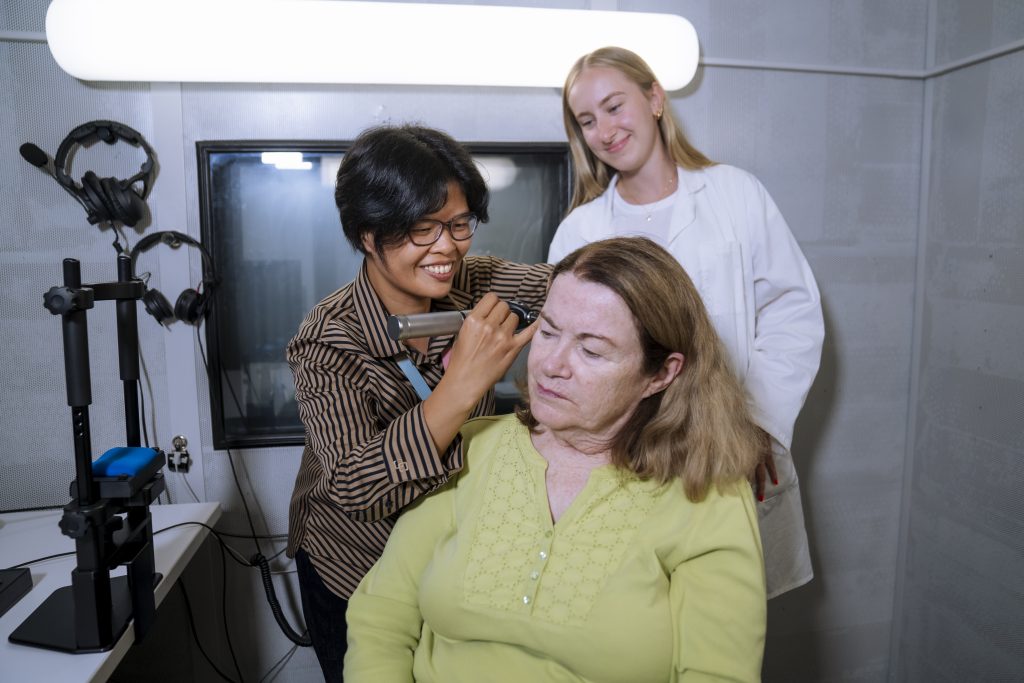
We are interested in working with older individuals with and without hearing loss who would like to participate in research. All of our research participants are compensated for their time and offered counseling about their auditory abilities as part of their involvement in our studies.
Support
We are grateful to have support for our work from the National Institute on Deafness and Other Communication Disorders
For information on our current research projects, please contact us at spaclab@temple.edu