- Renato is defending his Master’s thesis on 11/23/2021
- Renato is presenting at Ford Motor Company’s 6th Global Control Conference 12/2021
- Renato is awarded the Future Faculty Fellowship 8/2021
- Omidreza is presenting at ECC 2021 on 7/1/2021
- Mohsen and Andrew’s paper accepted for publication in Letter Dyn. Sys. Control, 2021
News 2019
- Andrew is defending his Master’s Thesis on 11/19/2019
- Renato J. Rodriguez presented at the 2019 DSCC, Dynamic Systems and Control Conference, ASME.
- Omidreza Ahmadzadeh joined DSLab in Fall 2019. Welcome Omid!
- Mohsen Derakhshan joined DSLab in Fall 2019. Welcome Mohsen!
News 2022
- Omidreza and Renato’s paper on Data-driven modeling of LIBs accepted in ACC 2022
- Renato’s paper on adaptive takeoff optimization accepted for publication at the Journal of Sailing Technology, 1/2022
- Mohsen’s paper on DRT accepted for publication in IEEE Control Sys. Letters (and ACC 2022)
Publication Alert: Renato’s paper to appear in the Journal of Sailing Technology (JST)
Cooperative path planning for multiple non-holonomic vehicles
We present a metric space approach for high-dimensional sample-based trajectory planning. Sample-based methods such as RRT and its variants have been widely used in robotic applications and beyond, but the convergence of such methods is known only for the specific cases of holonomic systems and sub-Riemannian non-holonomic systems. Here, we present a more general theory using a metric-based approach and prove the algorithm’s convergence for Euclidean and non-Euclidean spaces. The extended convergence theory is valid for joint planning of multiple heterogeneous holonomic or non-holonomic agents in a crowded environment in the presence of obstacles. We demonstrate the method both using abstract metric spaces (l_p geometries and fractal Sierpinski gasket) and using a multi-vehicle Reeds-Shepp vehicle system. For multi-vehicle systems, the degree of simultaneous motion can be adjusted by varying t.he metric on the joint state space, and we demonstrate the effects of this choice on the resulting choreographies.
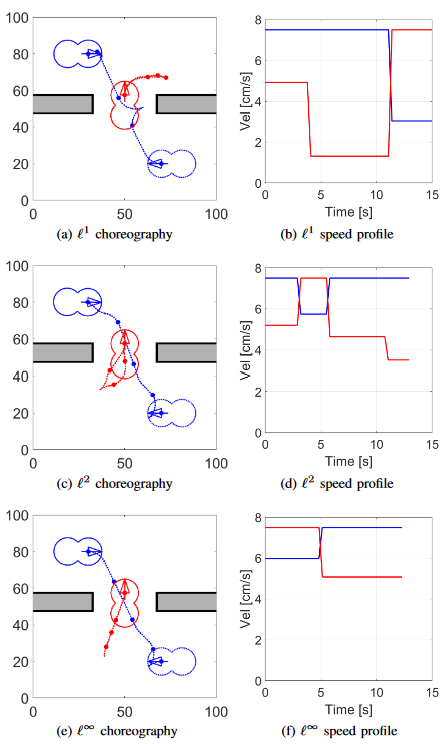
cm2 region with obstacles using (a) L1-norm, (c) L2-norm, and
(e) L∞-norm. We show the starting pose of each vehicle using
dashed lines and arrows, and the final pose using solid lines
and arrows. Static environmental obstacles are shown as gray
boxes. The speed of each vehicle over time is shown in the
corresponding figures (b), (d), (f).
Publications
A. Lukyanenko and D. Soudbakhsh, “Sampling-based multi-agent choreography planning: a metric space approach,” Robotics and Autonomous Systems, In Press 2023.
Lukyanenko, A., and Soudbakhsh, D. “Sampling-Based Multi-Agent Choreography Planning: A Metric Space Approach,” 2021, arXiv: 2108.03191 [cs.RO]. (download the arxiv version) https://arxiv.org/abs/2108.03191
Lukyanenko, A., Camphire, H., Austin, A., Schmidgall, S., and Soudbakhsh, D.”Optimal Localized Trajectory Planning of Multiple Non-holonomic Vehicles,” 2021 IEEE Conference on Control Technology and Applications (CCTA), 2021, pp. 820-825, doi: 10.1109/CCTA48906.2021.9658995.
Publication Alert: Mohsen’s paper to appear in IEEE Control Sys. Letters (and ACC 2022)
Derakhshan, Mohsen, and Damoon Soudbakhsh. “Temperature-Dependent Time Constants of Li-Ion Batteries.” IEEE Control Systems Letters 6 (2022): 2012–17. https://doi.org/10.1109/LCSYS.2021.3138036.
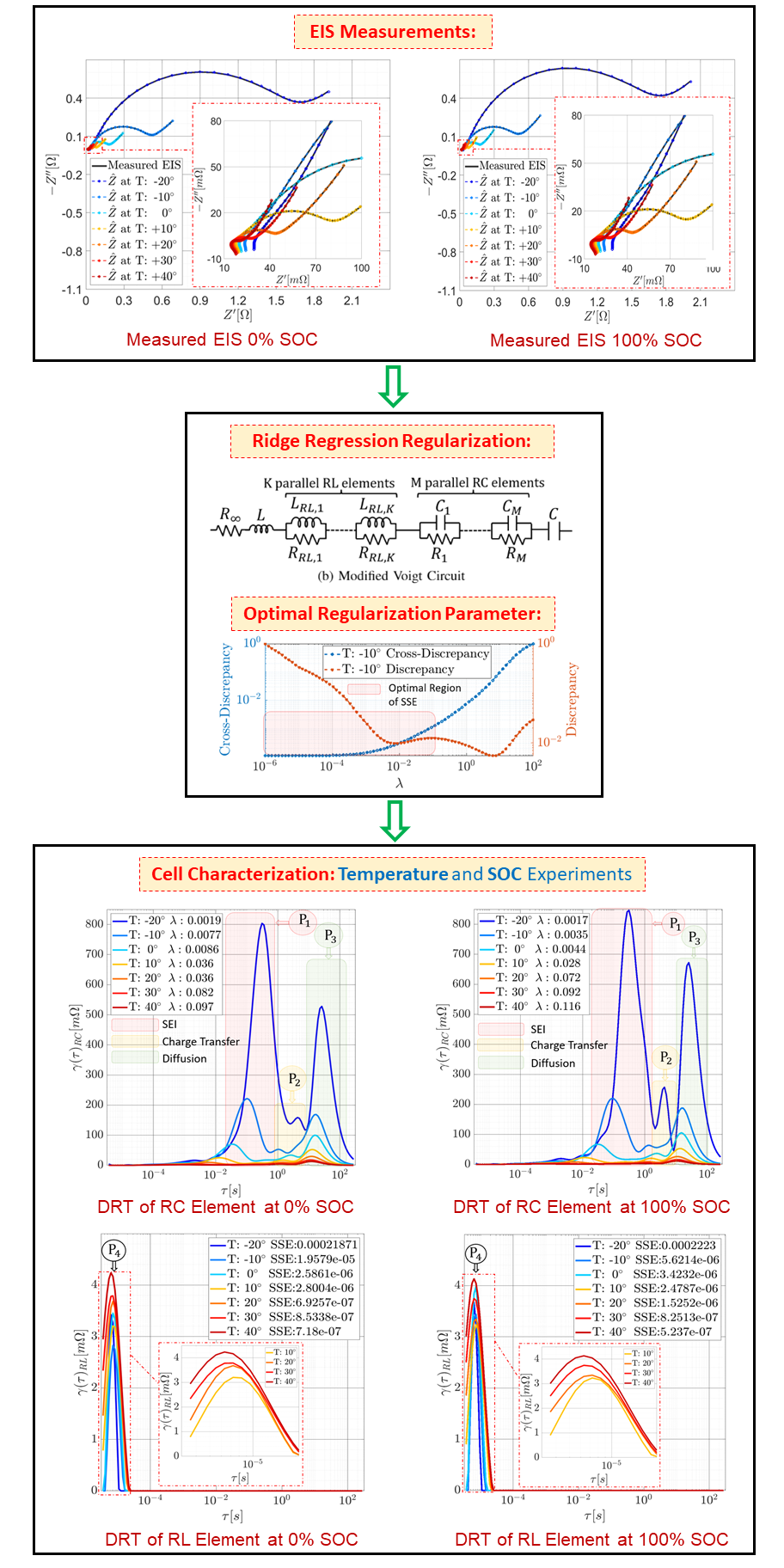
Abstract:We investigate the effect of temperature on the time constants of Li-ion batteries (LIBs). Using the distribution of relaxation times (DRT), the time constants of three cylindrical Li-ion cells were determined. EIS (Electrochemical Impedance Spectroscopy) was conducted on the cells, and the measured impedance spectra were analyzed using DRT. The DRT analysis is usually formulated as a Ridge Regression optimization problem. While the regression tuning parameter has a significant impact on the results, the studies on selecting this parameter are very limited. This letter proposes novel cost functions to select the optimal regressions parameters. The cost functions include (i) Discrepancy, (ii) Cross-Discrepancy, and (iii) the Sum of Squared Errors. The first two criteria exploit the Kramers-Kronig relations, and they quantify the discrepancy of the reconstructed impedance spectra using only its real, imaginary, or both components. The last criterion quantifies the errors in real and imaginary components of the data from the reconstructed EIS. The method was applied to the impedance spectra of Li-ion cells at low and high temperatures and different state of charges (SOCs). We identified the time constants of the cells using the proposed criteria for different test conditions.
Renato is presenting at Ford’s 6th Global Control Conference
Renato’s Master’s thesis defense
Renato is defending his Master’s thesis on Tuesday, November 23rd, 2021.
Congratulations to Renato for receiving the Future Faculty Fellowship (FFF)
Renato is awarded the Future Faculty Fellowship on 8/2021.

Future Faculty Fellowships have a twofold purpose. They are intended to attract outstanding students to Temple University and to diversify the American professoriate. While already a national leader in the training of graduate students from traditionally underrepresented groups, including ethnic minorities and women, Temple University is committed to doing all it can to diversify its graduate population and the professoriate. Candidates are newly admitted graduate students from underrepresented groups in the applicant’s discipline who show exceptional leadership and/or have overcome significant obstacles in pursuing an academic career.
https://www.temple.edu/gradarchives/11-12/grad/fff/index.htm
Omidreza is presenting at ECC’21
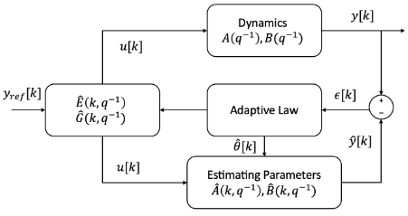
We present a matrix form for adaptive control with network control systems. We address the problem of controlling systems with linear dynamics with unknown parameters over a network. The dynamical system can be unstable subject to network delays. The delays are introduced due to the presence of several control and non-control applications in the network control system. We show the effectiveness of the algorithm through a simulation study on a Control Area Network (CAN bus).
Omidreza Ahmadzadeh, Damoon Soudbakhsh, “Adaptive Control of Network Control Systems”, ECC2021