Congratulations to Renato for Advancing to the University -Level 3MT (Thesis) Competition
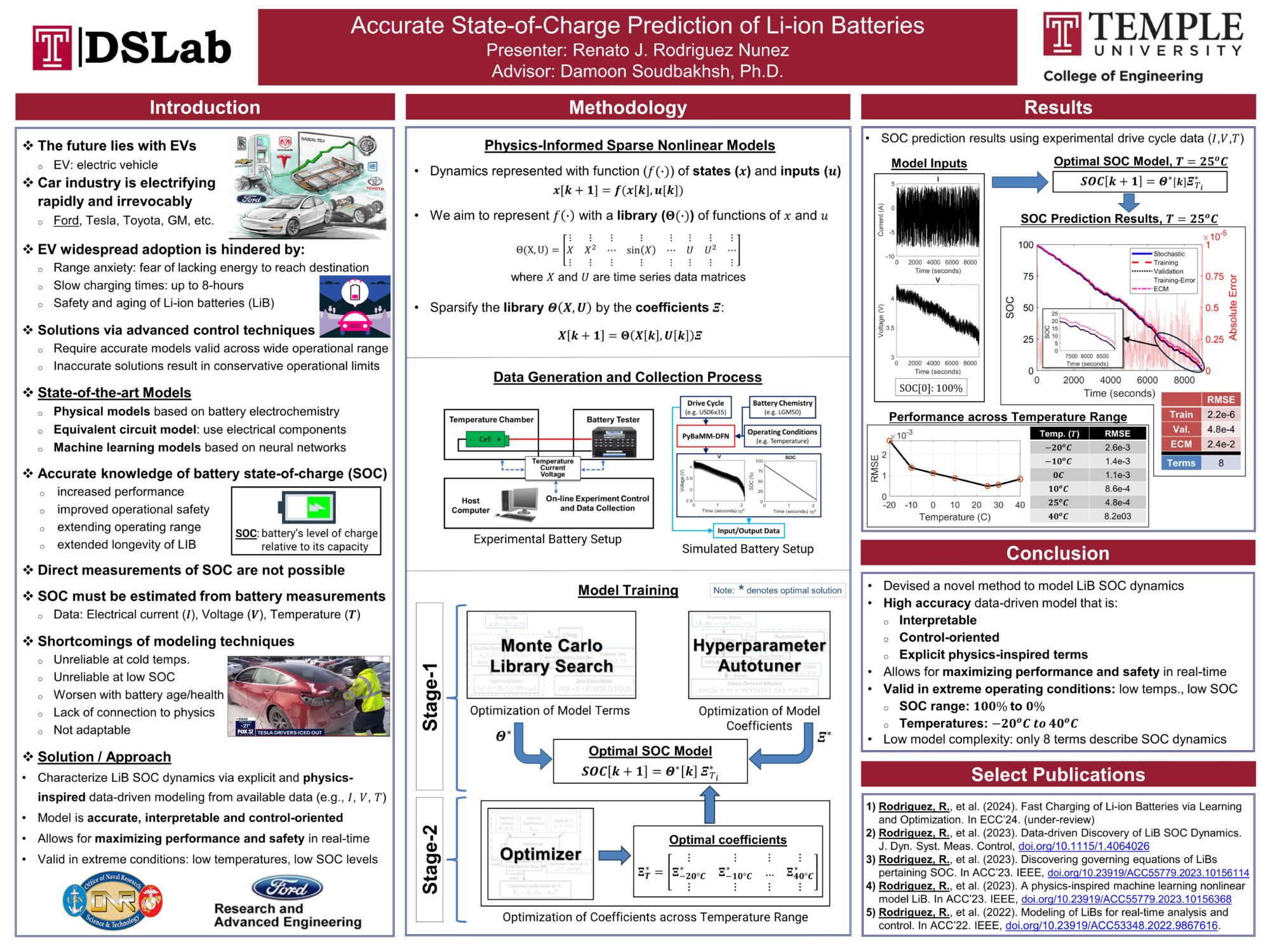
Congratulations to Renato for winning 1st Place at TU’s Graduate Research Poster Competition
Renato‘s research on “Accurate State-of-Charge Prediction of Li-ion Batteries”, was awarded 1st place at Temple University’s Graduate Research Poster Competition, on February 21th, 2024.
Research Topic
Data-driven Discovery of Governing Equations of Li-ion Batteries Pertaining State of Charge
Publications
- Rodriguez, R., Ahmadzadeh, O., Wang, Y., & Soudbakhsh, D. “Data-Driven Discovery of Lithium-Ion Battery State of Charge Dynamics.” ASME. J. Dyn. Sys., Meas., Control. January 2024; 146(1): 011101. https://doi.org/10.1115/1.4064026.
- Rodriguez, R., Ahmadzadeh, O., Wang, Y., & Soudbakhsh, D. (2023, May). Discovering governing equations of li-ion batteries pertaining state of charge using input-output data. In 2023 American Control Conference (ACC) (pp. 3081-3086), IEEE, https://doi.org/10.23919/ACC55779.2023.10156114.
- Ahmadzadeh, O., Rodriguez, R., Wang, Y., & Soudbakhsh, D. (2023, May). A physics-inspired machine learning nonlinear model of li-ion batteries. In 2023 American Control Conference (ACC) (pp. 3087-3092). IEEE, https://doi.org/10.23919/ACC55779.2023.10156368.
- Ahmadzadeh, O., Rodriguez, R., and Soudbakhsh, D. “Modelling of Li-ion Batteries for Real-Time Analysis: A Data-Driven Approach”, American Control Conference, 2022, https://doi.org/10.23919/ACC53348.2022.9867616

Publication Alert: Omidreza’s paper to appear in the Journal of Energy Storage
Title: A data-driven framework for learning governing equations of Li-ion batteries and co-estimating voltage and state-of-charge
Abstract: This paper presents a reduced-order nonlinear model for Lithium-ion batteries (LiBs). Unlike mechanistic models, data-driven models offer accurate representations of system dynamics without relying on in-situ measurements and proprietary information. However, these models may perform poorly in unseen scenarios due to overfitting training data, which is typical. We propose a physics-inspired, data-driven approach to determine LiBs governing equations based on their electrochemistry rather than generic terms. We employ a sparse identification method achieved through sequentially thresholding ridge regression to construct a nonlinear model from electrical current (excitation input) and measured voltage. We formulate the problem to optimize the sparsification parameters as hyperparameters and minimize a cost function comprised of training and validation sets and the number of terms as a measure of complexity. We augment the model with a joint unscented Kalman filter to handle noisy experimental data, enabling a more accurate estimate of the state of charge (SOC) and voltage. Model performance in unseen scenarios is evaluated with urban dynamometer driving schedule (UDDS) data, where the identified model achieves a root mean square error of 1.26e−2 for SOC and voltage prediction.
Ahmadzadeh, O., Wang, Y., & Soudbakhsh, D. (2024). A data-driven framework for learning governing equations of Li-ion batteries and co-estimating voltage and state-of-charge. Journal of Energy Storage, https://doi.org/10.1016/j.est.2024.110743
Congratulations to Omidreza for receiving the Dissertation Completion Grant
Gangho joined the DSLab as a Visiting Student from Sungkyunkwan University(SKKU), Korea.

Gangho is a senior Mechanical Engineering student at Sungkyunkwan University(SKKU), Korea. He joined SKKU in 2018, and then he served in the Korean military from 2019 to 2021. In 2022, he worked as an intern in the data science department of Hyundai Mobis Co.,ltd, and he is currently participating in the West program by the Korean government from 08,2023. He has an interest in data science and robotics. In DSlab, he is working on applying the SINDy algorithm to microbiome data and seeking a certain part of research to develop a dynamical model from the behaviors of a car.
Mohsen is presenting at IMECE’23
Title: Using Time Constants of Li-Ion Batteries for Safety Evaluation
Authors: Mohsen Derakhshan, Damoon Soudbakhsh
Abstract: Lithium-ion batteries (LiBs) are the preferred choice of energy storage in many aspects of modern life from cell phones to electric vehicles (EVs), because of many desired properties such as high energy and low self-discharge. However, they pose severe hazards if their safety is compromised such as after sustaining mechanical damage. Prior work on evaluating the safety of LiBs following substantial damage was not conclusive as no detectable voltage or capacity changes were observed in them. The current study proposes a powerful, efficient, and reliable tool that can provide a solution to this problem.
Therefore, we aim at quantifying the safety of LiBs following a mechanical load or impact. We created a method to detect mechanical damage to Li-ion cells from their electrical response. The method is based on measuring their impedance spectra, determining their distribution of relaxation times (DRT), and analyzing them. We Modeled a battery impedance based on the DRT by solving a ridge regression optimization that involves a series of inductors, resistors, and capacitors as passive electrical components. New criteria for determining the optimal value of ridge regression optimization is developed in a way that the number of output peaks in the DRT be connected to the physics of the system. We tested five cylindrical cells 18650 with graphite/LiFePO4, while four cylindrical batteries are used to study the effect of mechanical damage on Lithium-Ion battery time constants. In the mechanical damage experiment, two cells were used as controls, and two cells were subjected to the indentation experiment. Using a 12.7 mm hemispherical punch, two cells are indented 6.5mm before short-circuiting. The indentation was held after each 1 mm displacement to measure the impedance spectrum of the cells (in the last step, only 0.5 mm displacement is present). To account for the changes in the EIS measurements and decouple the effect of punch indentation from the order of the experiment and the OCV drops after each EIS measurement, we conducted similar EIS experiments on the control cells. Therefore, control cells were tested with the exact timing of the tests on two indented cells. One cylindrical cell is used to study the effect of temperature and SOC on the time constant of the cell’s internal processes. We measured the impedance spectra of LIBs utilizing an EIS instrument at different cell temperatures (-20 oC to +40 oC) and State-of-charge (0% and 100% SOC). Using the introduced approach results in 5-6 dominant peaks in the 0.01 Hz to 45 kHz range, with 4-5 peaks in the medium and low frequency and only one peak in the high-frequency part of the impedance. The number of dominant peaks agrees with the expected number of internal processes determined experimentally. We use the dependency of the peaks on temperature and SOC (State of Charge) to assign them to major processes (diffusion, charge transfer, SEI (Solid Electrolyte Interphase), and the changes in the properties of the electrodes and separator). Using our DRT formulation and criteria, we show that the indented cells have substantially different high-frequency characteristics than the control group (the changes of the height of high frequency peak is 2.5% for control cells and 36.0% for indented cells). This non-invasive method can detect hazardous mechanical damage to the EV batteries after a road crash or impact landings of drones. Other applications of the proposed approach include 1) EVs evaluation during standard crash tests, 2) planned impact and shock applications, and 3) regular safety checks.
Related Publications:
1- Derakhshan, M., Sahraei, E., & Soudbakhsh, D. (2022). Detecting mechanical indentation from the time constants of Li-ion batteries. Cell Reports Physical Science, 3(11).
2- Derakhshan, M., & Soudbakhsh, D. (2021). Temperature-dependent time constants of li-ion batteries. IEEE Control Systems Letters, 6, 2012-2017.
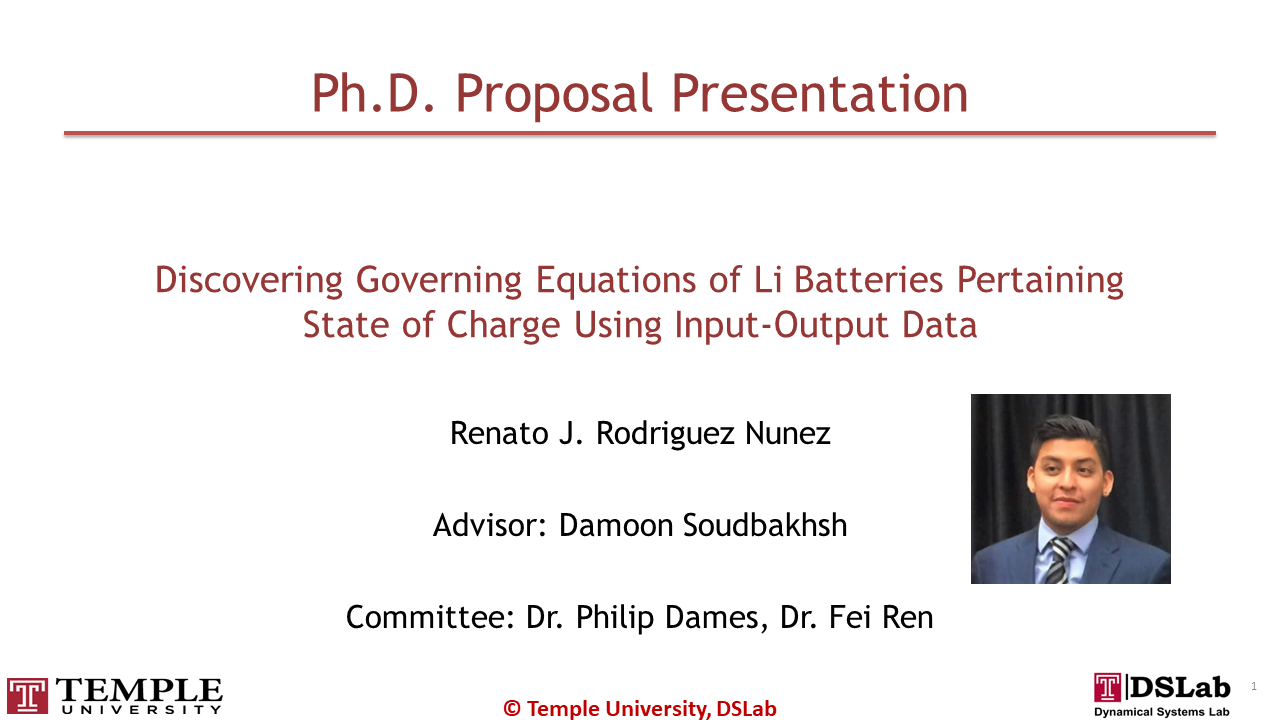
Renato’s Ph.D. Thesis Proposal
Renato is proposing his Ph.D. Thesis on Monday, October 9th, 2023.
Renato is presenting at IMECE’23
Renato presented at the IMECE 2023, International Mechanical Engineering Congress & Exposition, ASME.
Title: Data-Driven Modeling for Accurate State-of-Charge Prediction of Li-Ion Batteries
Abstract: We present a physics-inspired input/output predictor of lithium-ion batteries (LiBs) for online state-of-charge (SOC) prediction. The complex electrochemical behavior of batteries results in nonlinear and high-dimensional dynamics. Accurate SOC prediction is paramount for increased performance, improved operational safety, and extended longevity of LiBs. The battery’s internal parameters are cell-dependent and change with operating conditions and battery health variations. We present a data-driven solution to discover governing equations pertaining to SOC dynamics from battery operando measurements. Our approach relaxes the need for detailed knowledge of the battery’s composition while maintaining prediction fidelity. The predictor consists of a library of candidate terms and a set of coefficients found via a sparsity-promoting algorithm. The library was enhanced with explicit physics-inspired terms to improve the predictor’s interpretability and generalizability. Further, we developed a Monte Carlo search of additional nonlinear terms to efficiently explore the high-dimensional search space and improved the characterization of highly nonlinear behaviors. Additionally, we developed a hyperparameter autotuning approach for identifying optimal coefficients that balance accuracy and complexity. The resulting SOC predictor achieved high predictive performance scores (RMSE) of 2.2 × 10⁻⁶ and 4.8 × 10⁻⁴, respectively, for training and validation on experimental results corresponding to a stochastic drive cycle. Furthermore, the predictor achieved an RMSE of 8.5 × 10⁻⁴ on unseen battery measurements corresponding to the standard US06 drive cycle, further showcasing the adaptability of the predictor and the enhanced modeling approach to new conditions.
Related Publications:
- Rodriguez, R., Ahmadzadeh, O., Wang, Y., & Soudbakhsh, D. (2023). Data-driven Discovery of Lithium-Ion Battery State of Charge Dynamics. Journal of Dynamic Systems, Measurement, and Control, 1-13, https://doi.org/10.1115/1.4064026.
- Rodriguez, R., Ahmadzadeh, O., Wang, Y., & Soudbakhsh, D. (2023, May). Discovering governing equations of li-ion batteries pertaining state of charge using input-output data. In 2023 American Control Conference (ACC) (pp. 3081-3086). IEEE, https://doi.org/10.23919/ACC55779.2023.10156114.
Renato is presenting at ACC’23
Renato presented at the ACC’23, American Control Conference, IEEE.
Title: Discovering Governing Equations of Li-ion Batteries Pertaining State of Charge Using Input-Output Data
Abstract: Lithium-ion batteries (LIBs) have complex electrochemical behaviors, which result in nonlinear and high-dimensional dynamics. The modeling of this complex system often requires models involving PDEs, which are costly to develop and require invasive experiments to identify battery parameters. Here, we propose a data-driven technique to discover nonlinear reduced-order models that govern state-of-charge (SOC) dynamics from non-invasive input/output data. Accurate SOC estimation is paramount for increased performance, improved operational safety, and extended longevity of LIBs. The SOC model is developed from a library of candidate terms via a sparsity-promoting algorithm and data generated by the Doyle-Fuller-Newman (P2D) model with a thermal model to characterize the cell’s thermal effects. We tuned the model’s performance and sparsity by exploring different combinations of candidate terms (basis functions) and data sampling rates. Using current, voltage, and SOC, the model was trained and validated on the UDDS city driving cycle. It achieved a predictive performance (RMSE) of 3e-5% and 0.22% for training and model validation, respectively. The generalizability of the model was assessed via cross-validation on the US06 highway driving cycle, where an RMSE of 0.47% was achieved. The modeling technique includes explicit physics-inspired terms, which allows for interpretable and generalizable models. Furthermore, the procedures and methods developed in this research are generic and can guide machine learning modeling of other dynamical systems.
Rodriguez, R., Ahmadzadeh, O., Wang, Y., & Soudbakhsh, D. (2023, May). Discovering governing equations of li-ion batteries pertaining state of charge using input-output data. In 2023 American Control Conference (ACC) (pp. 3081-3086). IEEE
https://doi.org/10.23919/ACC55779.2023.10156114.