CURRENT WORK · CLASSROOM RESEARCH · PEDAGOGY
Active Research
Doing experiments live: Everyone is learning. Everyone is teaching.
This page is a running record of experiments currently being developed and performed. The Rahman Lab is actively recruiting student members who are passionate for medicinal/organic chemistry.
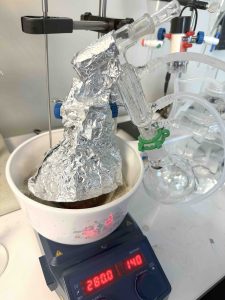
Short-Path Distillation with a water-cooled condenser.
Experiment Log
A running record of experiments, observations, and changes in direction as the work develops.
Lab Equipment Update!
The improved dry-ice condenser has arrived for our rotary evaporator. This design works much better and is able to distill pyridine at near room-temp without off-gassing vapor. The large capacity cold-finger holds a ton of dry ice/EtOH which allows for quick distillation!
We may soon have the ability to perform IR (Infrared) spectroscopy of reactions. To be continued!
Plan for the Week of Nov 16th – 20th
We will investigate the purity and subsequently perform an oxidation of our obtained diacetylated salicyl alcohol product to yield acetylsalicylic acid in two ways.
First, we will use Oxone at a neutral pH by using Sodium Bicarbonate as a base. This should form a buffered, neutral solution. While there is the possibility for hydrolysis of the acetylated phenol, room temperature and neutral pH should prevent this from occuring.
Next, we will use Potassium Permanganate with a catalytic amount of Sodium Hydroxide. This should oxidize the benzyllic position of the diacetylated salicyl alcohol to the benzoic acid derivative. Ideally, this slightly basic solution will not hydrolyze the phenolic acetyl group.
We will compare the obtained oxidation products with reference salicylic acid and acetylsalicylic acid samples.
We can perform the Ferric Chloride test quantitatively using UV-VIS to confirm our product matches the peaks expected for reference acetylsalicylic and salicylic acid, respectively.
Friday, Nov. 13, 2026
We used acetyl chloride in pyridine to acetylate salicyl alcohol. Students learned how to use inert-gas techniques and the proper usage of a syringe to safely transfer reagents.
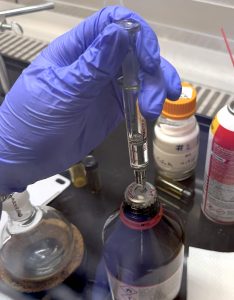
Students were shown how to cool a reaction mixture using a dry ice:ethanol bath, and the importance of adding the acetyl chloride dropwise. Students were introduced to performing their lab work in a fume hood, and combined student reactions were saved for continuation next week.
Lab Equipment Update!
Due to the very generous and kind support from Dr. Susan Jansen Varnum at Temple University, we have been able to borrow a Vernier UV-VIS spectrometer, as well as a melting point apparatus! Thank you Dr. V! We are finally able to begin quantitative/analytical measurements on our obtained reaction products.
Collaboration Update!
Thank you to Dr. Beth Moscato at Temple University who kindly ran some NMR samples of salicin products after extraction from White Willow Bark.
SUNDAY, OCTOBER 11, 2026 · MATERIALS UPDATE
New Reagents In
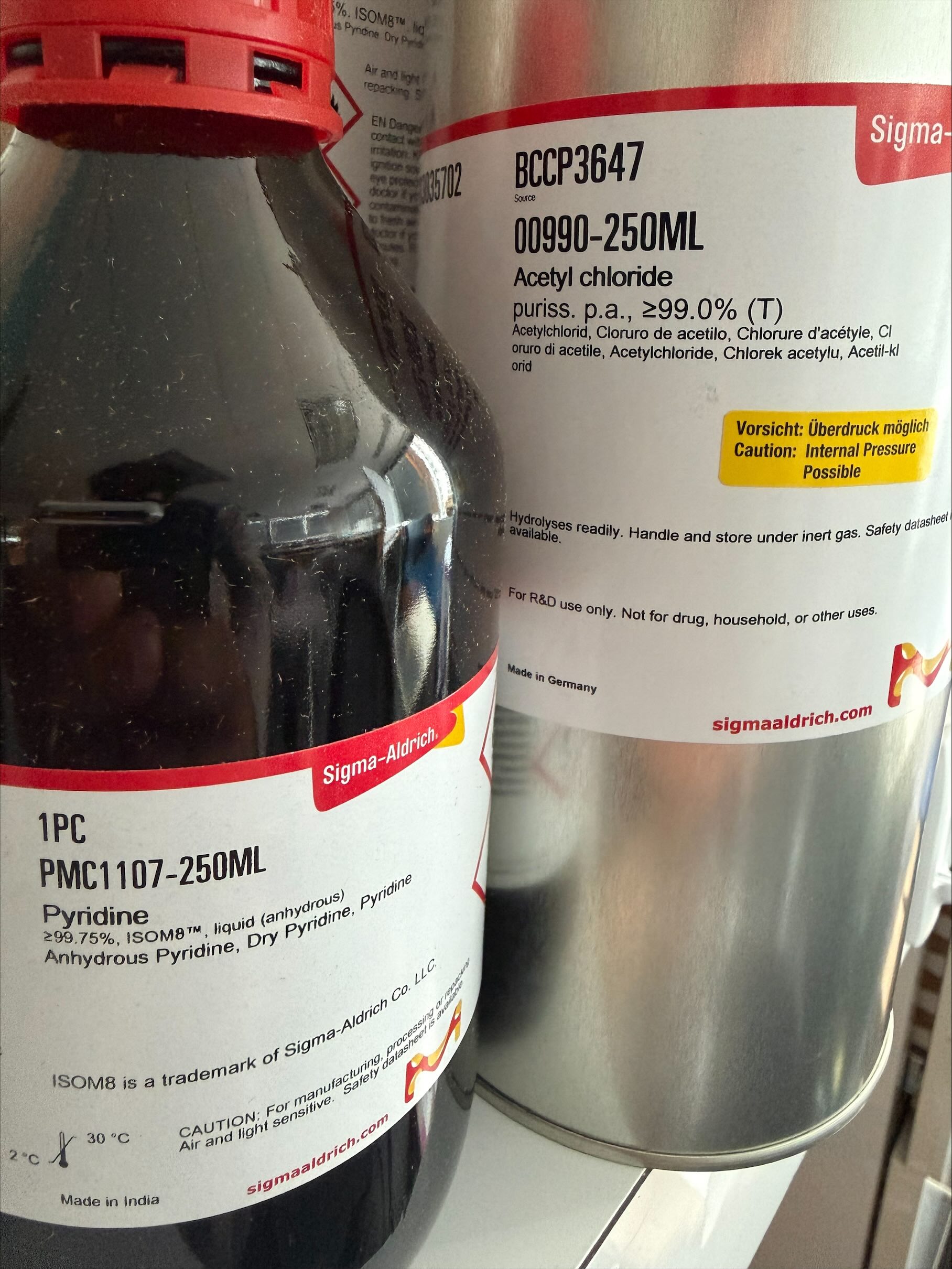
Update: A few new reagents came in for the next stage of the project.
We now have pyridine and acetyl chloride available for future work involving the
acetylation of salicylic acid.
This is one more step toward connecting the willow bark project to aspirin chemistry,
where the pathway can move from plant-derived compounds toward salicylic acid and,
eventually, acetylsalicylic acid.
SUNDAY, OCTOBER 11, 2026 · WILLOW BARK PROJECT
Current Status
Goal:
What we tried: We went over Thin Layer Chromatography (TLC) and spotted the aqueous and organic fractions from the initial aqueous “Willow Tea.” We tried 100% EtOAc, 10% EtOH:EtOAc, 15% EtOH:EtOAc, and 20% EtOH:EtOAc.
Observations: I initially ran samples at 75% EtOAc:25% Heptane which did not provide any separation. The spot at baseline stayed at baseline. From looking at the 100% EtOAc run, we see there is a a slight streaking present, but no meaningful separation. 10% EtOH:EtOAc seems to be the best (similar to 10% MeOH:DCM classically used perhaps), but 20% EtOH:EtOAc is too polar, and it brought everything to the solvent front. ,
What we learned: 10% EtOH:EtOAc seems to be a good choice for separating the cmpds present in willow extract. We have to try co-spotting with a salicin standard, which is something we will do this Friday.
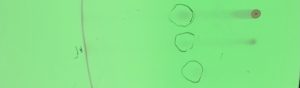
Top to Bottom: Salicin Aqueous, Co-Spot, Salicin Organic
Next question: Is the spot at baseline really Salicin?
FRIDAY, OCTOBER 16, 2026 · WEEKLY CHEMISTRY LAB
TLC Comparison and Identification
Goal: Compare the willow bark fractions with authentic salicin reference
material using TLC and continue improving the separation of the mixture.
Willow Bark Project
One of our current experiments begins with willow bark and a question that has existed
in chemistry and medicine for centuries: how can naturally occurring compounds in a
plant be separated, transformed, and connected to molecules that students already know
from everyday life?
The project is still in progress. Students have worked through extraction, separation,
observation, and the practical difficulties that appear when a real sample behaves
differently from what I originally expected. Salicin, the active compound in willow bark,
is a glucoside. Due to its high polarity and many oxygen-containing groups, it is very
soluble in the aqueous phase. We tried extracting using ethyl acetate, but it appears that
much of the strongly polar material still remains in the tea.
The goal of this lab is not simply to arrive at a final, purified product. The goal is
to understand why certain steps work, why some steps did not work as expected, and how
the chemistry changes when the starting material is a complex biological mixture rather
than a clean bottle of reagent.
Why This Belongs in a High School Chemistry Classroom
High school chemistry can easily become a collection of isolated skills: dimensional analysis, electron configuration, bonding, intermolecular forces, concentration, reaction types, and stoichiometry. Each of those ideas does matter, but they become much more powerful when students can see them all together inside one case study.
This willow bark project gives us a reason to revisit ideas across the curriculum. Solubility becomes more than a definition. Polarity becomes more than a diagram or calculation. Separation techniques become something we try physically rather than vocabulary words.
That is important because science is rarely organized into neat chapters outside of school. A real chemical problem does not announce, “Today you are doing Unit 3.” It asks you to use whatever you know, identify what you do not know, and figure out how to move forward.
Teacher-Student, Student-Teacher
This approach is strongly influenced by Paulo Freire’s Pedagogy of the Oppressed. I first read this while mentoring my sophomore and junior peers in film photography as a senior in high school.
Freire challenged what he called the “banking” model of education, where the teacher is treated as the owner of knowledge and students are treated as empty containers waiting to receive it. In higher education research, the distinction becomes less rigid; teachers, principal investigators, graduate students, and researchers investigate the world together through dialogue. However, this is not always easy to find in high school environments.
Freire describes a classroom in which the teacher is also taught through dialogue; while students, even as they are being taught, provide instruction and guidance. The responsibility for learning becomes shared rather than flowing in only one direction. This does not mean that the teacher has no responsibility or expertise. It means that expertise should not require pretending to be infallible.
My students often correct me, salicin and saligenin being one recent example. Sometimes I write something incorrectly on the board. Sometimes a student notices a detail I missed. Sometimes an experiment produces a result that does not agree with what I expected.
I am not always correct, and I do not think pretending otherwise makes me a better educator.
In those moments, the classroom becomes more scientific, not less. A student who can challenge an idea, defend an observation, or show me that I overlooked something is participating in the same process that scientists use with one another. The point is not to protect the authority of the teacher. The point is to get closer to what is true.
Who Gets to Sit at the Table?
There is another reason I care about this kind of classroom. Schools, universities, laboratories, and professional spaces can easily reproduce the same social habits students already recognize everywhere else: who is “in,” who is “out,” who gets heard, who gets invited to the table, and whose ideas are treated as legitimate before they have even spoken.
Sometimes it is no more sophisticated than the lunch table. If you are already part of the group, you are included. If you are not, you are expected to prove that you belong. Academic spaces can become just as club-like when credentials, titles, social familiarity, or access to the right people become more important than curiosity, effort, evidence, and the quality of an idea.
I do not want my classroom to reproduce that structure. A student who is curious should not need to engage in the lunch-table shuffle in order to be considered worthy enough to do science.
Freire’s critique of rigid teacher-student hierarchy matters here because education is not only about transmitting content. It is also about deciding who gets to participate in producing knowledge. A dialogue-based classroom asks students to become co-investigators rather than passive recipients.
As an educator, I have to remain willing to learn.
In order to do this, my students have to be given the freedom and trust to get their hands on the equipment, satisfy their curiosity, and teach from what they observe. Otherwise, we are not really doing science together.
Experiment in Progress
The willow bark experiment is still developing. We are continuing to evaluate what we
collected, what our observations mean, and which next steps make the most chemical
sense. Some ideas have worked better than others, and that is part of the value of the
project.
I want students to leave chemistry understanding that science is not a performance in
which the teacher already knows every answer. It is a process of asking better questions,
testing ideas, revising explanations, and being willing to admit when the evidence tells
us something different from what we expected. We are all in this together.
October 11th, 2026
Sources & Further Reading
Paulo Freire, Pedagogy of the Oppressed, 50th Anniversary Edition,
Bloomsbury Academic.
Publisher Page
ERIC, Pedagogy of the Oppressed, ED045793.
ERIC Record
National Science Teaching Association,
Science and Engineering Practices: Planning and Carrying Out Investigations.
NSTA / NGSS
National Academies,
Next Generation Science Standards: For States, By States.
National Academies