Credibility
Two studies by Attari, Krantz, and Weber showed that the credibility of climate scientists and their ability to influence the public is directly related to their own actions. In other words, if climate scientists want to convince people of the seriousness of the climate crisis and motivate the public to act aggressively to stop global warming, climate scientists need to practice what they preach, walk the talk, etc.
I’m not a climate scientist, but I do advocate for aggressive, radical action to stop global warming. What, you may ask, am I doing in my personal life to model behaviors that reflect the seriousness of the climate crisis and convince others to do what I advocate? I’m doing the following, in the order of impact:
- Attend conferences, symposia, and other meetings, events, and exhibitions that require air travel; travel overland by car or train only (I last flew to the 2012 CELA Conference in Champaign, IL; I drove to CELA 2023 in San Antonio, TX, with my colleague, Kate Benisek, and plan to drive to CELA 2026 in Cincinnati.)
- Travel by train to visit my family in Nebraska annually, and by train or car to visit family in Boston every other year. Avoid air travel.
- Eat a vegetarian diet (also don’t drink milk or eat yogurt, though I do eat cheese)
- Commute by e-bike to Main (8 miles one-way) and Ambler (17 miles one-way) campuses
- Drive a compact, hybrid car, if I need to drive
- Pay to participate in a local industrial composting service (my family and I live in an apartment)
- As much as possible, want less, need less, use less.
- Single-stream recycling
- Collect and recycle plastic film and walk to nearby grocery to recycle
- I do NOT purchase carbon offsets, which erode support for other, more effective measures, do not alter behaviors or actually prevent CO2 emissions, and may increase emissions overall, in the long term. Why should anyone pay a person of lesser means to diet for them?
Diesel-Powered Construction Machinery
My current research centers on the machines with which landscape architectural designs are executed. I have been collecting data and performed an initial analysis that has been accepted as an oral presentation at CELA 2026 in March. Following is the abstract.
The 2040 ASLA Climate & Biodiversity Action Plan envisions that the design, planning, construction, and maintenance of all landscape architecture projects will achieve absolute zero emissions by 2040. Thus, electric construction machinery (CM) must become ubiquitous in 15 years. To date, the SITES rating system, ASLA decarbonization documents, Climate Positive Design Pathfinder, and Carbon Conscience design tools focus on minimizing embodied material and maintenance equipment emissions while assuming the continued use of diesel-powered CM. Hence, the purpose of this presentation is to investigate the degree to which electric CM is penetrating the industry. The presence of electric CM may bode well for meeting the goal, whereas its absence will hinder achievement. Spreadsheet software recorded the top-selling quantities of new and used equipment makes and models, and total units of equipment by type (e.g., skid steers), from Equipment World Market Pulse annual online reports between 2020 and 2025. Online databases of used machinery available for sale in June 2025 from eight top-selling CM manufacturers served as sources of five equipment types by year, make, and hours of operation. Finally, CM manufacturer websites and industry periodicals served as sources for a catalogue of electric CMs that contains availability, energy, and charging specifications. I recorded over 355,000 new and 228,000 used diesel-powered construction machines that were purchased between 2020 and 2025. Assuming a 10,000-hour, 10-year lifetime and reported average age in years for used machines, the 76 and 73 new and used top-selling CMs have over 1.55 billion and 368,000 hours of operation left, respectively, that may total 97 million tonnes of carbon dioxide emissions. About 50 percent of used machinery available for sale on company databases have operation hours under 3,000. Seventy-seven models across 24 equipment types from 25 companies indicate that most electric machines that exist are available for sale, but are comparatively smaller in size because of material, energy and power limitations. Therefore, ample diesel-powered machines will be present and used to construct landscape architecture projects until at least 2035. Design implications regarding material installation and earthwork are many, ranging from designing with smaller and or fewer machines to design intervention sizes and the use of muscle-powered equipment. Further investigation of industry and refereed literature is needed to understand the potential of future developments in electric construction machinery, along with a call for collective consideration of other practical and policy strategies to address the challenge of meeting the zero-by-2040 goal.
I intend to develop this abstract into a manuscript for submission to a refereed outlet.
Conference-Related Travel
For the most part, the following is in chronological order, with an exception or two.
eNuero. I worked with two other authors on a poster presentation at the 2022 Neuroscience Conference, which presented estimations of travel-related greenhouse gas emissions from the 2018 conference and potential emissions reductions from meeting in alternative modes. We produced a poster and 5-minute virtual presentation, which can be found here, https://youtu.be/b9NGQ4rWeFI. Additionally, we submitted a manuscript on this topic to the eNeruo, which was peer reviewed, accepted for publication, and published in September 2023. Please find here the article, which was selected by editors as noteworthy (Featured), https://doi.org/10.1523/ENEURO.0476-22.2023.
CELA. I estimated travel-related emissions from six past Council of Educators in Landscape Architecture (CELA) and modeled potential emissions reductions from alternative meeting modes. In March 2023, I gave a verbal presentation at the CELA conference in San Antonio. I anticipate a decision regarding the manuscript in late July 2023. Please find a video recording of my presentation here, https://youtu.be/19wwto38UqY. The full manuscript I submitted for peer review in January 2023 was accepted in September 2023 for publication in Landscape Research Record, the proceedings of CELA conferences. Please find the published manuscript here, https://thecela.org/wp-content/uploads/LRR12-TRAVEL-RELATED-EMISSIONS-FROM-PAST-AND-FUTURE-CELA-ANNUAL-CONFERENCES.pdf
ASLA. In November 2025 Landscape Journal published a content analysis that I conducted of American Society of Landscape Architect (ASLA) conference education sessions between 2011-2023. I used VOSviewer to visualize relationships between education session presenters and institutions represented, along with some supplementary analysis using Voyant. The data for this work was collected while gathering data related to the work that I describe below. A version of the manuscript can be found here: MS_Visualizing ASLA Conference Education Session Content REV02 AAM
After undergoing peer review by three anonymous, independent referees, Landscape Journal published my policy brief entitled, “Alternatives to in-person American Society of Landscape Architects Conferences on Landscape Architecture”. The manuscript appears in volume 41, issue 1 (2022); a version may be found here: MS_LJ_Pol.Brief.EmissionsASLA2018 2019Meetings REV01 AAM
Two parts comprise the study. First, I estimate carbon dioxide emissions related to the 2018 and 2019 ASLA EXPOs, particularly regarding exhibitor’s travel, event venues, EXPO organization, material use and disassembly; and hotel accommodations. Thereafter, I examine various means of convening annually, within the context of ASLA’s stated commitments to emissions reductions targets associated with the IPCC’s recommendations and Paris Climate Agreement. I conclude with recommendations for convening annually based upon estimated emissions reductions relative to a few meeting methods (i.e., random participants virtual, most distant participants virtual, all virtual). I may share a preprint of the policy brief here when published.
A manuscript entitled “Travel-Related Carbon Dioxide Emissions from American Society of Landscape Architects’ (ASLA) Annual Meetings” was published in Landscape Journal, after undergoing review by three anonymous referees and a co-editor. The manuscript appears in volume 38, issue 1-2 (2019, though released in June 2020). The Department of Architecture and Environmental Design supported this research by funding the Gold Open Access. Please find the article by visiting this web address: http://lj.uwpress.org/content/38/1-2/105.full.pdf+html or clicking here: Kuper.2020.Travel-Related CO2 Emissions from ASLA Annual Meetings.Land.J.38_1-2_105-127
In the study, we used two web-based carbon calculators, meeting programs, websites, handouts, and ASLA meeting attendance numbers to perform two travel-related carbon emission estimations: for 2,821 education session featured speakers that presented at annual ASLA meetings in 2011, and between 2013 and 2019; and for annual ASLA meeting attendees between 1960 and 2019. By applying findings from scientific literature to our emission estimations we additionally estimated the area of September Arctic sea-ice loss that may be attributed to annual meetings; labor productivity losses in purchasing power parity that may be associated with ASLA meeting emissions; and the quantity of trees that would be needed to remove the meeting-related quantity of carbon dioxide from the atmosphere.
As an extension of the aforementioned study, I have estimated travel-related carbon dioxide emissions associated with the 2018 and 2019 EXPOs that occurred at the ASLA’s Conferences on Landscape Architecture. Like the study published in Landscape Journal, my current study uses the web-based Carbon Footprint Calculator. Unlike the published study, I also estimated travel-related emissions using the ICAO’s web-based calculator and values from Jungbluth and Meili (2019), which include radiative forcing index factors that provide some indication of the increased global warming potential from aircraft emissions at high altitudes. I may extend this dataset further to estimate the emissions associated with EXPO representatives’ nightly hoteling, direct and indirect fresh water use in liters per day, required land use for hoteling in square meters, and food use in grams per day. I will complete the latter estimations in summer 2021 and submit the manuscript for review and consideration of publication sometime in late summer or fall 2021.
In November 2020, I gave a presentation entitled Green on the Ground but Gray in the Air about travel-related emissions from ASLA’s annual meetings to attendees at the Pennsylvania/Delaware Chapter of the ASLA. The video, while not perfect, demonstrates many possible advantages of pre-recorded conference presentations in comparison to conventional conference presentations that occurred prior to the Covid-19 pandemic, and that will likely resume when the pandemic subsides.
In addition, Steve Austin, Clinical Assistant Professor of Landscape Architecture at Washington State University, and I gave a joint presentation entitled Closing the Value-Action Gap: Examining Landscape Architecture in a Zero Carbon Future. Following is a brief summary:
This presentation examines the implications of eliminating fossil fuels from landscape architecture in the next 30 years, and compels attendees to use all available personal and professional resources to immediately change the culture of practice, construction, and academia, and work collectively to ensure professional credibility, relevance, and vitality in the future.
In April 2021, the Lectures and Exhibitions Committee within the Tyler School of Art and Architecture’s Department of Architecture and Environmental Design invited me to give a presentation entitled The Radical Reality of the Future. Generally, I refer to peer-reviewed literature and focus on flattening the curves of CO2 and Covid cases; the limitations of technological solutions in comparison to behavioral solutions; the disparate harm to people of color; the relationship between our personal actions and credibility and the need to model new behaviors and revise or create new norms; personal responsibility and sacrifice; insufficient and radical solutions to the climate crisis; and briefly distinguishing between realistic and unrealistic futures before concluding with an opportunity to keep and extend the behavioral changes Covid-19 has afforded.
Background
In October 2018, the Intergovernmental Panel on Climate Change (IPCC) released the Special Report on Global Warming of 1.5-degrees Celsius. According to the report, restricting global warming to 1.5-degrees C requires a 45-percent reduction in global carbon emissions by 2030 and the complete elimination of carbon emissions by 2050.
Weeks after the release of the IPCC’s special report, I attended the Annual Meeting and EXPO of the American Society of Landscape Architects (ASLA) in Philadelphia and realized that many registrants traveled by air to attend the meeting and, consequently, emitted many metric tons of carbon into the atmosphere. Moreover, I began to examine how the conclusions in the IPCC’s report could or would affect landscape architectural research and practice.
Preliminary estimations. The following two preliminary estimations are based upon conferences that occurred prior to the IPCC’s special report. Each implies that carbon was emitted into the atmosphere as a result of collective actions (i.e., air travel) by landscape architects. Each estimation may contribute to the establishment of a carbon emission baseline related to annual conferences/symposia of landscape architecture from which future efforts to reduce, and ultimately, eliminate carbon emissions may be gauged.
For an unpublished, non-refereed manuscript that estimates the carbon emissions of the 395 educational session featured speakers at the 2018 ASLA Meeting and EXPO from conference-related travel, please click here: Kuper.R_Carbon Count MS
The ASLA announced in early April 2019 that 2019 Conference registrants will have the option of purchasing carbon offsets for conference-related travel. For an unpublished, non-refereed manuscript that examines the potential effectiveness of carbon offsets within this context, please click here: Kuper.R_Forget Offsets-2019 ASLA Conference
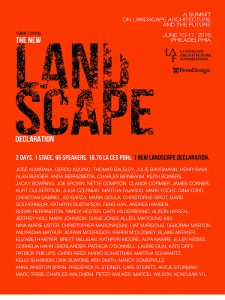
On June 10 and 11, 2016, in Philadelphia, somewhere between 600 and 700 registrants attended the presentation of “declarations” by 69 speakers. See the advertisement above. For an estimation in tabular form of the travel-related carbon emitted by the speakers, please click here: T1n2_Carbon Count-2016 LAF Summit on LA and the Future. The methodology used to compute the carbon emission estimations is the same as that presented in “Carbon Count,” which is available above.
Petition to the ASLA Regarding Conference-Related Carbon Emissions. Steve Austin, Clinical Assistant Professor of Landscape Architecture, and I started a PETITION to the American Society of Landscape Architects Regarding the CO2 Footprint of Annual Conferences in late March 2019 that demands the ASLA to commit to conference-related carbon emission reductions outlined in the IPCC’s special report. When the Covid-19 pandemic began and continued into fall 2020, ASLA cancelled the 2020 in-person conference that was planned for Miami and instead held a virtual conference, reVISION that contained 25 presentations. Despite all the posturing, including contracting with Honeycomb Strategies to estimate travel- and conference-related emissions, ASLA appears uninterested in implementing an alternative meeting mode in the future. The cities in which they intend to convene are the same as those in which they’ve convened in the past. Business as usual.