Teaching, at its heart, is a journey I take with my students, and technology is one of the vehicles we use along the way: some move quickly, like an animated video that carries a class from confusion to clarity in minutes; others move slowly, like a simulation debrief that lets a student retrace their own steps. As a Temple University Nursing Education Instructor teaching Traditional and Accelerated BSN students across didactic, laboratory, and simulation environments, I choose these vehicles purposefully, to make abstract content visible and to build habits of self-directed, growth-oriented learning that outlast my classroom. My philosophy is grounded in my D.I.V.E.R.S.E. framework: Diverse, Inclusive, Valuable, Equitable, Responsible, Sustainable, and Excellence.
That philosophy also rests on Universal Design for Learning, which shapes how I offer content, and Bloom’s Taxonomy, which shapes what I ask students to do with their knowledge. By adopting Fink’s Taxonomy, I ask whether a lesson built genuine understanding and clinical perspective, not just delivered a fact or a skill. Piaget’s view of learning as self-constructed is why I resist handing students finished answers during class activities or exam reviews. Employing Vygotsky’s model, I sequence a branching case so that students collaborate in their learning journeys, building knowledge and experience together that support long-term retention and recall. And Goleman’s emotional intelligence is my instructional lens during debriefing sessions, when students are still composing themselves after a live code simulation and the technology needs to make room for that before it asks for reflection, to get at the real and raw experiences that drive their developing clinical decisions.
Technology as a Gateway to Knowledge and Experience
Every cohort arrives carrying different academic and life experience. UDL promises multiple means of engagement, representation, and action from the outset, not accommodations retrofitted after a student struggles. A single concept offered as a visual explainer, a narrated slide deck, a simulation, and a written case study lets every student reach the same destination through the pathway most accessible to them. That is equity in practice.
Visual Media and Real-Time Formative Technology
Static slides only carry a lecture so far, so in the classroom I reach for media built to match the content itself: an animated explainer, a branching clinical-reasoning case, a drag-and-drop dosage module, a pharmacokinetics animation, and a de-escalation scenario. Each moves students from Remembering into Applying and Analyzing within the same class period. I pair this with real-time polling to check comprehension throughout the lecture, while I can still change course. When data shows a third of the class has misidentified a priority action, I pause, reteach through a different modality, and re-poll, giving every student, including those who would never raise a hand in class, an equal and anonymous voice in shaping the pace of instruction.
Simulation and Skills Lab as a Catalyst for Growth Mindset
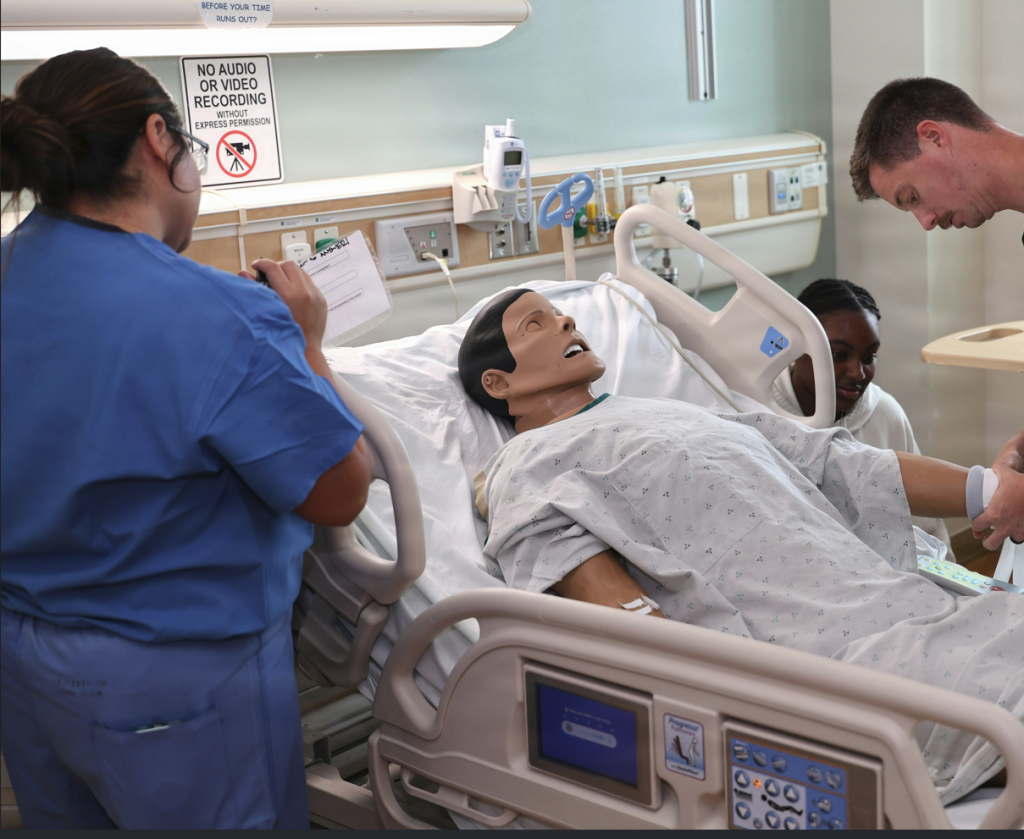
Simulation-based learning in the lab takes three forms. High-fidelity manikins with video playback support debriefing that builds clinical reasoning and safe, effective critical-thinking decision making. Separately, students create their own videos role-playing clinical scenarios with each other to build therapeutic communication and physical examination skills. And simulation software lets students rehearse both low-stakes and high-stakes situations, a seizing toddler, a decompensating neonate, a post-surgical adult in hemorrhagic shock, in an environment engineered for productive failure. Across all three, I use recordings to guide self-reflective debriefing where students narrate their own decision points. This is where Fink’s Human Dimension meets growth mindset: an imperfect first attempt becomes a guidepost, not a verdict, and technology becomes a mirror for growth rather than a grading instrument.
Learning Activities Built on Theory, Carried by Technology
Beyond the lab, two classroom activities carry this same philosophy into everyday coursework. In the NCLEX Challenge, clinical groups of eight build a shared PowerPoint, each student contributing one NCLEX-style question with rationale for the correct answer and for why each distractor is wrong. Vygotsky’s sociocultural model does quiet work here: the reasoning is built inside the group, where defending a shaky rationale to seven peers teaches faster than defending it to me alone. Groups post to a live discussion board and compete for points and TU Swag, and Bloom is underneath the fun, since writing a defensible rationale for a wrong answer requires Analyzing and Evaluating, not just Remembering. When I pull one question from each group into the exam, that is my nod to Piaget: the question was never handed to them to memorize, they built it, and constructed knowledge sticks differently than received knowledge.
The SBAR video project is a separate classroom activity, distinct from the role-play videos used in skills lab: students record themselves giving each other an SBAR handoff about a real patient, peer-review the recordings, and then sit with me, both students together, to discuss what they liked, what was easiest, and what was hardest, including how well they collected and reported the Situation, Background, Assessment, and Recommendation using data gathered on the unit, vital signs, physical exam findings, and EPIC documentation. Fink’s Human Dimension is why that debrief exists at all. Goleman’s emotional intelligence shows up when a student watches themselves hesitate on playback and names that out loud, an emotional-awareness exercise wearing the disguise of a clinical-communication one. And UDL is why the format works for students who would never role-play live but will do it on camera, wince a little, and try again before anyone else sees it.
A Lesson in Equitable Participation
Not every attempt has landed the way I hoped. I once facilitated an online Jeopardy game with the entire class split into clinical groups of eight, and I did not rotate who within each group was answering. Within a few rounds, the same two or three students in each group were the only ones answering, and their groupmates quietly stopped trying, having learned their turn wasn’t coming. The technology had done exactly what I asked; what I’d asked just wasn’t equitable. What I learned was specific: I needed to call on a different student from each group at every new question, so every student had a guaranteed turn. Once that turn was guaranteed, the groups shifted into genuine collaboration, huddling together to make sure whoever was called on actually understood the answer. The win wasn’t that the game got easier; it was that every student participated, and participation forced the group reasoning I’d wanted all along.
Integration Goals Moving Forward
My ongoing goals are threefold: diversifying how content is represented so it reaches every student; designing each technology vehicle with an equitable entry point that provides real-time feedback; and deepening the reflective use of simulation recording to build metacognition alongside psychomotor skill. The same questions guide my selection: does this move a student further up Bloom’s hierarchy, does it touch more than cognition as Fink asks, who does UDL say this leaves out, and does it reflect the D.I.V.E.R.S.E. commitments underneath all three? When the answer is yes, technology becomes part of how my students learn to learn, building the clinicians our patients and communities depend on. Every shift. Every patient. Every time.